






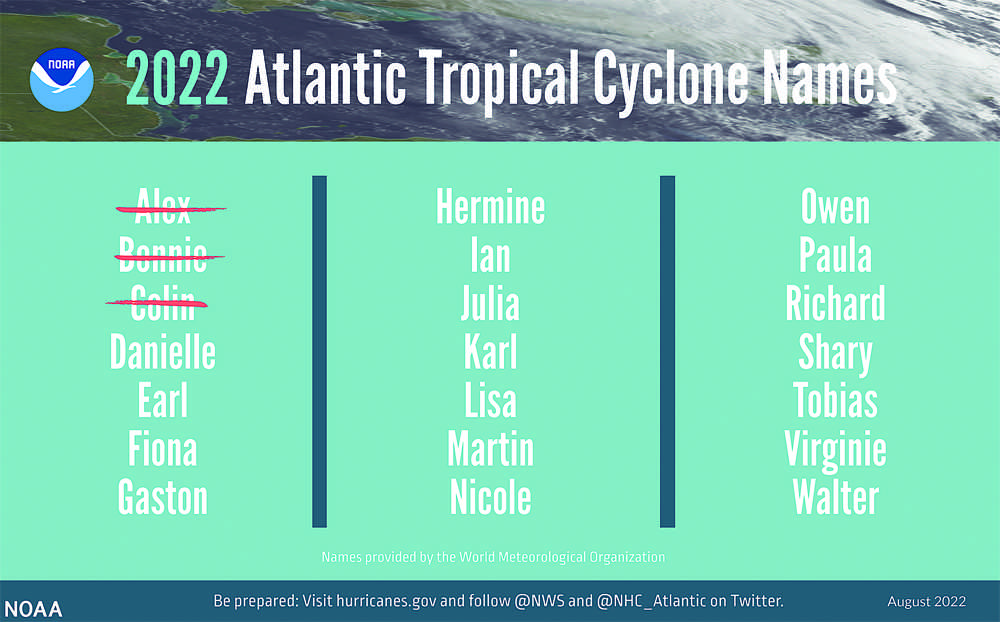
Be on the lookout for Danielle, Earl and maybe even Walter.
The Climate Prediction Center at the National Weather Service updated its forecast Aug. 4 for the 2022 Atlantic hurricane season.
With more than three months remaining and peak months to come, the federal government still predicts an above-normal season.
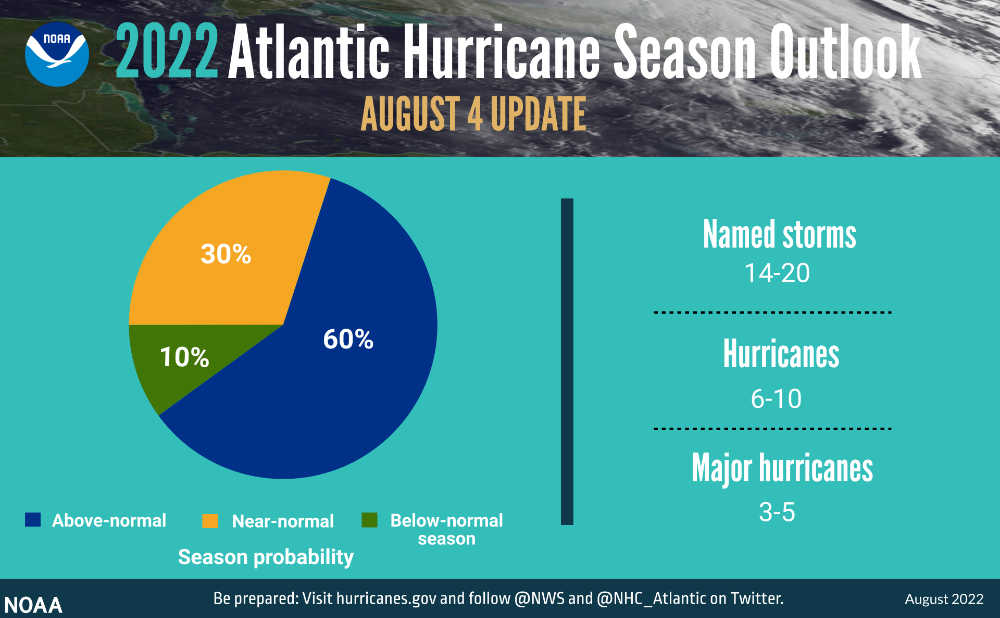
The agency slightly decreased the likelihood of an above-normal Atlantic hurricane season to 60% — lowered from the outlook in May, which predicted a 65% chance.
The likelihood of near-normal activity rose to 30% and the chances remain at 10% for a below-normal season.
The National Weather Service is under the National Oceanic and Atmospheric Administration, where administrator Rick Spinrad, at an Aug. 4 streamed news conference said, “We’re just getting into the peak months of August through October for hurricane development and we anticipate that more storms are on the way.”
The outlook calls for 14-20 named storms with winds of 39 mph or greater, of which 6-10 could become hurricanes with winds of 74 mph or greater. The outlook predicts three-five storms could become major hurricanes, with winds of 111 mph or greater.
As of Aug. 4, the season produced three named storms but no hurricanes in the Atlantic Basin.
An average hurricane season produces 14 named storms, of which seven become hurricanes.
The atmospheric and oceanic conditions that favor an active hurricane season include:
- La Nina conditions, which are favored to remain in place for the rest of 2022 and could allow the ongoing high-activity era conditions to dominate or slightly enhance hurricane activity;
- Weaker tropical Atlantic trade winds;
- An active west African monsoon;
- Above-normal Atlantic sea-surface temperatures.
“Although it has been a relatively slow start to hurricane season, with no major storms developing in the Atlantic, this is not unusual and we therefore cannot afford to let our guard down,” FEMA
Administrator Deanne Criswell said in a news release. “This is especially important as we enter peak hurricane season — the next Ida or Sandy could still be lying in wait.”
Hurricane Ida formed Aug. 26, 2021.
Hurricane Irma formed Aug. 30, 2017.
Hurricane Sandy formed Oct. 12, 2012.
And the strongest hurricane ever recorded, Wilma, formed Oct. 15, 2005.