




Prior to the blow caused by Nicole, fishing around Anna Maria Island was quite good. I anticipate the same once things settle down.
Fishing the flats for snook, redfish and spotted seatrout has been productive. Fishing the higher stages of the tides seems to be advantageous and casting baits against and under the mangrove shoreline is working for snook and redfish.
If you fish during the lower stages of the tides, you might find cooperative snook and reds. Look for deeper holes on the flats, where the fish may stage in anticipation of the next high tide, when they can go back to their hiding places among the mangrove roots.
As for the spotted seatrout, working deeper grass flats during incoming tides is producing good action for my charters. Areas where a good tidal flow exists will produce better than areas of stagnant water. With water temps dropping slightly, it’ll be a good time to try some artificials for the trout. Soft plastics on a jig head or topwater plugs are good options. I’m definitely ready to try the topwater lures if, while you’re targeting trout, large schools of mullet are present.
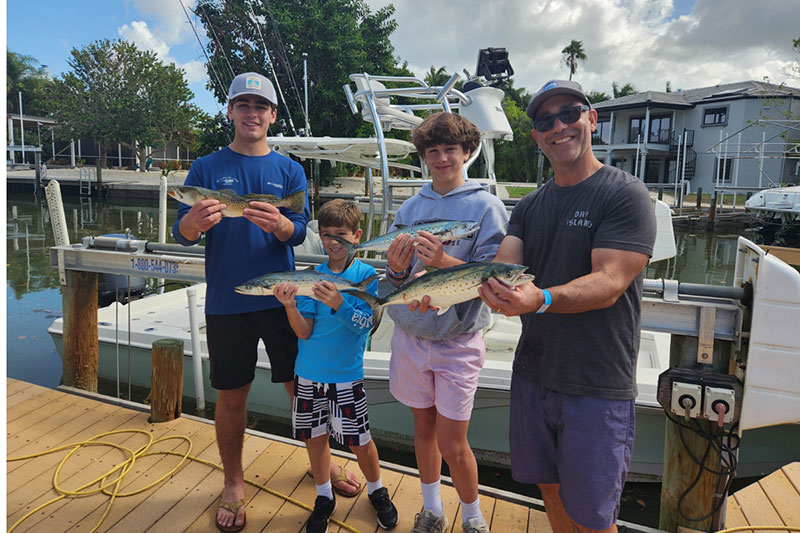
Moving into the Gulf of Mexico, fishing structure such as reefs and wrecks is putting a bend in the rods. Spanish mackerel are the most apparent, as they quickly ravage free-lined live shiners as bait. On many occasions, the bite will occur within a few seconds of your bait hitting the water’s surface. Other species being found around structure include mangrove snapper, gag grouper and cobia.
On my Just Reel charters, I’m working artificial reefs in the Gulf, where we’re yielding plenty of Spanish mackerel, including some reaching 22 inches.
While working the reefs, Cobia are letting their curiosity get the best of them as they rise to the surface within a few feet of the boat. Having a large spinning rod ready to drop a bait in front of them is smart. We had two fish on at once one morning.
Moving to the flats, snook, redfish and trout are cooperating when offered live shiners. On higher tides, snook and reds are being caught close to the mangrove shorelines. During lower stages of the tide, we’re finding trout on the deeper flats.
Capt. David White is finding action while working the nearshore waters in the Gulf of Mexico, as well in the inshore waters of Tampa Bay. Fishing structure in the Gulf is yielding Spanish mackerel with free-lining live shiners as bait. Switching to free-lined pinfish also is attracting a bite.
Gag grouper are being found in select areas of the wrecks and reefs.
While motoring from one spot to the next, White is seeing an occasional tripletail floating on the surface, awaiting an unsuspecting shiner or shrimp to cross in front of its nose.
When the tripletail is big enough to target, White is casting either bait in hopes of finessing a strike.
On the flats of Tampa Bay, White is finding snook and redfish cooperative while casting live shiners along the mangrove shorelines. He says high tides are yielding the best results.
Capt. Jason Stock says he’s experiencing an excellent bite on gag grouper while fishing offshore in the Gulf of Mexico. Using live pinfish around structure such as reefs, wrecks or hard bottom is working well to get limits of gags in the cooler. Stock also says he’s seeing large mangrove snapper being caught in many of the same areas.
Migratory fish such as kingfish are being found over reefs and wrecks, where large live shiners free-lined on the surface above the structure are being devoured by the high-speed predators.
Jim Malfese at the Rod & Reel Pier says he’s seeing black drum being caught by anglers using live shrimp as bait. Casting shrimp under the pier deck on a weighted rig is resulting in black drum measuring 15-22 inches. Other species — sheepshead, redfish and snapper — are prone to eating a live shrimp offering and are being caught by lucky pier anglers.
Anglers looking to hook into snook are using larger baits, such as pinfish, large shiners or small ladyfish. Malfese says some snook being caught by the really lucky anglers are within the slot of 28-37 inches.
Lastly, Spanish mackerel are being caught by pier fishers using such artificials as speck rigs.
Capt. Warren Girle report’s he’s working nearshore structure in the Gulf of Mexico. Free-lining live shiners over reefs and wrecks is proving to be good to attract Spanish mackerel, ladyfish, mangrove snapper and an occasional cobia.
Moving inshore, Girle is finding plenty of action on Spotted seatrout. The deeper grass flats of Sarasota Bay are host to excellent trout fishing and Girle is taking advantage. Free-lined shiners over
the deep grass are attracting many slot-size trout to the hook as well as numerous fish that are just short of the mark.
Girle says moving shallower on the flats is resulting in snook and redfish, and casting baits near the mangrove or oyster bars is working best.
Send high-resolution photos and fishing reports to fish@islander.org.