





Sea turtles take certain cues to find their way.
The team that monitors nesting activity on Anna Maria Island wants beachgoers and coastal dwellers to take a seasonal cue: Lights out for turtles.
The Islander checked in June 15 with Kristen Mazzarella, executive director of Anna Maria Island Turtle Watch and Shorebird Monitoring, who anticipates hatchlings will begin emerging from the season’s first nests in the next few weeks.
The Islander: Artificial light reaching the beach can be a threat to hatchlings and nesting adults. What’s the concern?
Kristen Mazzarella: Sea turtles use certain cues to find their way to a suitable nesting site or the water.
Hatchlings emerging from a nest move in the brightest direction and away from darkness. On a natural beach, that direction is toward the open ocean — away from dark dunes and toward the night sky.
Nesting females will generally seek dark areas on the beach.
Artificial lights interfere with those instinctive cues and result in turtles traveling farther to reach the water, hatchlings not making it to the water, and adults not finding an optimal nesting site.
The Islander: Are you seeing lighting issues on the beaches? Anyplace in particular problematic?
KM: Every year requires a review of beachfront lighting because changes can be made from one season to the next.
There is no one particular area that is problematic but we work closely with local code enforcement to alert them to any problems, especially in areas where there are nests.
The Islander: There’s a tendency to focus on property lighting that’s covered under municipal ordinances but beachgoers with phones and flashlights also can present a threat. How should folks conduct themselves on the beach at night?
KM: With more and more people using the beach at night, it’s especially important that they understand that any lights — flashlights, fishing lamps, flash photography, cellphones — can have an impact on nesting and hatchling turtles.
We have documented several turtle crawls indicative of light disturbance this year — where turtles have traveled long distances parallel to the water rather than taking a direct path back to the water.
We recommend that people stay off the beach at night as the presence of even the most respectful people can inadvertently disturb a nesting turtle or prevent a turtle from emerging from the water.
If you are on the beach at night, it’s best — and the law — to not use any lights — let your eyes adjust to the night. If you encounter a nesting sea turtle you should observe from a distance, stay behind the turtle, stay quiet and do not use any lights.
You will be rewarded with an experience few people are able to enjoy.
For more information about AMITW, call 941-301-8434, email info@islandturtlwatch.com or go online to islandturtlewatch.com.
Funds for retrofits
The Sea Turtle Conservancy is offering funding to AMI beachfront properties to help reduce the negative impacts of lights on sea turtles.
The nonprofit, in a release, says, “Poorly managed lights confuse and disorient hundreds of thousands of sea turtles each year, which can lead to their death.”
With a grant from the National Fish and Wildlife Foundation, STC is providing money to owners of single-family homes, condo communities and commercial sites seeking to convert “problematic light fixtures and bulbs to wildlife-friendly alternatives.”
For more information, go online to conserveturtles.org and click the tab for beachfront lighting or contact STC at 352-373-6441 or rachel@conserveturtles.org.
Turtle tagging time
The annual Tour de Turtles will begin Aug. 1.
The tour is an educational and research effort by the Sea Turtle Conservancy and its partners that involves tagging sea turtles to track them in a distance “race” for about three months.
On Anna Maria Island, the Sea Turtle Conservancy’s nonprofit partner is the Anna Maria Island Turtle Watch and Shorebird Monitoring, which patrols the beaches each morning to document and collect nesting data.
Also, a local business partner — sponsor of AMI’s racer in the 2023 Tour de Turtles — is Waterline Resorts of Holmes Beach.
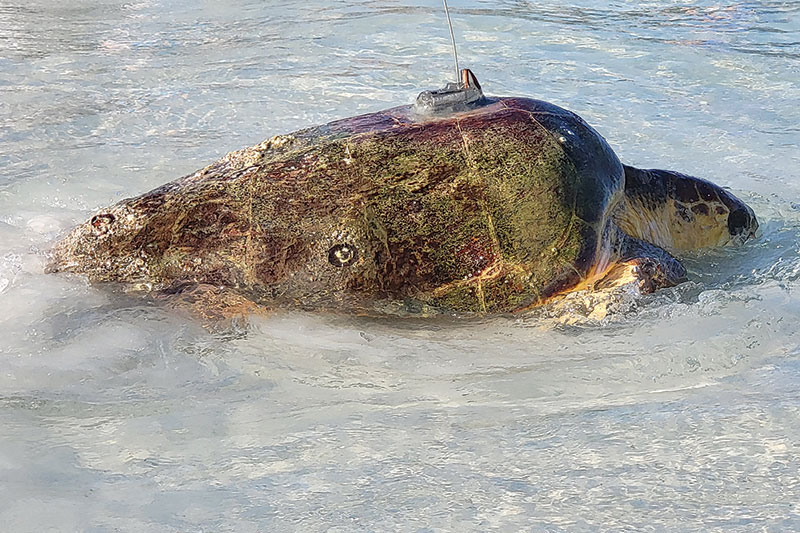
The conservancy plans to place a satellite tracker on a nesting turtle on AMI on June 26-27 and to release the turtle at about 8:30 a.m. June 27.
The location of the release will be announced early June 27, after the tagging the turtle.
For more about the Tour de Turtles, go online to tourdeturtles.org or conserveturtles.org.