





Sea turtles nests are hatching on the shores of Anna Maria Island.
But a couple of things didn’t go so swimmingly.
During the July 4 holiday week, the Florida Fish and Wildlife Conservation Commission opened an investigation into a “dug-up” nest and, in a second incident, local volunteers and city staff teamed up to rescue a group of disoriented hatchlings.
Florida’s shores are home to annual nesting sites for three species of sea turtles — including loggerheads, green turtles and leatherbacks, all of which are protected under the U.S. Endangered Species Act due to declining populations.
Sea turtle nesting season on AMI began in May and runs through October. Nests started hatching in late June.
Kristen Mazzarella, the executive director of the Anna Maria Island Turtle Watch and Shorebird Monitoring, told The Islander July 6 that they have documented more than 300 nests along the island’s shores about halfway through the season.
Sea turtles will continue laying nests into August-September, so that number will rise as the season goes on.
AMITW is a nonprofit with a team of 15-20 volunteers trained by the FWC to monitor sea turtle nesting activity on the island.
So far, Mazzarella said there have been some “usual” issues, such as people removing AMITW nest stakes or using lights on the beach at night but AMITW and the island cities are addressing them.
“(The cities) have been great. They’ve been very helpful,” Mazzarella said.
Nevertheless, some things haven’t been “usual.”
FWC investigation
FWC public information officer Forest Rothchild wrote in a July 7 email to The Islander that the commission was investigating a “dug-up” turtle nest on the island.
However, much remains unknown about the incident.
“Despite immediate investigation in partnership with the Anna Maria Island Turtle Watch, the circumstances surrounding the incident remain unclear due to the absence of eyewitnesses,” Rothchild wrote. “The FWC views this incident with utmost gravity. Interfering with wildlife, particularly species like sea turtles, which are protected by federal law, is not only unethical but also illegal.”
Rothchild did not respond to a July 7 email from The Islander asking if any of the nest’s eggs were salvageable following the incident.
Mazzarella declined to comment on the nest during an ongoing FWC investigation.
Rothchild called for the public’s help in determining what happened to the nest.
“If you were in the area over the (July 4) holiday and saw anything suspicious or have any information that could be of help to the investigation, we urge you to contact the FWC,” Rothchild wrote. “Please, remember, your tips may be instrumental in preserving our state’s rich and diverse wildlife. The protection of these creatures is a responsibility we all share.”
People can call the FWC’s wildlife alert number at 888-404-3922 or submit anonymous tips to its website, myfwc.com/wildlifealert.
Disorientation
In other news, AMITW and staff from the cities of Bradenton Beach and Holmes Beach teamed up July 5 to save a group of disoriented hatchlings.
Mazzarella said two women reported finding disoriented hatchlings that morning on a sidewalk in Bradenton Beach, which brought AMITW volunteers to the scene, where they found a hatched nest nearby.
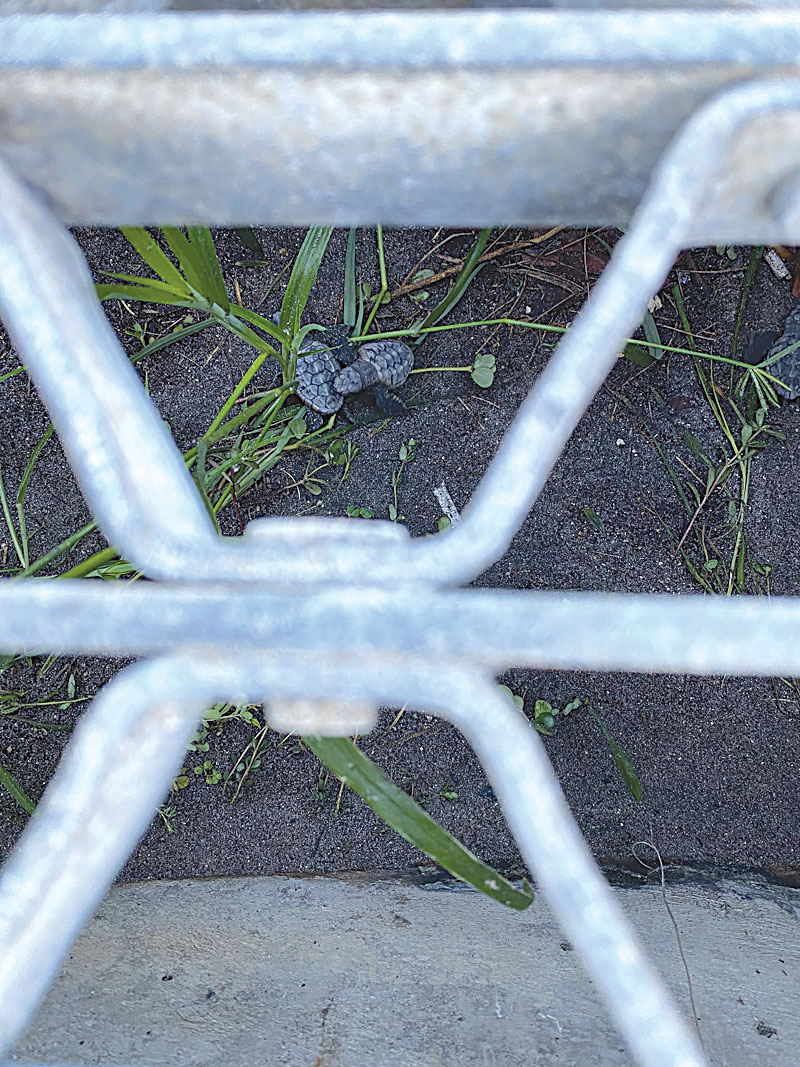
They followed several hatchling tracks from the nest over the dunes — away from the shore — toward Gulf Drive, where they found seven hatchlings stuck below a drainage grate near the intersection with Cortez Road.
Holmes Beach code compliance supervisor JT Thomas told The Islander July 6 that he got a call to help at the scene along with Bradenton Beach police and code enforcement.
Thomas said they struggled with the drainage grate until they reached Holmes Beach public works employee Scott Roscoe, who also went to Bradenton Beach to help the sea turtles. He lifted the grate so AMITW volunteers could reach in and remove the hatchlings.
The rescuers took the hatchlings to the beach and guided them to the water.
“I thought it was a great situation of everyone working together,” Thomas said.
Disorientations are caused when factors such as artificial lights, beach furniture and holes prevent or distract hatchlings from reaching the water.
Disoriented hatchlings can wander into roadways or exhaust themselves before reaching water, which can result in their death. Predation by other animals also becomes a problem, especially by birds during daylight hours.
Holmes Beach code compliance officer Jayson Clayton told The Islander July 6 that beachgoers can help prevent disorientations by removing their furniture from the beach, filling in holes left on the shore and minimizing light visible from the beach.
People can learn more about AMITW on its website, islandturtlewatch.com.
Mazzarella asked for people who find hatchlings roaming away from the shore to immediately call AMITW for help at 941-301-8434.