






Island anglers need to know when and where to seek shelter as thunderstorms and rain showers are typical during late summer.
These storms can bring gusts of wind, torrential rain and lightning.
The last place you want to be is on open water during a lightning storm. Out on the water, you’re at the highest point, greatly improving the potential for a strike. Even running on the outskirts of a thunderstorm can be dangerous, as lightning can strike miles from the center.
So keeping an eye on the horizon — as well as on the radar —is a good idea in August and September, when storms can pop up and catch you off guard.
Many of the storms can be brief, so escaping them can be as easy as finding the closest ramp or pier to take shelter off the boat.
If you’re offshore fishing, your best bet is to evade the storm by going in a different direction, heading in or not going out at all if the forecast calls for stormy weather and rough seas.
Whether fishing offshore or inshore, it’s good to have a plan on where to go to take shelter.
As much as we love being on the water and fishing, we must put safety first. You don’t want to learn this lesson the hard way.
On my Just Reel charters, I’m seeing limits of mangrove snapper being caught. Some days, I’m using knocker rigs to catch the snapper near the bottom. On other days, the snapper are rising toward the surface in the chum, making them catchable on a free-line.
After working the snapper bite, I’m fishing over deep grass flats for spotted seatrout, which also is yielding Spanish mackerel, ladyfish and silver trout.
Capt. David White is finding plenty of action for clients offshore in the Gulf of Mexico. Snappers are the predominant species and are being caught on a variety of baits, including frozen shiners, frozen threadfin herring or live bait, such as shiners and pinfish. American red snapper, the largest of the species being caught, are taking both frozen and live bait offerings. Smaller snappers, such as mangrove and yellowtail, are being caught on live shiners.
Moving inshore, catch-and-release snook are providing action while baiting with live shiners. Spotted seatrout also are an option, as well as sharks and mangrove snapper.
Capt. Warren Girle says targeting spotted seatrout in Sarasota Bay is producing a fairly consistent bite. Free-lining live shiners over deeper grass flats is leading to plenty of action on trout, as well as a variety of other species in the same areas. Ladyfish, mackerel and bluefish are taking the bait, too. And lucky anglers are finding mangrove snapper mixed in.
Fishing shallow flats is yielding catch-and-release snook, as well as a few redfish. The best bite for the reds is occurring when Girle puts anglers on a school on the flats.
Jim Malfese at the Rod & Reel Pier says limits of mangrove snapper are attainable by determined anglers. Using live shrimp as bait on a weighted rig cast under the pier is working best. Snapper 10-12 inches are the norm, although larger fish are present.
Catch-and-release snook— ranging from 20 to 40 inches —are being caught frequently on live shrimp.
Lastly, live shrimp as bait is attracting an occasional redfish to the hook at the northernmost pier on Anna Maria Island.
Send high-resolution photos and fishing reports to fish@islander.org.
Beating the heat on AMI
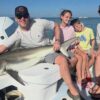
Marc Wiesniewski reported from Wisconsin on his fishing adventures while on a trip to Anna Maria Island for his mother-in-law’s 90th birthday. His crew included his three kids — Anna, Ava and Andrew — and niece Christina with husband Brian.
To beat the heat, they mostly fished 6-9:30 a.m. and again from about 7:30 p.m. into the night.
Wiesniewski said in his Aug. 17 email, “The best action came on moving tides. It didn’t seem to matter if it was in-coming or out-going as long as it was moving.”
The family fished piers and passes from Anna Maria Island down to New Pass. “We ended up catching 13 different species using nothing but artificial lures. We used no live or natural bait.”
All their fish were released.