







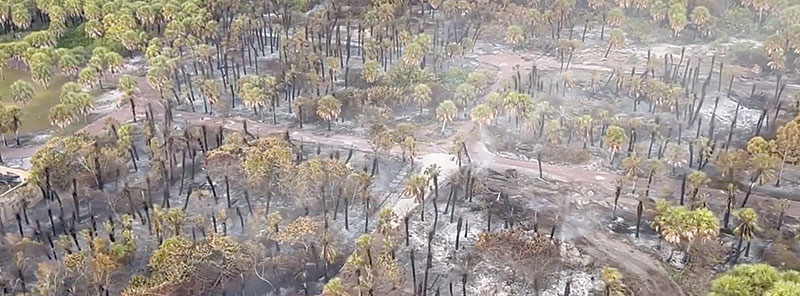
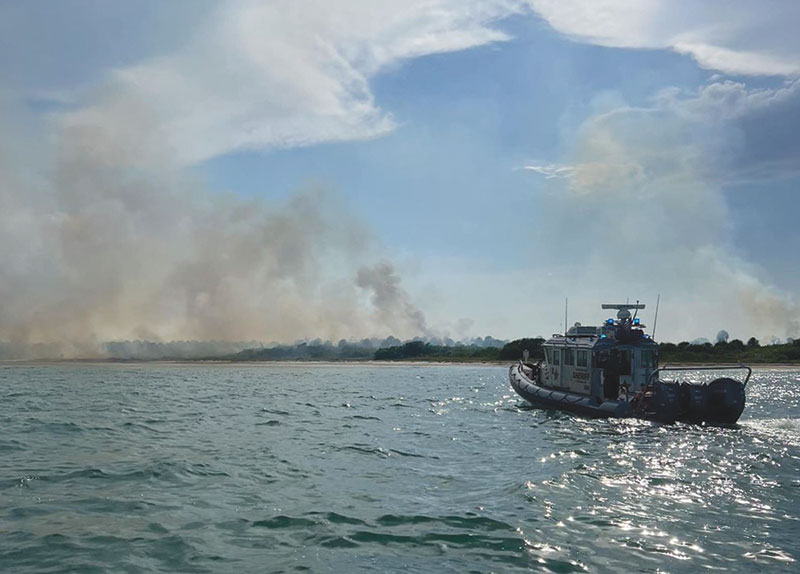
The U.S. Fish and Wildlife Service temporarily closed access Aug. 13 to Egmont Key, where a wildfire burned 30-35 acres.
Egmont Key, at the mouth of Tampa Bay and visible from the north end of AMI, is a 270-acre island that’s home to a national wildlife refuge.
The wildfire began about 3 p.m. Aug. 13 on the north end of Egmont, according to a news release from the U.S. Fish and Wildlife Service.
Multiple agencies at the federal, state and local levels responded to the fire call, as well as to evacuate six people from the island and clear boats from the area.
Responders included:
- FWS;
- Florida Fish and Wildlife Conservation Commission;
- Florida Department of Environmental Protection;
- Pinellas County;
- Manatee County;
- Hillsborough County,
- Tierre Verde Fire District;
- St. Petersburg Fire Rescue;
- Eckerd College Search and Rescue;
- U.S. Coast Guard;
- Great Lakes Dredging.
Two of the first responders were crews from Tierre Verde Fire District and the Coast Guard-29195-St. Petersburg, which helped enforce safety zones around Egmont while FWS rangers were evacuating people and engaging the fire to try to stop its spread.
Meanwhile, the Hillsborough County Sheriff’s Office deployed a helicopter outfitted with a “Bambi Bucket” to knock down the flames.
“Our pilots and tactical flight deputies are trained to handle any scenario, whether that’s locating a lost child, tracking a criminal, or in this case, mitigating the damages of a wildfire,” Hillsborough Sheriff Chad Chronister said in a statement.
Rain also “helped immensely,” according to the FWS.
There were no injuries to people reported and there was no damage to structures or equipment.
However, the Egmont Key National Wildlife Refuge was closed temporarily.
Fire crews remained on Egmont the week ending Aug. 20 to monitor the situation.
As of Islander press time, a cause of the wildlife was not announced.
The national wildlife refuge was established in 1974 to protect the natural, historical and cultural resources from development. The island boasts more than 30,000 nesting pairs of birds, as well habitat for nesting sea turtles and gopher tortoises.