




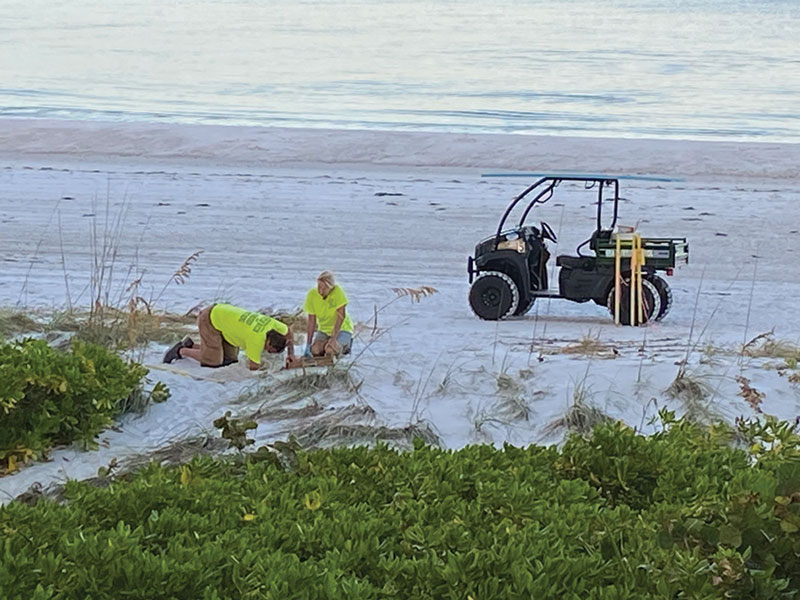
Yellow stakes and pink ribbon marked 76 sea turtle nests Aug. 29 on Anna Maria Island beaches.
When Anna Maria Island Turtle Watch and Shorebird Monitoring surveyed the beach Aug. 31, the morning after Hurricane Idalia made landfall in the Big Bend area, stakes remained at just 12 nests.
AMITW estimated that about 16% of the nests for the season — 405 nests — were lost due to the storm.
“We lost 84% — 64 out of 76 —of the nests remaining on the beach when Hurricane Idalia came through but only 16% of all nests laid this year,” said AMITW executive director Kristen Mazzarella.
A week after the storm passed, The Islander checked in with Mazzarella for a status update.
The Islander: Did nests higher up in the dunes fare better than other nests during Idalia?
Kristen Mazzarella: Yes, the nests laid higher up in the dunes were the ones that remained after the storm.
Sea turtles lay multiple nests in a season and place them in different areas of the beach such that some portions of their nests are successful — with hatchlings reaching the ocean.
In the dunes, nests are more susceptible to predators and root invasion but they are protected from the tidal conditions and hatchlings have further to go to reach the water while mid-beach nests have more likelihood of getting overwashed by high tides and surf conditions but fewer are impacted by predators or roots and hatchlings have a shorter distance to reach the water.
The Islander: Are there any nests remaining in Bradenton Beach or on the Gulf shore in Anna Maria?
KM: After the storm we had four nests remaining on the Gulf side – all four were in Holmes Beach.
We also had eight nests remaining on the bayside in Anna Maria.
No nests were left in Bradenton Beach.
The Islander: In the data collection and reporting, does AMITW record and report details of a storm like Idalia?
KM: Yes, AMITW patrollers check every nest every day and record anything that happens to them, be it overwash by surf, predation by a raccoon, hatch or washout by a storm like Idalia.
Such data are important to understanding what happened to each nest.
At the end of each season, all data are double-checked, compiled and reported to Manatee County and the Florida Fish and Wildlife Conservation Commission.
The Islander: The season officially continues through October? How will AMITW continue through these final two months?
KM: AMITW will continue to monitor the nests that are on the beach until they have hatched or reached 70 days — the overdue date — and are excavated.
For some of the nests, we will be checking them through October, while others will be done sooner.
We hope to see hatches from some of the remaining nests and possibly some unmarked hatches from nests that lost their stakes in the storm but were still viable.
The Islander: Do you have a take on how much erosion took place on the beaches during Idalia?
KM: Erosion is not something that AMITW measures across the entire beach.
We mark our nest stakes to determine if erosion or accretion or added sand happened over the nest sites.
Accretion was documented on a few of the remaining nests and we definitely saw erosion in places where nests and their stakes were totally washed out.
However, we cannot calculate the extent of the erosion or accretion from these data.