







Anna Maria city commissioners’ work revising cannabis codes could be a slow burn.
Commissioners reached a consensus March 28 to renew 30-day extensions for a pair of violators — the North Shore Cafe and Cool Beans AMI — to comply with city code as the commission continues work on potential revisions.
City code currently prohibits the growing, processing, distribution and sale of any plants or products derived from the genus Cannabis, which includes marijuana and hemp.
Conversation about the prohibition began in February, when the municipality denied Holmes Beach-based Edibles N More participation in an arts and crafts show at Roser Memorial Community Church, 512 Pine Ave., due to the business’ CBD and hemp sales.
Later that month, Nathan Geller, co-owner of the North Shore Cafe, 304 Pine Ave., attended a city commission meeting to speak about a notice of violation the cafe received for using hemp products in some food and drinks.
The cafe has four menu items that feature hemp powder, protein and/or seeds, and the business also sells hemp protein powder as an add-on ingredient to some items.
Geller called for the city to explore code changes to better target unwanted products and allow the use of “harmless” products such as hemp powder, protein and seeds, which feature little to no THC or CBD.
The commission held a first reading and hearing March 14 to discuss a proposed ordinance that would prohibit medical marijuana dispensing facilities and retail establishments with more than 10% of their inventories of cannabis products.
The proposed ordinance also would prohibit mobile sales of cannabis products, unless approved as part of a special event permit, and establish a $500 daily fine for violations.
It would not address synthetic marijuana products.
Commissioners had issues with the proposal, such as the questionable enforceability of a 10% inventory limit on cannabis products and the size of the $500 daily fine for violations.
Those issues remained March 28, when the same proposed ordinance was presented to commissioners for discussion on a specific direction for the legislation.
Commissioner Charlie Salem suggested changing the 10% rule to pertain to inventory value, instead of number of items, but added that such a code would still be practically unenforceable.
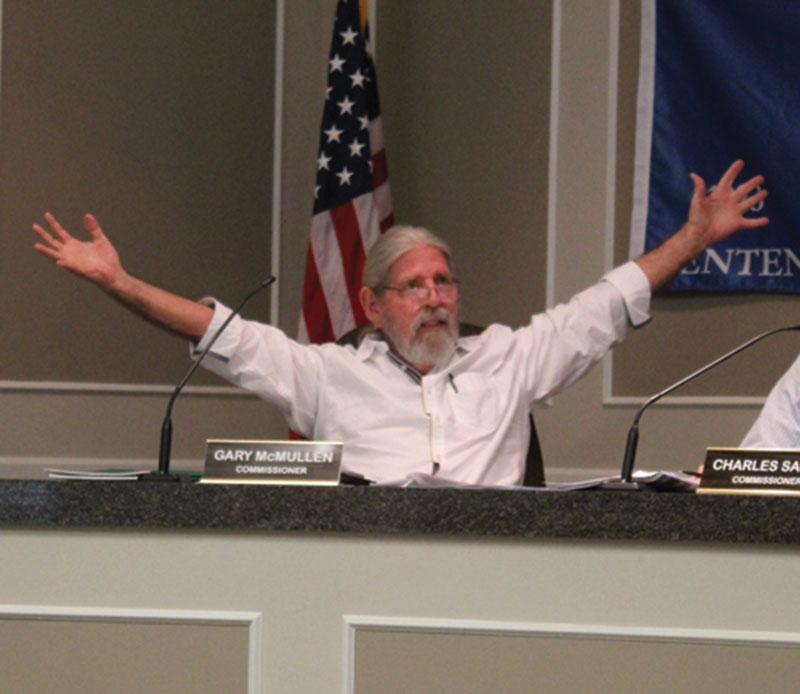
Commissioners Mark Short, Kathleen Morgan-Johnson and Gary McMullen agreed the 10% limit was unenforceable, but McMullen took it further.
He said he has a “problem with outlawing something that is plainly within the law,” since medical marijuana is legal in Florida.
McMullen, a baby boomer, said most people his age are not concerned about cannabis and the city was unnecessarily raising roadblocks without asking for a vote from its citizens.
Commissioner Jonathan Crane said he had nothing against medical marijuana but would be bothered by the additional traffic from short-term purchases it would attract.
City attorney Becky Vose asked commissioners for their thoughts on the proposed ban on mobile sales of cannabis products, except during permitted special events.
Commissioners agreed to keep the provision since it allowed the board flexibility to effectively approve or deny vendors for special events.
As for the $500 daily fine, Vose said the penalty would be removed from the proposed ordinance and added to a resolution to be presented at the same time of the ordinance’s second reading.
The city has moved many of its fines and fees out of its ordinances and into resolutions to make them easier to change since new resolutions can be adopted upon first reading and hearing instead of a second, as ordinances require.
Crane, who was a vocal opponent of the $500 daily fine at the March 14 meeting, recommended the city instead implement a sliding scale for penalties.
He said the scale would start at a $25 daily fine that, after 10 days or a determination from a special magistrate upholding a violation, would increase to a $250 daily fine.
Crane said his proposal would give violators an initially small penalty and a chance to appeal. But, if they fail to come into compliance within a reasonable time frame, the city can hit them hard with significant fines.
Short agreed with a sliding scale, stating he had planned to propose a $100 daily fine for five days and increase to a $500 daily fine.
Short said they would table the proposed ordinance until a future meeting so commissioners could continue to consider changes to the penalty for violators and 10% inventory limit on cannabis products.
He also asked Vose to research synthetic marijuana regulations so the ordinance could address such products.
In the meantime, Mayor Dan Murphy said he had issued 30-day extensions for compliance to the two businesses found in violation of the city’s cannabis prohibition, but they were set to expire April 1.
He asked the commission for a consensus, which it reached, to renew the 30-day extensions while they work on code revisions.
There was no public comment.
The commission will meet next at 2 p.m. Thursday, April 11, at city hall, 10005 Gulf Drive.
Directions to attend via Zoom can be found on the city’s website, cityofannamaria.com.