




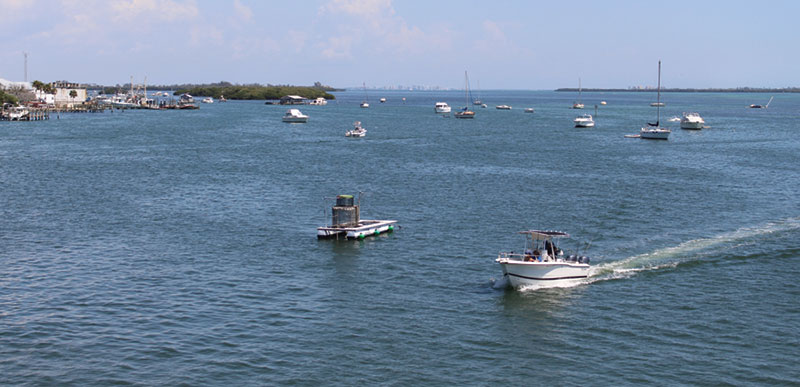
An influx of live-aboard boats and anchored vessels is testing the waters in Cortez.
Cortez also has seen an increase in abandoned and at-risk vessels, raising questions about the need for the sort of maritime enforcement employed in other communities.
In recent months, there has been an uptick in vessels in the village anchorage, including some at-risk boats that pose hazards to navigation and threaten the environment.
Karen Bell, who owns A.P. Bell Fish Co., 4600 124th St. Court W., and the adjacent Star Fish Company Market & Restaurant, said captains operating at the A.P. Bell docks must navigate around too many anchor lines and sunken vessels.
“It’s really hard for them to get through,” Bell said. “Most of the live-aboards are not anchored properly. Most of them don’t have the right size anchor much less the proper amount of scope. You literally have to weave in and out of that craziness.”
Bell said derelict and at-risk vessels break loose from anchors in storms and drift until they collide with other vessels or structures or run aground in the shallows.
She and others in the Cortez community have been in touch with the Florida Fish and Wildlife Conservation Commission and Manatee County about the need to police at-risk vessels and remove derelict or abandoned boats.
The FWC works with municipal governments to remove vessels in state waters through a derelict vessel grant program, which reimburses local governments.
Also, Sarasota, Bradenton Beach and Palmetto governments police waters within their municipal boundaries.
Cortez has no municipal or local government.
Police Chief John Cosby spoke to The Islander May 1 about Bradenton Beach’s derelict boat program, which started in 2013.
Officers utilize a 24-foot center console Pathfinder, the same model used locally by FWC officers and purchased for $120,000 with a grant from the West Coast Inland Navigation District.
Cosby said since its inception the program has removed more than 75 derelict or problem vessels from Bradenton Beach waters.
He also said as of May 1 the anchorage area next to the city’s Historic Bridge Street Pier had only five vessels.
“The word’s out,” Cosby said. “If your boat’s not up to speed, don’t come here.”
“The key to this is constantly being out there,” he added. “We don’t care if they come. It’s just that they have to be up to speed.”
Cosby said the police department applies the same conditions for at-risk as the FWC:
- A vessel has taken on water without a way to de-water;
- Enclosed spaces can’t be sealed off or stay open for long periods;
- It’s broken loose or is at risk of breaking loose from an anchor;
- It’s left unattended aground;
- It’s sunk or partially sunk.
Sometimes rather than meet requirements for seaworthiness, at-risk or near-at-risk boat owners move outside an area of enforcement, which is the situation in Cortez — an unincorporated area in Manatee County.
Cosby said the county has a program for the removal of abandoned boats but not at-risk live-aboard vessels.
However, the county has approached Bradenton Beach about how it implemented the derelict and at-risk vessel program.
“The discussion we had with them is that they are doing the research to look at seeing what it would take to move it forward,” Cosby said. “Because they know that there are issues. They asked for a copy of our ordinance and we provided it to them.”
Ironic, Bradenton Beach solved its problem by shifting the vessels to the Cortez side of the intercoastal waterway. If the vessels are hazardous to navigation the U. S. Coast Guard is empowered to deal with such, and they operate in Cortez and navigate that same channel, are they being reported to the Coast Guard?