






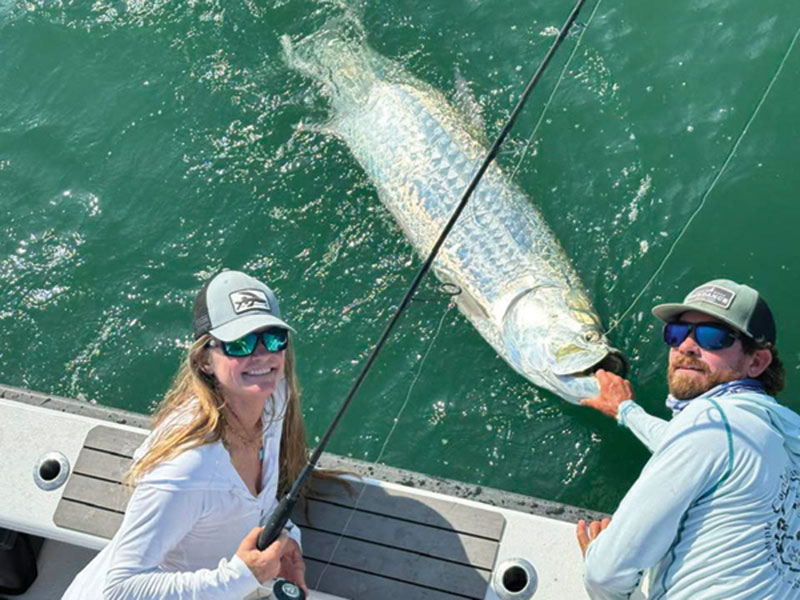
Many Anna Maria Island fishers are wondering when the migration of tarpon will settle in along our beaches and in the passes as the numbers of silver kings we are used to this time of year have yet to be seen.
Still, tarpon anglers are finding success.
Most action on silver kings is occurring in the passes around Bean Point and Egmont Key by casting live crabs as bait during afternoon tides.
While fishing the passes, you can count on other boats being in the area, which can make the fishing more challenging. But if that’s what it takes to get a bite, many anglers are more than willing to work in the pack.
Finding schools of tarpon along the beaches is attainable but they are spread out, requiring a lot of time, cruising and looking for fish. The benefit of finding schools along the beaches is that you work on your own, without sharing the fish with multiple boats, increasing your chances of a bite.
Meanwhile, fishing the backcountry is heating up. Snook fishing around mangrove shorelines, especially where bait and good tidal flow exist, is improving and we are seeing greater numbers of fish schooling in anticipation of their spawn. Free-lined live shiners are being inhaled by hungry snook while packing on the pounds before spawning.
Spotted trout are a mainstay on the flats as they inhabit the deeper grass areas of southern Tampa Bay south to Sarasota Bay. If you’re looking for action and want to bring home a fish or two for dinner, trout is your best bet.
On my Just Reel charters, I’m happy to see the snook bite on the upswing. Casting live shiners against the roots of mangroves is yielding decent numbers of snook. Most are 20-26 inches, although I am seeing a few slot-size fish on the hook.
After snook fishing, I’m going after spotted seatrout. On deeper flats, I’m encountering respectable amounts of trout, as well as a blend of other species to complete the recipe of a good day’s fishing. Species such as silver trout, Spanish mackerel, ladyfish and jack crevalle are included in this bite.
I’m also seeing sharks in the same areas, which are biting our trout in half as they are reeled to the boat. We’re catching the trout on larger rods and casting it back in the water, resulting in immediate hookups on 4-5 foot sharks. And the anglers on the boat really like reeling in a large fish.
Capt. Johnny Mattay is impressed with the offshore bite as he anticipates a stellar kickoff when red snapper season starts June 1. While bottom fishing in depths of 120 feet, Mattay reports he can’t keep the red snapper away from the bait long enough to catch the red grouper he’s targeting. He sure knows where the snapper can be caught.
In areas where red snapper are not lurking, keeper-size red grouper are being caught, as well as many mangrove snapper exceeding 20 inches.
Free-lining surface baits while offshore in the Gulf of Mexico is yielding action, especially on amberjack. The tackle-busters are in the 20-pound range and more than worthy of wearing out the strongest angler.
Moving inshore, Mattay is putting clients on good numbers of spotted seatrout. Many are in the slot of 15-19 inches, with lucky anglers hooking into some fish over 20 inches.
After targeting trout, Mattay has clients going after redfish in various spots, from mangrove edges to oyster bars and even along the beaches.
Capt. David White has his sights on tarpon. Averaging five or more hook ups a day, White is finding the best action on swift moving tides around the new and full moons. Casting live crabs during the evening tides seem to be productive for White, while live threadfin herring are working well before noon. Most hookups are 80-120 pounds, with some larger fish mixed in for lucky anglers.
Capt. Warren Girle is easing into tarpon season by patrolling the beaches and passes, which is paying off in hookups, although, Girle notes, the mass numbers of fish have not showed up yet. Girle is finding action, although he anticipates greater numbers of fish to arrive in the weeks to come.
On days when he’s not tarpon fishing, Girle is putting clients on plenty of spotted seatrout in Sarasota Bay with many fish exceeding 20 inches in length.
He also notes that snook fishing in Sarasota Bay is shaping up. Casting live shiners along mangrove shorelines is yielding good action on linesiders during the high tides. Also, Girle is finding a few redfish mixed in while targeting snook.
Send high-resolution photos and fishing reports to fish@islander.org.