








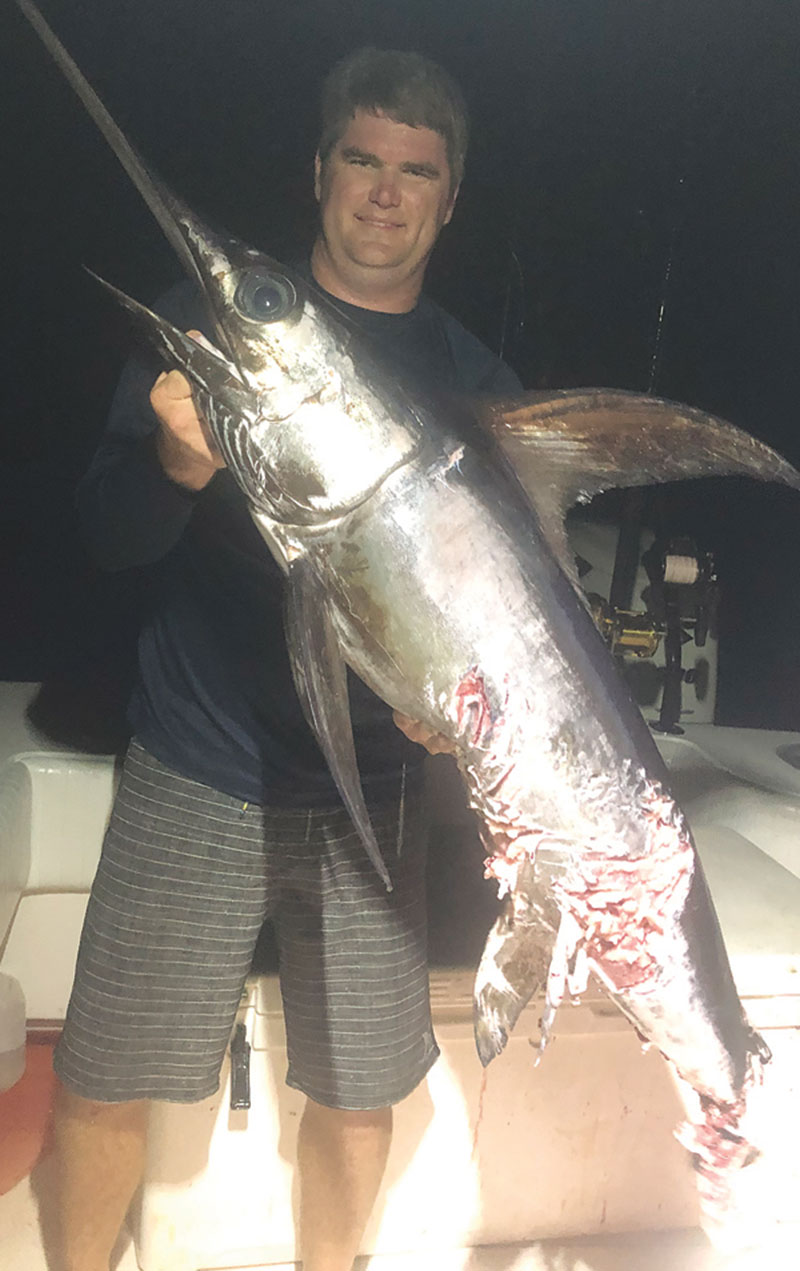

A discussion has surfaced in Cortez where commercial fishers say they are reeling in the consequences of federal legislation aimed at conserving shark populations.
They say a 2011 law created hardships and they now are grappling with depredation issues caused by more frequent encounters with apex predators due to higher populations.
The Shark Conservation Act of 2011 was intended to improve shark conservation in the United States. The law amended the Magnuson–Stevens Fishery Conservation and Management Act of 1976 and the High Seas Driftnet Fishing Moratorium Protection Act of 1992 and provides, in part, that sharks caught in U.S. waters must be brought to shore with fins naturally attached.
Shark finning, banned in many parts of the world, involves cutting off fins and discarding the fish, sometimes still alive. The fins often are used as an aphrodisiac or for soup that can cost up to $100 per bowl.
With protective legislation and bans in effect for more than a decade, fishers now say there are too many sharks.
“Regulation is good but a complete stop is too extreme,” said Nate Meschelle, a Cortez commercial captain, who spoke to The Islander July 11.
He said regulations and a growing list of prohibited shark species have left some local fishers tied to the docks.
Understanding shark depredation
Depredation occurs when sharks intercept or consume fish on lines before fishers can retrieve their intended catch.
Depredation can reduce the quantity of marketable fish and damages gear, leading to increased costs for replacement and lost fishing time.
Depredation also can raise the price of seafood due to the heightened cost of trips and lower numbers of landed fish.
Fishers and seafood merchants operating out of Cortez said shark depredation poses an economic and operational threat.
Karen Bell, owner of A.P. Bell Fish Co., a fish processing plant, and Star Fish Co., a restaurant and market, both in Cortez, spoke July 10 about the impact of shark depredation on the business.
Bell owns a fleet of six boats that bring in seafood that is sold locally, as well as shipped worldwide.
Hook-and-line caught species such as grouper and snapper are becoming harder to land, she said.
“At least half of the lines are being bitten off by sharks or dolphin,” Bell said. “It’s a struggle because these guys spend a lot of money on gear and the sharks are making their jobs almost impossible.”
She also said sharks take the hook after eating a fish, resulting in sharks needing to be unhooked and released, a danger for crews.
Captains, according to Bell, have reported instances of sharks coming to the surface en masse upon a boat’s arrival to a fishing ground.
“The environmentalists say, ‘There are not enough sharks, they are not even back to the numbers that they should be,’” Bell said. “We don’t see that because there are so many that seem unchecked.”
“The Gulf and the Atlantic are being overrun by these sharks. People might say this is a callous way to look at it, but I don’t see it as any different than culling out deer when populations are too high,” she added.
A view from science
Angela Collins a scientist with Florida Sea Grant and University of Florida’s School of Fisheries spoke to The Islander July 9 about the depredation dilemma.
“So there’s been a lot of regulatory activity that has taken place over the past 40 years that has protected sharks from overfishing,” Collins said. “With more and more sharks, these interactions with fishermen are expected to increase.”
She also said, “Definitely the shark interaction problem is something that’s being experienced on both coasts of Florida. Both commercial and recreational anglers are being impacted by the interaction of sharks either with their catch or with their gear.”
However, Collins cautioned, a lot of shark populations are still under pressure worldwide.
“Sharks are very susceptible to being overfished,” Collins said. “Their life history is such that if you take a lot of them, it’s going to take them longer to rebuild their populations than something like a mahi-mahi or a mullet.”
Sharks are a keystone species in maintaining marine ecosystems — balancing coral reefs, preventing disease spread, and encouraging marine diversity. Without them, the food chain could collapse.
The human impact on sharks
From 2008-17, commercial anglers harvested on average 1 million pounds of shark a year from waters off Florida and recreational anglers took an average of 477,000 sharks per year on the east coast and 723,000 on the west coast, according to the Florida Fish and Wildlife Conservation Commission.
Under FWC regulations, harvestable sharks fall into two groups based on size limits:
- Group 1 sharks, which include Atlantic sharpnose, blacktip and finetooth sharks, have no minimum size limit;
- Group 2 sharks, which include bull, nurse, and spinner sharks, have a minimum size limit of 54 inches
Other sharks, including tiger sharks, are prohibited from commercial harvest in Florida waters.
Commercial shark fishers can sell to a state-licensed wholesaler that also is a federally permitted shark dealer.
The bag limit for the commercial harvest of sharks in state waters is the same as recreational harvest: one per person per day and a maximum of two per vessel.
In federal waters, regulations are overseen by the National Oceanic and Atmospheric Administration Fisheries department.
In 2023, the commercial retention limit for large coastal sharks other than sandbar sharks was 55 per vessel per trip in the Atlantic and Gulf of Mexico sub-regions.
Efforts for compromise
Throughout Florida, captains, scientists and legislators are exploring solutions to mitigate the impact of shark depredation but continue shark conservation.
Focus groups are being created to understand shark behavior patterns and develop technology and regulations to deter sharks from gear.
Meanwhile, in 2023, the SHARKED Act was introduced in the U.S. House and passed in that chamber in February. The bill, now before the U.S. Senate Committee on Commerce, Science and Transportation, would establish a task force to identify research priorities and funding opportunities to limit depredation.
Collins stressed the importance of avoiding new decisions that might endanger sharks.
“The last thing that we want to see happen is for us to reduce a population of any species to levels where you don’t have a sustainable population,” she said.
She added, “Just being cognizant of all of the different pieces that go into keeping not only our targeted fisheries sustainable but also sustainable levels for the populations of sharks that we have out in our waters.”
About shark overfishing
Sharks have lower fecundity relative to other marine fish.
The low reproductive rate is due to sharks’ slow growth, late sexual maturity, a one- to two-year reproductive cycle, a small number of young per brood and specific requirements for nursery areas.
The biological factors can leave many species of sharks vulnerable to overfishing.
— Robert Anderson
I am the Executive Director of the Southeastern Fisheries Association representing the commercial seafood industry in FL and the SE. I am also a commercial representative on the HMS AP who advises the NMFS HMS on the state of HMS species. Sharks and their overpopulation are causing increased and excessive predation on commercial and recreational fishing activity and increased shark attacks along our beaches. Angela Collins says a lot of shark populations are still under pressure worldwide. While this may be true, we argue shark populations along the east coast and Gulf of Mexico are out of control. The question is why? Our answer is the excessive regulations that restrict shark harvest by commercial and recreational fishers. The legislative shark fin ban has caused commercial shark fishers to not seek sharks because without the ability to sell the fins, the market is not economically feasible to fish for sharks. Shark meat, which is a high source of protein, sells for around a dollar per pound. This low price provides no incentive to harvest sharks which has caused the commercial shark quota (the amount of sharks to be legally harvested) to only have 20% harvested, leaving 80% of the fish in the water. The price for shark fins is high and is what makes an economic incentive to harvest sharks. The law passed in 1992 required sharks to be landed in a whole condition with fins intact. In our country, this is how sharks were landed and once laid on the processing table the fins and meat were removed, processed, and sold and there was a profitable market producing quality meat and fins for consumers. On 12-16-22 Congress passed legislation, subsequently signed by President Biden, which prevents the sale and/or possession of shark fins in the U.S. This irresponsible law is why shark fins cannot be sold even when legally harvested sharks, with fins intact, are landed. Until this ban on the sale of legally harvested sharks with fins intact is rescinded the shark populations will continue to increase, unabated, causing more predation of commercial and recreational fisheries and increased shark attacks along our beaches. SFA is working on building support to remove the shark fin ban and to help put commercial shark fishers back to work to provide a great source of protein enriched shark meat and fins to consumers. Capt. Bob Zales, bobzales@sfaonline.org.