






Anna Maria Island Turtle Watch and Shorebird Monitoring has declared the least tern colony at the 27th Street North beach access in Bradenton Beach “a success.”
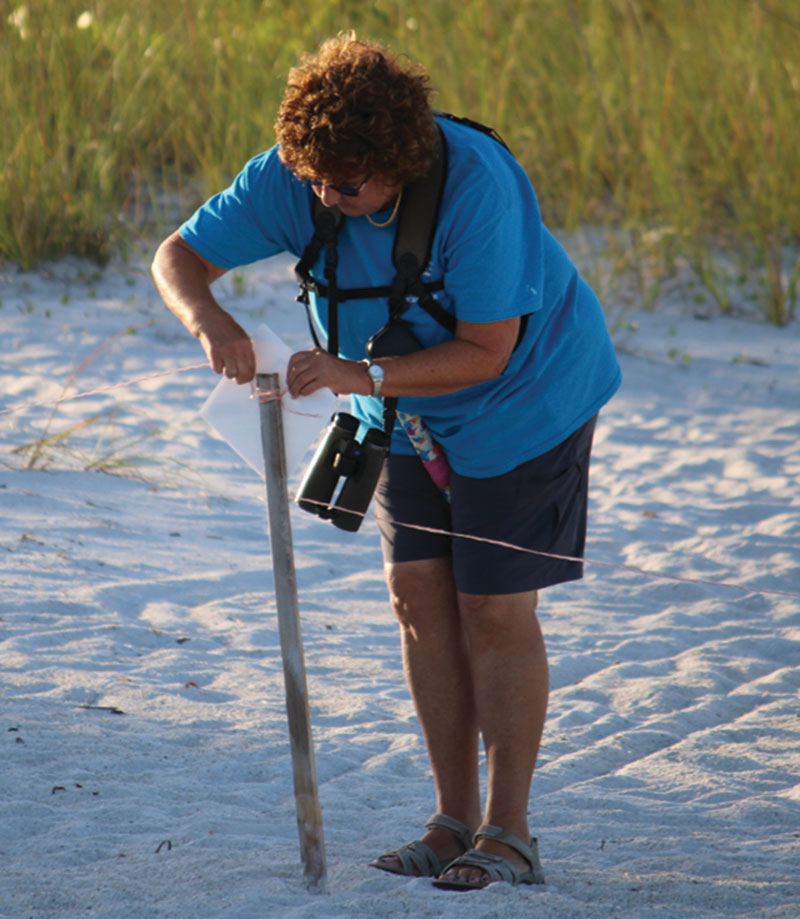
Kathy Doddridge, shorebird coordinator at AMITW, discovered the colony May 9.
The colony flourished for 88 days before Tropical Storm Debby caused the least terns to abandon the location, which Doddridge determined after visiting the area Aug. 5.
The colony fledged nine chicks.
The last time a least tern colony gathered on the island was in 2021 and fledged only two chicks before disbanding due to cat predation.
This year, predation was managed with help from Bradenton Beach and Manatee County officials and law enforcement officers.
Even with the intervention, 18 of 29 nests in the colony were predated or abandoned, drawing attention to just how fragile least terns are to the presence of laughing gulls, fish crows and domestic cats.
AMITW, in announcing the colony’s success, shared other details:
- The first hatch occurred June 14.
- The last hatch was July 23.
- The incubation time for one nest was 23 days. According to the Florida Fish and Wildlife Conservation Commission, the average least tern egg incubation period is 21 days — shorter than the two-month period of sea turtle eggs.
Kristen Mazzarella, executive director of AMITW, said Aug. 8 she is looking forward to applying the knowledge gained about how to best protect least terns next year.
“Our thanks to shorebird coordinator Kathy Doddridge, who managed these partnerships, took actions to mitigate predation and educated beachgoers on a daily basis,” Mazzarella said.
AMITW also shared guidelines that are always relevant to helping keep shorebirds safe:
- Keep a distance. If birds become agitated or leave their nests, people are too close. A general rule is to stay at least 300 feet from a nest.
- Respect posted areas. Avoid posted nesting and resting areas and use designated walkways.
- Never force birds to fly. When birds are chased or disturbed, they use energy they need to reserve for nesting and migration.
- Keep pets away from nesting areas. Pets are or can be perceived as a threat to birds and will disturb them. Keep cats indoors.
- Keep the beach clean and do not feed wildlife. Food scraps attract predators such as racoons and crows to the beaches. Litter on beaches can entangle birds.
For more information or ways to help protect nesting shorebirds and seabirds, visit islandturtlewatch.com.
From the director’s report
Anna Maria Island Turtle Watch and Shorebird Monitoring completed its post-storm assessment of the remaining nests after Tropical Storm/Hurricane Debby.
The final tally — 479 nests were incubating on the beach at the time of the storm, which impacted AMI Aug. 3-6.
Of the 683 nests laid, 202 or 30% already had hatched by the time Debby hit.
Prior to the storm, we secured the nest stakes and made sure that all nests were marked with a special GPS.
After the storm passed, we picked up about 1,000 nest stakes that washed out in heavy surf.
We also assessed which nests remained on the beach and whether they had any tidal washover or inundation, as well as inventoried nests.
Nest inventories are conducted three days after a hatch. We count the eggs inside the nest to determine the hatch success.
Having missed two days of patrol, on Aug. 7 we had 27 inventories to complete — 19 were completed and we were unable to find eight.
Next, we used GPS to locate nests and determine which were washouts and which could be reposted. We documented 182 nests washed out and reposted 68 nests that might be viable.
We have continued to patrol for new turtle crawls, checking existing nests for hatch or disturbance and conducting inventories on hatched nests.
Aug. 10-16, we documented one new nest and three false crawls, as well as 31 hatches.
We are hopeful for a near record season, with 255 nests incubating on the beach, combined with the 202 nests that hatched pre-storm.
— Kristen Mazzarella, AMITW
As of Aug. 16, there were 684 total nests, 835 false crawls and 233 hatched nests producing 17,444 hatchlings.
About least terns
The Cornell Lab of Ornithology, regarding least terns, says, “Everything about the least tern is sharp, from its brilliant yellow bill to its crisp black-and-white head pattern, to its slender pointed wings and forked tail. This smallest of the world’s terns is a noisy presence around its breeding colonies and in coastal waters or broad inland rivers.”
The species status is:
Florida: Threatened.
Federal: Endangered in Midwest and Great Plains states.
International Union for Conservation of Nature: Least concern.