






Tropical Storm Debby moved past Anna Maria Island Aug. 4-5, delivering high surf and waves to the beaches where hundreds of sea turtle nests were incubating and a least tern colony was flourishing.
As of Aug. 9, Kristin Mazzarella, executive director of Anna Maria Turtle Watch and Shorebird Monitoring, said 227 nests remained staked, 44 were restaked, 169 were washed out and 39 nests needed to be assessed.
Also, because of beach erosion, AMITW was planning to walk some sections to conduct nest surveys.
“It’s heartbreaking to see it happen,” Mazzarella said in an Islander interview Aug. 6. “But we were very happy to see more nests that we actually found today.”
That day, AMITW found 10 hatched nests among those they inventoried.
Mazzarella said the storm also may have altered incubation temperatures, which can factor into the sex ratio of the hatchlings.
“For the nests that have survived, it definitely will cool down the nests.” Cooler sand can produce more males — or “it could’ve drowned the eggs,” she said.
Kathy Doddridge, shorebird coordinator for AMITW, said she was surprised by the resilience of the least terns on the beach.
On Aug. 5, Doddridge saw no birds at the colony near the 27th Street North beach access in Bradenton Beach.
“I had initially called it abandoned,” she said.
However, Doddridge went back Aug. 6 and saw 16 least terns.
“One of them was calling as if it were calling a chick and bringing in food,” Doddridge said. “So now I’m not so sure what’s going on with these birds. I was quite delighted to see them still around.”
Before the storm, the colony had fledged nine chicks and there was one remaining chick, the youngest, that had not started to fly. Doddridge said because it liked to wander, there’s a possibility the chick hid in the dunes and survived.
Even with the disruption from the storm, Doddridge said she considers this year’s least tern colony an improvement from past years.
“Anything more than the two chicks that fledged three years ago, I would consider a success,” she said. “That’s nine more birds into the population.”
Doddridge attributes the success of the colony to increased awareness of predation problems. In 2021, a least tern colony disbanded at the same location because of cat predation.
This year, AMITW captured photos of feral cats attacking least tern chicks and worked to relocate them. They also obtained crow decoys from the U.S. Department of Agriculture, more effective than the artificial effigies that stopped working after a few weeks.
The fact that the least terns continue to come to the spot in Bradenton Beach left Doddridge hopeful.
“It’s obvious that they felt secure in that location and hopefully they come back next year,” she said.
From the director’s report
Anna Maria Island Turtle Watch was unable to patrol the beaches on Aug. 4 and Aug. 5 due to the high tides, heavy rain and thunderstorms associated with Tropical Storm Debby.
Turtle patrol was back out on the beach Aug. 6 to assess the damages.
We knew we were going to lose some nests but we were happy to report that we documented many hatched nests on Aug. 4, before the storm, and a couple more hatches were reported by the public on the days we were unable to survey.
There may be even more hatches that we don’t know about. So we are glad to know that those hatchlings got out!
At the time of the storm, about 479 nests were still incubating. Over the past four days, we have been determining the fate of each of these nests, fixing stakes and restaking some nests that we believe are still viable.
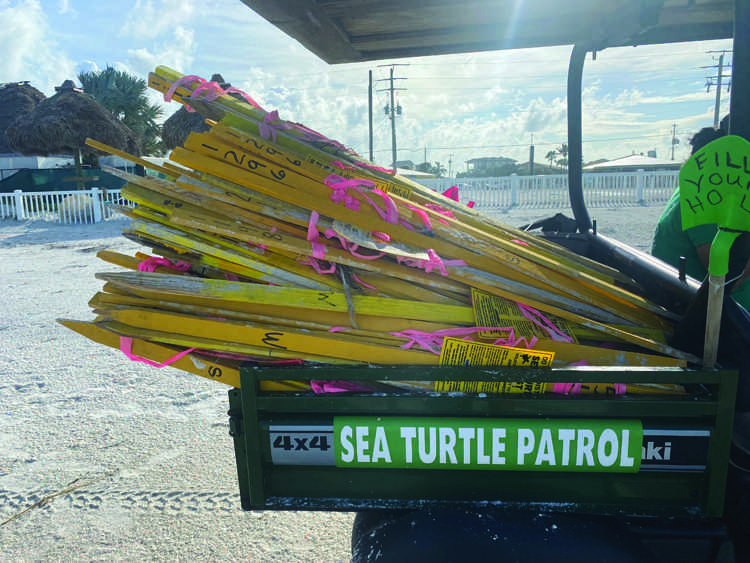
We also have been collecting more than 1,000 nest stakes that washed up after the storm.
AMITW would like to express our gratitude to those who placed our stakes in piles at the dunes for us to find them.
Here’s our preliminary assessment as of Aug. 9:
- 227 remained staked and are believed to be viable;
- 44 have been restaked and are believed to be viable;
- 169 have been confirmed as washouts;
- 39 nests still need to be assessed.
At this time in the season, nesting is slowing down and hatching is picking up.
We continue to conduct daily patrols looking for new crawls, documenting new hatches and any disturbances to nests and inventorying nests that have hatched or reached an overdue date.
While we are saddened by the loss of so many nests, we are encouraged by the number of nests still left on the beach.
AMITW can be reached at 941-301-8434.
— Kristen Mazzarella, AMITW executive director
As of Aug. 9, there were 683 nests., 832 false crawls and 220 hatched nests producing 16,074 hatchlings.