





The numbers add up.
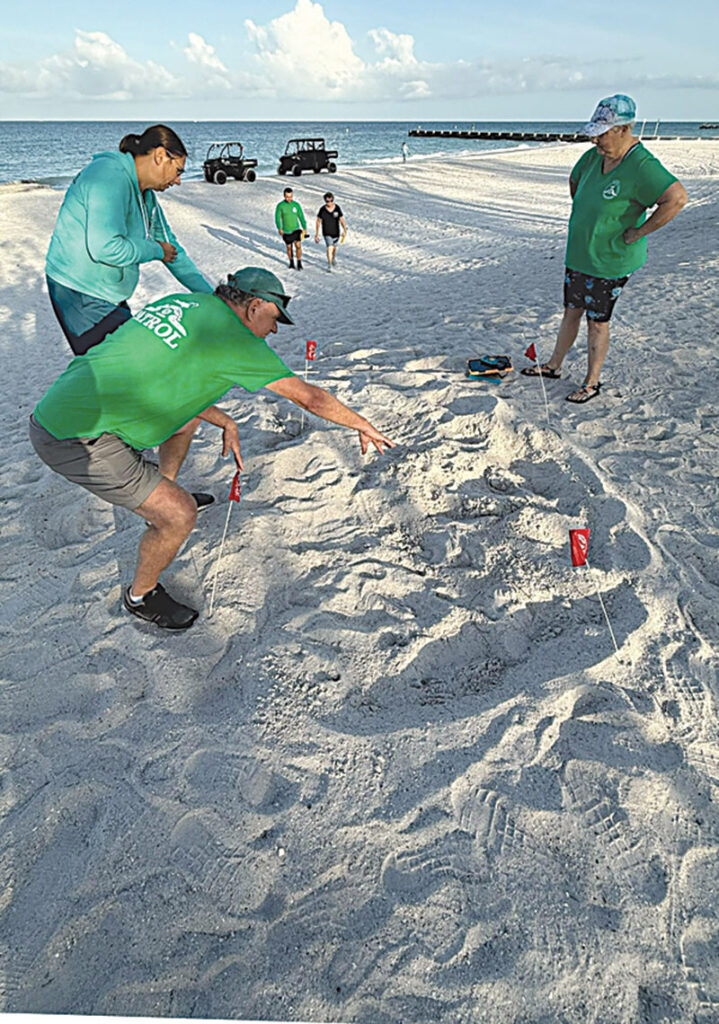
Anna Maria Island Turtle Watch and Shorebird Monitoring identified the first loggerhead sea turtle nest of the 2025 season May 3 and before the week was complete identified six more nests.
AMITW, which monitors the island beaches by ATV during a nesting season that runs May 1 through Oct. 31, also identified 10 false crawls and one adult disorientation in the first week.
“It’s been a strong start to the nesting season, with seven loggerhead nests found in the first week,” AMITW executive director Kristen Mazzarella told The Islander May 9. “Looking forward to more in the coming weeks.”
AMITW also monitors for shorebird nesting activity and in April the team had identified a colony of black skimmers in north Bradenton Beach.
“We continue to watch the black skimmers in and around the area we posted at the end of April,” Mazzarella said. “We expanded the closure this week to protect the courting birds from pedestrian and vehicular traffic.”
Skimmers and some other shorebird species nest on the sand. So in areas that attract lots of people, cordoning off a zone is one conservation tool.
Mazzarella said the colony’s population number dwindled the second full week in May, “which may indicate that they have chosen to nest elsewhere.”
Still, she said, “while the protective closure is in place, please keep your distance from the closure and do not disturb resting birds. We want to make sure that we keep the beach as welcoming as possible.”
Turtle watch continues to ask beachgoers and beachfront dwellers to observe best practices to help create safe nesting habitat for sea turtles and shorebirds.
For the turtles
- Turn off or adjust lighting along the beachfront to prevent sea turtles from becoming disoriented and moving toward the glow of artificial light on land, instead of natural light reflecting on the surface of the water.
Beachfront interior lights should be turned off with curtains closed after dark and exterior lighting should be from turtle-friendly bulbs.
Exterior lighting fixtures should be low to the ground and shielded from view at the shoreline.
- Avoid using flashlights or camera flashes on the beach at night. Such lights can distract sea turtles.
- Clear the way at the end of the day.
Sea turtles can become trapped, confused or impeded by items left on the beach.
Remove gear and furniture, as well as fill in holes and level sand sculptures.
For the birds
- Place trash in its proper place and do not feed birds.
- Keep a distance. If birds become agitated or leave their nests, people are too close. A general rule is to stay at least 300 feet away from a shorebird nest.
- Keep pets away from nesting areas. Even well-behaved pets can be perceived as a threat.
- Domestic cats should be kept indoors and attracting feral cats near the beach is discouraged.
- Do not force birds to fly. When birds are chased or disturbed, they use energy they need to reserve for nesting and
As of May 9, AMITW documented seven sea turtle nests, 10 false crawls and one disorientation.