





Approaching the fourth month of the season, Anna Maria Island Turtle Watch and Shorebird Monitoring reported seeing fewer new nests but an increase in hatches the week of July 12-18.
“Which is about right for this time of year,” said AMITW executive director Kristen Mazzarella.
For the past week, AMITW reported 43 new nests and 48 false crawls.
For the total as of July 18, AMITW reported 490 loggerhead nests and 12 green nests, 48 hatched nests, 2,656 hatchlings produced, 27 adult disorientations, 15 hatchling disorientations and 789 false crawls.
What’s the difference between a false crawl and a disorientation?
A sea turtle false crawl, also known as a non-nesting emergence, occurs when a female sea turtle crawls ashore to nest but then returns to the water without laying eggs.
False crawls can occur because the turtle is deterred by:
- Unfavorable beach conditions like loose sand or steep slopes;
- Human presence, noise or artificial lighting.
Repeated false crawls can negatively impact a sea turtle’s reproductive success.
A disorientation is when a nesting female or turtle hatchling is drawn away from the water to artificial light. Sea turtles navigate to the water using a combination of visual cues, wave orientation and the Earth’s magnetic field. Initially, they are drawn to the brighter horizon over the water.
A misdirection away from the water can be fatal, as disoriented turtles may exhaust themselves, be eaten by predators or face other dangers on land.
Mazzarella, in a July 12 report on nesting, said, “As expected, disorientations skyrocketed this week as hatching started increasing, with 13 new hatchling disorientations just this week.”
She continued, “Many hatchlings were found in pools and had to be taken to Mote (Marine Laboratory) for rehabilitation from chlorine ingestion.”
The hatchlings will be taken offshore and released by boat into the sargassum line, according to Mazzarella, who said people who find a sea turtle in distress can call AMITW’s hotline 24/7 at 941-301-8434.
It’s elementary
Class lessons from AMITW, AME
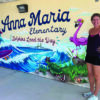
Anna Maria Island Turtle Watch and Shorebird Monitoring, during the 2024-25 academic year, invited teachers and students at Anna Maria Elementary School in Holmes Beach to compose questions about sea turtles, shorebirds and AMITW’s work on the beaches. This summer, the Islander is sharing AME’s questions and AMITW’s answers.
Teacher Rachel Mauk’s first-grade class: How big can a sea turtle get?
AMITW: The size of a sea turtle is different for each species.
The largest species, the leatherback, can get to be 5 to 6 feet long and weigh between 750 and 1,000 pounds!
The smallest sea turtle is the Kemp’s ridley and they can be up to 2 feet long and 70-100 pounds.
Loggerheads, which are the most common nester on Anna Maria Island are 2.5 to 3.5 feet long and 200-350 pounds.
Talking turtles
The city of Holmes Beach is hosting Anna Maria Island Turtle Watch and Shorebird Monitoring for weekly talks about sea turtle and shorebird nesting.
Sea Turtle Tracks and Shorebird Facts talks continue most Mondays at 10 a.m. through August at city hall, 5801 Marina Drive.
For more information, call turtle watch at 941-301-8434 or go to www.islandturtlewatch.com.
Nesting numbers
As of July 18, AMITW reported 502 nests, 789 false crawls, 48 hatched nests, 2,656 hatchlings to the Gulf, 27 adult disorientations and 15 hatchling disorientations.