





A legal battle over an easement on 51st Street in Holmes Beach may be nearing an end.
Meanwhile, the plants in the easement, put there by one of the involved parties, have been removed.
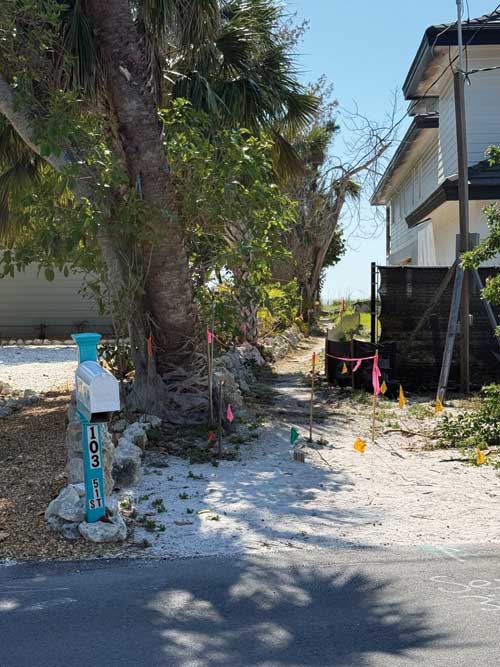
Larry Davis, owner of 103 51st St., alongside the easement, reported March 27 to Holmes Beach police that vegetation had been removed from the easement before a final verdict was reached in the case.
The dispute revolves around the ownership and rights over the easement, which runs between 103 51st St. and 5102 Fifth Ave., where it has served for decades as a beach path for property owners in the Gutierrez subdivision.
The subdivision covers a whole neighborhood, both sides of 51st Street and the south side of 52nd Street, with Second Avenue as an eastern border and the beach as the western border.
In November 2023, a group of 20 property owners within the subdivision, including the Gutierrez family, sued another 35 property owners, headlined by the Davis family, claiming that the Davises had launched “a campaign to prevent owners within the Gutierrez Subdivision from enjoying or accessing the easement.”
According to their complaint, the Davises planted obstructive vegetation in the 5-foot-wide easement and also installed large boulders to prevent access, as well as “began interrogating property owners about whether they lived within the Gutierrez Subdivision and whether they were authorized users of the easement.”
The Davises also posted an armed security officer and “no trespassing” signs at the path’s entrance, as well as attempted to build a fence within the easement before city staff halted construction.
The plaintiffs sought in their lawsuit a declaratory judgment from the court that they have an easement right over the path, and they seek injunctive relief requiring the Davises to remove all obstructions from the easement, as well as prevent them from blocking future access to it.
In their response, the Davises claimed that the easement had been abandoned and no longer existed, and it was not based on necessity since there are two nearby public paths to the beach.
They also claimed that the easement was terminated or limited by “abuse of the claimed easement.”
The Davises filed a counterclaim, alleging that the plaintiffs have “attempted” to use the easement in an “extreme manner,” such as by clearing the space of vegetation, creating a graveled pathway, littering, removing multiple “no trespassing” signs and more.
They claimed that such actions constitute “trespass and extreme abuse of any claimed easement,” which had resulted in damages to them.
The Davises’ counterclaim requested the court enter a judgment for compensatory and consequential damages, as well as injunctive relief to prevent the plaintiffs from “continuing to abuse the claimed easement.”
The case went to trial March 16-20 under 12th Circuit Judge Charles Sniffen, with a jury acting as fact-finders.
The jury rendered its verdict March 20, answering multiple questions posed by Sniffen in favor of the plaintiffs.
That includes determining that “one or more plats for the Gutierrez Subdivision” created an easement for the beach access path and that the easement benefited the plaintiffs.
They also determined that the Davises failed to establish adverse possession of the easement and the plaintiffs’ abandonment of it.
Lastly, the jury found that neither defendant nor plaintiff suffered damages for the other party’s removal of landscaping.
Now, all there is to do is wait for a final verdict from Sniffen, which had not been filed as of April 4.
However, someone may have jumped the gun with the latest removal of landscaping and vegetation within the easement.
The Davises filed a request March 30 for an expedited case management conference with the court, alleging that the plaintiffs once again removed vegetation from the easement and reinstalled a graveled pathway ahead of the final judgment.
They claimed that there is security footage of the incident, which “captured the use of chainsaws on their property and conversations between one or more plaintiffs with laborers on site.”
A case management conference was held April 2 to discuss both parties’ rights and obligations pending Sniffen’s entry of a final judgment.
Correction: the only thing that was removed was the top of the dead tree in the middle of the easement ( see in photo) . It was dead, hollow, leaning over the easement and in danger of falling on someone. No “plantings” were removed. Some branches growing into the easement were trimmed back as has been done for 75 years. It’s easy to see that it still looks exactly like the before photo in this article.