




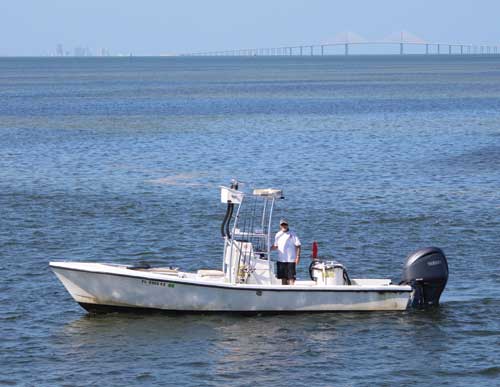
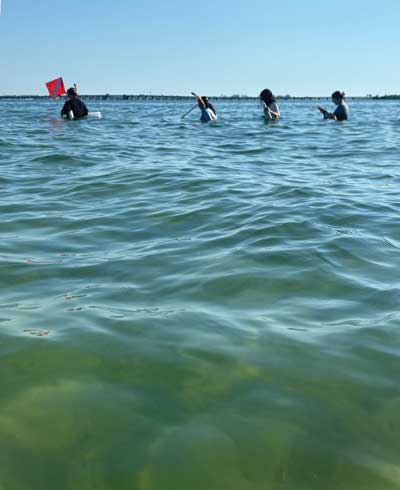
Months after fishing guide Scott Moore raised concerns about apparent seagrass loss in Anna Maria Sound, environmental groups are working to determine what, if anything, has changed in the sound.
Moore said April 14 the decline had been underway for more than a year by the time he reported it in December 2025, becoming most visible as winter’s clearer water revealed areas of white sand where grasses once grew.
“There’s a lot of grass missing there, a lot of white sand showing instead,” Moore said, describing a stretch of seagrass meadows from the mouth of the Manatee River westward through the flats near Key Royale and southward to Kingfish Boat Ramp.
Seagrass meadows support fish, shrimp and crabs and their nurseries, stabilize sediments and help maintain water clarity.
“Sea grasses are everything,” the captain said. “You got to have the groceries, you got to have the shrimp, you got to have the forage fish.”
Maya Burke of the Tampa Bay Estuary Program, a regional partnership focused on restoring and protecting the bay, said it will take time to determine whether the changes reflect a trend.
Burke said April 14 that seagrass is tracked through biennial aerial mapping by the Southwest Florida Water Management District and annual transect surveys. In these surveys, scientists sample seagrass along fixed lines on the bay bottom to track changes over time. Surveys are conducted during peak growing season.
The latest aerial imagery has been collected but remains under review, with final mapping expected in 2027.
In the meantime, TBEP has added a monitoring transect near Key Royale in Holmes Beach, with setup planned for this summer and initial data collection during the late summer growing season, when seagrasses typically peak.
“It’s a lot of background and prep work but no actual data or results to share with the public yet,” Burke said.
Burke said recent monitoring elsewhere in Tampa Bay shows mostly stable or increasing seagrass coverage, though parts of the lower bay show slight declines.
Burke pointed to potential stressors, including impacts from hurricanes Helene and Milton in 2024, nutrient runoff and swings between drought and heavy rainfall.
Independent field observations suggest localized stress.
Abbey Tyrna of Suncoast Waterkeeper said April 15 that the nonprofit responded a few days after Moore’s 2025 report, documenting widespread macroalgae and heavy propeller scarring. Propeller scaring occurs when boaters traverse shallow grass flats instead of operating in marked channels, damaging sensitive seagrass meadows.
Macroalgae — large, fast-growing algae such as lyngbya, often seen as dark or fuzzy growth on the flats — can grow over seagrass and block sunlight needed for growth.
Tyrna said conditions ranged from areas where grass was “covered,” with algae growing over it, to “smothered,” where “piles and piles of macroalgae” obscured the bottom.
“We saw a ton of prop scarring, like a sad amount of prop scarring, and then a lot of macroalgae,” Tyrna said. “It was an amount that should not be seen in a healthy system.”
All three sources said the issue is likely to have more than one cause.
Tyrna said the flow from the Manatee River and Palma Sola Bay carry nutrients into Anna Maria Sound toward Sarasota Bay, adding to storm impacts, runoff and infrastructure pressures, potentially contributing to water quality issues in the sound.
Moore said he has also observed seagrass growth in deeper water but stressed the importance of protecting shallow flats and controlling stormwater runoff before it enters the waterway.
“Everybody needs to stay vigilant,” he said.
Burke said the region already knows how to support seagrass, pointing to continued investment in wastewater upgrades and nutrient reduction, while Tyrna said ongoing monitoring will be key to identifying pollution sources and tracking any changes that may occur.
Critical — and fragile
Local seagrass meadows serve as nurseries for fish, shrimp and crabs and help keep water clear by stabilizing sediments.
The shallow areas can be damaged by boat propellers and can be smothered by fast-growing macroalgae when excess nutrients enter the water, blocking the sunlight seagrasses need to survive.
The sand migration is very much seen, it is dredged and pumped onto the beach for renourishment purposes then the storms and flow redistribute it into the bay and make sandbars where there were none previously. As to the algae I would suggest that the deep well elimination of treated waste water is finding its way back and promoting the growth that wasn’t present before, obviously pumping millions of gallons from all those permitted wells into the ground where no vessel retains it will nourish something, and it seems to be a statewide problem, not just around Anna Maria Island.