







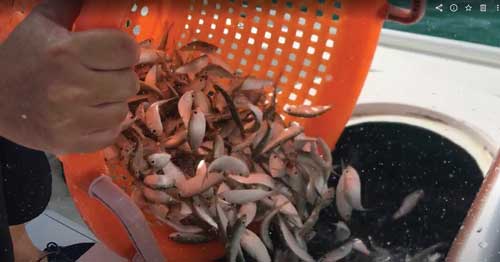
If you’ve been on the flats in the morning throwing a bait net, you’ve probably seen an abundance of small shiners or, as we call them, hatch bait.
Large schools of small bait have infested the flats, requiring a small-mesh net to prevent gilling the baits and avoid extra work cleaning the net of excess bait.
The small shiners — measuring about 2 inches in length work well for the inshore bite despite the small size. In fact, you may notice that many of the fish we target — snook, redfish, and trout — prefer them this time of year as that is what’s available for their daily diet.
The significance of the arrival of hatch bait is it indicates the mangrove snapper bite throughout our inshore and nearshore waters should be turning on.
And true to form, that’s exactly what’s happening. It’s that time again to head out to your favorite inshore and nearshore reefs, wrecks and rock piles and start snapper fishing.
It’s time to break out the light to medium-spinning gear, small hooks and light fluorocarbon leader material and get out there and get your limit of the popular inshore snappers.
And don’t think you need to be in a boat to find these fish. Once they arrive, they tend to gather on just about any bit of structure they can find, including docks, piers, bridge pilings and jetties. In fact, sometimes you can even find them on the grass flats or in the roots of the mangroves.
In any case, if you like mangrove snapper, this is your opportunity to do so with pretty good odds of getting your limit.
Just remember, in state waters mangrove snapper must be a minimum of 10 inches in total length with a bag limit of five per person per day.
On my Just Reel charters, I’m finding good action on mangrove snapper while working during the slower stages of the tide. Using small shiners or hatch bait is leading to limits of these tasty fish.
Targeting spotted seatrout yields limits for my clients most days. Fishing over deep grass flats where clean water and good tidal flow exist is producing the best action. In fact, trout up to 25 inches are being caught, with many measuring 15-20 inches — depending on location.
Lastly, catch-and-release snook are rounding out the bite, with most fish measuring 20-30 inches.
Capt. David White says he’s catching plenty of mangrove snapper inshore in Tampa Bay and nearshore in the Gulf. He says hatch bait is key to getting limits of snapper on the hook most days.
After catching their fill of snapper, White is cruising sandbars for blacktip sharks, which are attainable by sight casting — and thrilling for his clients.
Finally, catch-and-release snook are being found along the beaches, as well as in the back country along mangrove shorelines.
Capt. Johnny Mattay of Anna Maria Charters is finding good action while working offshore in the Gulf of Mexico. Snapper fishing is red hot right now for Mattay, as he’s putting clients on American red snapper, mangrove snapper and yellowtail snapper. All three provide excellent table fare as well as putting up a strong fight on the end of the line.
Also offshore, Mattay is finding an abundance of red grouper and catch-and-release gag grouper.
If pelagics are what you desire, Mattay reports he’s finding blackfin tuna, as well as an occasional wahoo. Amberjack are present to wrap up the offshore bite.
Moving inshore, Mattay says redfish and catch-and-release snook are taking his bait along the mangrove shorelines, as well as some snook along the beaches.
Finally, spotted seatrout can be caught on the deeper grass flats of Sarasota Bay.
Send high-resolution photos and fishing reports to fish@islander.org.