






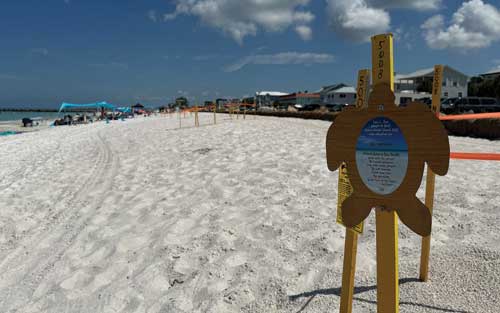
Sea turtle hatchlings are off to a rough start on Anna Maria Island.
And the island’s three cities are trying to right the ship.
Anna Maria Island Turtle Watch & Shorebird Monitoring executive director Kristin Mazzarella told The Islander July 16 that 15 out of 27 hatched sea turtle nests had resulted in disorientations due to artificial lighting along the shoreline.
When sea turtle hatchlings emerge from their nests, they instinctually crawl toward the brightest light — which, in nature, is usually the moon and stars reflecting off the Gulf of Mexico.
However, when artificial lighting is visible from the beach, hatchlings can be drawn toward it, resulting in a disorientation.
Disorientations can be deadly for hatchlings, as they have limited energy to crawl to the water and swim out to the weed line — floating seagrasses like sargassum — where they take in nutrients.
As hatchlings crawl away from the water and toward human civilization, they are at risk of being killed by motorists on roadways, becoming dehydrated and burning out their limited energy before reaching a food source that can sustain them.
“Once they leave the nest, they really need to reach the water,” Mazzarella said. “If they’re not reaching the water because they’re going towards lights and the streets, we’re not putting all those hatchlings out into the ocean to grow up to be big new turtles nesting on our beaches.”
“All the conservation efforts that we put in towards protecting these nests and these hatchlings kind of go out the window when the hatchlings don’t make it to the water,” she added.
Mazzarella said that the 15 disorientations had resulted in multiple dead hatchlings on island roadways, while others were found trapped in swimming pools.
The trapped hatchlings were collected and taken to Mote Marine Laboratory. There, the hatchlings are cared for until a boat is available to take them out to the weed line, where they are released.
As of July 16, out of 27 hatched nests, 10 disorientations had occurred in Bradenton Beach and five in Holmes Beach.
The island cities have ordinances to protect nesting sea turtles and hatchlings, establishing rules for artificial lighting along the beach.
Mazzarella said AMITW stays in contact with code enforcement departments in the cities to report and address artificial lighting that could result in disorientations.
Nevertheless, she acknowledged that certain factors impact the number of disorientations, like how “most of Bradenton Beach is right up against the beach.”
Bradenton Beach Police Chief John Cosby told The Islander July 16 that another factor leading to disorientations is the lack of dunes lining the shores.
Hurricanes Helene and Milton all but wiped out the Gulffront dunes in 2024, eliminating a natural barrier to disorientations, as dunes block some artificial light from reaching the shore and obstruct disoriented hatchlings from making their way landward.
He said the issue might not be addressed until an upcoming Manatee County beach renourishment project can rebuild the dunes in Bradenton Beach and Holmes Beach.
In the meantime, Cosby said code enforcement staff had spent about a third of their time addressing turtle concerns like artificial lighting, but thus far had only issued warnings.
He said there were some cases of ornamental lights that needed to be addressed, but defended the use of lights to illuminate roadway crossings, parking lots and outdoor dining spots.
“I have an issue with some of what (AMITW’s) expectations are,” Cosby said. “People are still more important than turtles.”
He added that the city has been working with Florida Power & Light for two years to shield the illuminated lights on Gulf Drive, but FPL has yet to complete the job.
“Everybody is just going to have to come to terms with the fact that, until the dune system is put back in and the beach is put back in, we’re going to have an issue,” Cosby said.
Holmes Beach code enforcement officer Jayson Clayton told The Islander July 15 that another factor in regulating artificial lighting along the beach was the transient nature of the island’s population.
He said that, while the city hosts well-attended turtle talks by AMITW Mondays during turtle season, it is basically impossible to properly educate the revolving door of vacationers on the island.
Clayton said that full-time residents know to turn off their lights and close their blinds at night to prevent interior lighting from reaching the shore, but vacationers often do not.
He said hotels and vacation rental owners provide educational material at their establishments, but there is no guarantee that their patrons pay attention to it.
“It can be tough to tackle in a community like ours because week by week, day by day, we have so much changeover,” Clayton said.
Nevertheless, Clayton said a code staff member like himself is trying to address every issue possible by walking the beach — including at night — identifying potential lighting problems and contacting the property owners or tenants to fix them.
“It’s a really special thing that we have over here,” he said. “They were here thousands of years before we found this island, and they’ll be here for thousands of years after we leave it. We just need to be mindful of them and do our best to coexist.”
A quick guide to turtle-friendly lighting
People can help prevent turtle disorientations by:
- Shielding exterior light fixtures to prevent light from reaching the beach, or installing low-wattage amber/red LED lightbulbs in the fixtures since sea turtles are less attracted to light with longer wavelengths;
- Turning off unnecessary exterior lighting at night;
- Turning off interior lighting and closing blinds before going to bed at night;
- Tinting windows overlooking the beach to limit the amount of light that reaches the shore;
- Moving light sources, such as televisions, away from windows overlooking the beach;
- Using amber/red lights while walking the beach at night.
— Ryan Paice