






Big changes could be coming to the parking rulebook in Anna Maria.
Christine Fanchi, senior transportation planner for New York-based WSP USA, presented results of the firm’s parking study to city officials during an Aug. 11 informational meeting.
The results included a draft plan for sweeping parking changes, such as implementing programs for paid parking — which Fanchi estimated could raise $11 million in annual city revenue — and residential parking permits.
The city hired WSP in April to study parking issues and present potential solutions.
Fanchi said the city has 5,573 total parking spaces, with 4,460 available to the public and 113 in private lots.
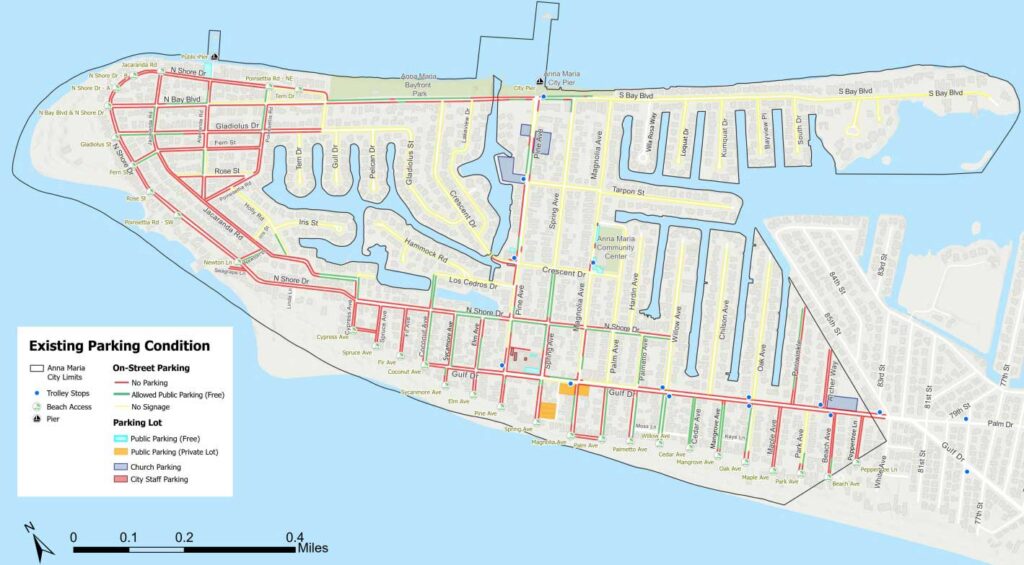
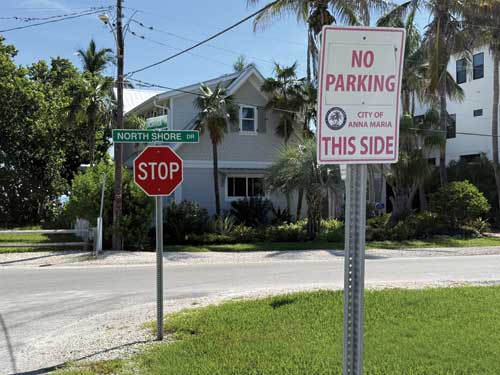
The municipality currently prohibits parking on a number of roadways on the western coastline and at the northern tip of the island near Bean Point. It also marks several stretches of roadway where public parking is allowed.
At the same time, many central roadways have no parking signage, leaving an estimated 3,309 undesignated parking spaces.
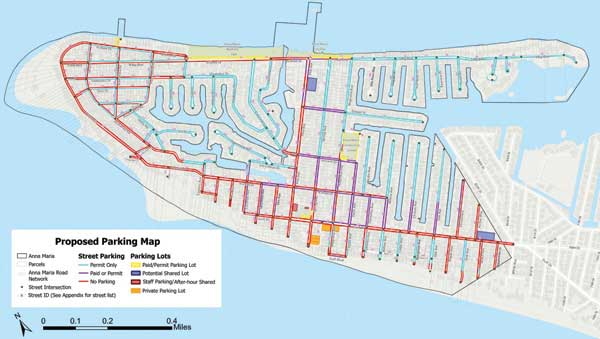
Fanchi proposed cutting the maximum number of public parking spaces by 9% and implementing permit, special event and paid parking programs to regulate the remaining 4,043 spaces.
Motorists with residential permits would be able to access all parking spaces.
City officials agreed during the meeting that residents would not be charged for permits.
Special event passes would be available to allow parking for events and construction in residential areas, as well as employee parking for local businesses.
Only 28%, or 1,119 of the city’s 4,043 public spaces, would be paid parking, with a maximum of 3-4 hours in commercial areas. That includes 825 on-street spaces and 294 spaces in public lots.
While hourly rates for paid parking remain undetermined, Fanchi said the average rate for comparable cities is $4.50 per hour. In addition to the hourly rate, people would pay $0.65 in fees per transaction.
She estimated that, at the $4.50 hourly rate, the city would collect about $25,000 a day in revenue from parking.
“It could be about $11 million a year,” Fanchi said. “$25,000 a day was on the conservative side.”
“Wow,” Mayor Mark Short said in reaction to the estimate.
Since the city already contracts with Passport Parking to issue citations, Fanchi said the company would be WSP’s preferred vendor for handling its proposed paid- and permit-parking programs.
With Passport as the vendor, parking payments could be completed via the company’s mobile application, over the phone or on the internet. The vendor also would provide a portal for residents to register their vehicles for parking permits.
The vendor’s costs would be paid using an undetermined portion of revenues from paid parking.
The proposed changes also include alterations to existing parking setups at Bayfront Park, as well as a partnership with Roser Memorial Community Church and CrossPointe Fellowship to provide public parking.
She said benefits from the proposed changes include increasing parking availability by encouraging turnover through time limits, preventing negative impacts on residential areas, as well as creating a dedicated funding source for the municipality.
According to Fanchi, implementing WSP’s proposed on-street parking plan would cost the city about $292,000 for posts and signs to designate the different zones — paid, permit and no parking.
However, she noted that it was an overestimate since it did not account for existing parking signage in the field and labor costs could be lowered by using public works for installation.
Fanchi concluded that the proposed on-street parking changes could be implemented by March 2027, during the next spring tourist season and a peak in visitor traffic.
Short said the city’s parking issues had become the largest focus of complaints received by the municipality since its transition to Waste Pro as its franchised waste hauler.
He emphasized the issues must be addressed.
He added that Manatee County’s potential implementation of paid parking at Manatee Public Beach and Coquina Beach would push beachgoers to find cheaper parking elsewhere — a possibility that played a part in the city’s consideration of paid parking.
“If they do that — and I’m not saying they will — but if they do that, we definitely have to have a plan in place,” Short said.
The city will host a workshop on the WSP parking proposal at 4 p.m. Monday, Aug. 31, at city hall, 10005 Gulf Drive.