




Whether local or visitor, get in the know to hook up
Fishing around Anna Maria Island remains consistent, especially for knowledgeable fishers who also know the area. For those who are new to the area or are just briefly visiting, this article is for you.
To start, let’s talk about that kind of gear you’ll need. For most applications, it would be best to purchase, or bring along a medium-action spinning outfit. This is a rod and reel that is rated in the 8 to 17-pound class. A 7-foot rod rated for about the same will suffice. These combinations can range in price from $50 to $500, so make the choice that best suits your purpose.
Hooks, leader and other terminal tackle such as artificials will be best determined by where you are going to fish and what you would like to target.
There are certain “spots” to choose for fishing and tackle and rigging choices that are specific to the “spot.”
Visiting the local fishing piers on Anna Maria Island are your best bet to get started. The Rod & Reel Pier and the Anna Maria City Pier are both fisher-friendly. Taking a casual walk out to the end of the pier and observing the local fishers is a great way to get your bearings on what you should be doing.
Generally, live and frozen bait are readily available at the two piers. Live shrimp paired with a No. 2 hook on the end and a split shot about 12 inches above the hook complete the rig. To target the snapper, simply bait up with a live shrimp and cast under the pier. Not only do snapper put up quite a fight for their size, but they also are excellent on the plate.
Spanish mackerel are another popular species at the pier. For these fish, most fishers use artificials such as small white jigs, silver spoons or Gotcha plugs. These high-activity fish put up a great fight on light tackle and can be good eating if properly prepared.
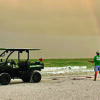
If keeping away from the crowds is in your interest, you can always fish from the beach on Anna Maria Island. Almost all beach, except for the public swim areas with lifeguards, are fishable. When fishing the Gulf of Mexico side, you’ll probably want to use artificials such as spoons and jigs. These lures will get you hooked up with mackerel, jacks and ladyfish. To catch these sporty species, you simply need to cast out into the surf and retrieve.
Now that you have a couple of options or destinations to start fishing, you’re probably wondering where to get your supplies. I suggest going to Island Discount Tackle, which is conveniently located on the water in Holmes Beach. The helpful, courteous staff consists of anglers ready to guide you to what’s biting and the proper equipment to use, as well as the right bait. Also, Keyes Marina at the same location, is a full-service marina with boat slips and a full-time mechanic on duty, so feel free to dock there while you shop for bait and gear.
For more serious anglers, there are plenty of local charter captains who are available to take you and your family out for a day of fishing — myself included. This is probably a vacationer’s best option to experience a good day of fishing on the water.
Once you’re booked, all you have to do is show up at the dock and be ready to fish. The captain supplies your bait, tackle, ice, licenses and has local knowledge of the area to guide you to the fish. This choice takes a lot of the legwork out of planning a day of fishing.
Finally, remember to familiarize yourself with the local and state laws for saltwater fishing in our area. Your best option is to visit the website www.myfwc.com for all of the rules and regulations.
Unless you’re fishing one of the local fishing piers or on a charter boat, you’re going to need a fishing license, which you can also purchase online before you arrive. There are size and bag limits, as well as open and closed season for just about every species you encounter, so be literate in these areas.
Most importantly, remember to have fun and enjoy yourself while fishing the waters of Anna Maria Island.
Capt. Rick Gross of Fishy Business Charters is catching schooling redfish along the shallow grass flats of Tampa Bay. Once a school is located, Gross is quietly approaching with a push pole. Once in casting range, Gross is casting live shiners into the school to achieve a bite. Slot-size fish are the norm.
By fishing mangrove shorelines, Gross is finding encouraging numbers of snook. Areas holding 50-75 fish are not uncommon. By free-lining live shiners, Gross is catching quantities of fish 22-26 inches, and keeper-size fish are in the mix.
Finally spotted seatrout are being found on drop offs adjacent to shallow grass flats. These drop offs can be channels, ditches or deep potholes. Live shiners under a popping cork are resulting in fish up to 24 inches.
Capt. Aaron Lowman at Island Discount Tackle also is finding good action on the flats and mangrove edges at high tide. Most fish, including snook, redfish and mangrove snapper, are being found along the edges of the mangrove’s hanging limbs and roots. A live shiner targeted to the proper spot is quickly devoured.
On deeper flats, Lowman says spotted seatrout, Spanish mackerel and jack crevalle are abundant. These fish are providing great light-tackle action for both novice and skilled angler. Slot-size trout are attainable, which adds a few fish to the cooler.
Jim Malfese at the Rod & Reel Pier says the “bull” redfish are finally making an appearance. Pier fishers using live lizardfish, shrimp or pinfish are catching these over-slot reds, some exceeding 40 inches.
Black drum are being caught under the pier by fishers soaking live shrimp on the bottom. Drifting baits under the pier is proving successful, too. While fishing this method, you can expect to catch keeper-size mangrove snapper.
Finally, snook fishing at the R&R is resulting in slot-size fish. Pier fishers using live shiners, pinfish or ladyfish are getting the bite. When using smaller baits, such as shiners, expect to catch numerous under-slot snook, while ladyfish and large pinfish are resulting in slot and over-slot fish. Bigger bait, bigger fish.
Capt. Warren Girle is targeting mangrove snapper around nearshore structure with good results. Limits of fish are still being reeled up daily along with a variety of other species. While targeting snapper, Girle is finding flounder around the sandy potholes that surround the structure. Cobia are being caught in these areas.
For the Spanish mackerel and bonito that are patrolling nearshore structure, live free-lined shiners combined with a longshank hook are providing action. For the blacktip sharks, fresh-cut chunks of the macks or bonito are dynamite bait.
Moving inshore, Girle is producing good numbers of redfish and spotted seatrout. For the reds, Girle is locating schooling fish and pitching them live baits. For the trout, deeper grass edges are holding fish up to 22 inches.
Send high-resolution photos and fishing reports to fish@islander.org.