




Stealth is key to catch weary mangrove snapper
Fishing the back country around Anna Maria Island is following the same pattern we’ve seen for several weeks.
With temperatures averaging in the mid 90s and the heat index around 105 degrees, early morning fishing has been the most productive. Spotted sea trout will be on the shallower flats at sunrise, gradually work their way to deeper water as the sun gets higher in the sky. Areas with good tidal flow are your best bet to find trout in a feeding mood.
It’s time now to start looking for schools of reds on the shallower flats in our area. Try looking for schools around the outside of Miguel Bay and work your way south toward Terra Ceia Bay. Gold spoons are a good way to target these fish because they allow you to cast long distances, which enables you — and your boat — to stay farther away from the fish you’re trying to catch. If you get too close, you’ll spook the school, which is not in your best interest since they probably won’t bite after that.
Mangrove snapper are making a showing on near-shore structures, such as bridges, docks and piers. Don’t pass up the opportunity to take a few of these small, tasty fish home for dinner while they are accessible for just about anyone with a hook and line. They are fairly easy to catch and make some of the finest table fare you’ll find in these waters.
A No. 4 live-bait hook tied to a 15-pound fluorocarbon leader and some split shots is all you need for a rig to target small snapper. Small shiners work the best for mangrove snapper, but if you don’t have a cast net to gather up shiners, try using small live shrimp.
Capt. Warren Girle is working the offshore waters for a mixed bag. Catch-and-release gag grouper have been the most abundant with the biggest fish coming in at 32 inches in length. Red grouper inhabit the same areas, but most are undersized. Of course, while bottom fishing, Girle also is catching good numbers of Key West grunts between the red and gag grouper hookups. Moving up in the water column, Spanish mackerel and bonito are being caught in good numbers on small whitebait.
Inshore, Girle is plying north Sarasota Bay for redfish and spotted sea trout. “The reds in the bay are getting smart,” says Girle. “You may want to experiment a little to see what produces the best bite.”
Girle is fishing shallower flats and potholes to locate the larger reds. He’s finding spotted sea trout lurking on the shallower flats in the mornings, then moving to deeper water as the day goes on. Girle also is catching ladyfish and bonnethead sharks in the same areas.
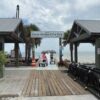
Dave Sork at the Anna Maria City Pier is seeing tons of hatch bait arriving around the pier. With all of this small bait, comes mangrove snapper. “There are good numbers being caught,” says Sork, “but a lot of them aren’t keepers.”
A No. 4-size hook free-lined and baited with a shiner is the ticket to catch some feisty little snapper. If the current is moving too fast to get a bait down, add a split shot or two. Another thing to consider when targeting mangrove snapper is your leader size. You can scale down to at least 15-pound fluorocarbon. The less visible the leader, the better, especially when fishing for snapper at the pier. The snapper that congregate around the pier usually see many different rigs and baits thrown at them, which makes them hesitant to take a bait. Stealth is the answer to catching these heavily targeted fish.
Spanish mackerel are making a showing around the pier. “Most of the mackerel are here at sun up,” says Sork. “They bite for about an hour and then it’s over.”
Fishers looking to target catch-and-release snook are bouncing large buck-tail jigs off the bottom around the pilings of the pier. Live baits such as pinfish, lizardfish and live shiners are working, too, according to Sork.
Bob Kilb at the Rod & Reel Pier says there are still hordes of pinfish hanging around under the pier, which is making it difficult to fish with shrimp. Determined anglers are catching black drum under the pier. Fish in the 24-inch range have been the norm.
With the arrival of the swarms of small bait come mangrove snapper. Light tackle baited with small shiners has been producing good numbers of snapper in the 10- to 12-inch range. Spanish mackerel are appearing briefly in the mornings, so it you’re targeting them, best to be at the pier at sunrise. Flounder also are making an appearance around the pier, with fish up to 3 pounds being landed daily.
And one pier fisher last week put on a good battle with a 6-foot hammerhead shark on his line for an hour before it chewed through the leader.
Capt. Rick Gross of Fishy Business charters is pursuing redfish on the incoming tides around turtle grass beds along the mangrove shoreline. Gross likes to locate the fish, anchor the boat a short distance away and chum with live shiners to draw the reds to the boat. “That way, you don’t spook them too bad,” says Gross.
Once the redfish start biting on the “chummers,” you cast your bait toward the boils. This is a highly effective way to target reds, and since the bite is usually close to the boat, it’s very visual, too, Gross says.
Moving out to the near-shore reefs, Gross is catching Spanish mackerel in the 24-inch range by free-lining shiners behind the boat. Gross likes to call them “baseball bat” mackerel because of the resemblance of their size and shape.
Flounder also are being caught around the near-shore structure on live shiners. You can use the same rig you’re using for mackerel by just adding a No. 1 split shot a foot above your hook. Flounder up to 24 inches are being caught, although most have been in the 18-inch range. Also on the near-shore structure, Gross is finding keeper mangrove snapper, although he feels the bite has room to improve.
Jeff Medley at the south bait shop on the Sunshine Skyway Bridge Fishing Piers says fishing is good as long you can tolerate the heat. Mangrove snapper have arrived in good numbers and are averaging 17-18 inches. Fresh-cut greenbacks are the bait of choice. Targeting mangrove snapper on the slower tides has been productive, although if the tide is running strong, Medley says you need to add weight to your rig.
Gag grouper are still dominating the bite around the small reefs around the pier. Remember you can only catch them for fun — the season is still closed. Sheepshead are beginning to show around the pier again with fiddler crabs being the ultimate bait. “We’re seeing at least two to three sheepies on every piling,” Medley says. “Most of them are good-sized fish, too.”
Pier fishers working away from the pier are catching decent numbers of flounder. The technique to catch these tasty flat fish is to drag a greenback, either whole or cut, along the bottom. Large schools of bait fish, threadfin herring and scale sardines, have arrived around the pier, which in turn has attracted schools of ladyfish, skipjacks and jack crevalle. Live baits, silver spoons or white crappie jigs are producing good numbers of all these of these species.
Finally, Medley says pier fishers are still hooking up tarpon around the piers. Most have been in the 60-pound range and are hitting live pinfish.
Capt. Sam Kimball of Legend Charters is fishing offshore hard bottom as well as wrecks and reefs in search of a good bite in spite of high water temps. Mangrove snapper in the 5-pound range have been the norm with a couple topping out at 7 pounds. Lane snapper are abundant. Other species, such as triggerfish, Key West grunts and porgies, have been in the mix, which make a good variety for the dinner table. Limits of red grouper in the 24-inch range are being caught on hard bottom using shiners and pinfish for bait.
Catch-and-release gag grouper are going strong with last week’s biggest fish topping out at 25 pounds. To round off the day, Kimball is catching a few kingfish and amberjack.
Capt. Mark Johnston of Just Reel fishing charters is seeing good numbers of spotted sea trout on the deeper flats of Sarasota Bay. “You really need a good moving tide to get these trout to bite,” says Johnston. “Try to target areas with good water flow for best results.” Johnston is fishing structure in Sarasota Bay as well as in the passes to target mangrove snapper. “There are still a lot of small ones around,” Johnston says, “but you can get a few keepers if you’re persistent.”
Johnston is catching flounder in decent numbers around the passes over small rock piles and ledges. And as the tides rise in the afternoon, Johnston is catching slot-size redfish along mangrove edges in Sarasota Bay. He suggests chumming first to get the reds “in the mood” and begin presenting bait once they are biting.
Capt. Mark Howard of SumoTime fishing charters says the fishing is excellent as long as you take advantage of what Mother Nature presents. Shiners that hatched in June are now fishable bait and easy to catch.
Howard says redfish are scattered, but oversized copper-belly fish are cruising the flats and potholes at low tide, gulping down shiners with abandon. He suggests working potholes close to the mangrove line as the tide decreases to catch redfish as they retreat from the roots to deeper water.
The speckled trout bite is excellent in 4-8 feet of water on a moving tide, and Howard suggests using a release tool to minimize damage to the smaller trout as you work up a nice stringer of keepers.
Mangrove snapper have invaded the inshore waters and can be found just about anywhere there is structure, and Howard put his anglers on keepers in 5 feet of water over hard bottom and grass, and he found the near-shore reefs holding a lot of mangrove snapper as well.
Send fishing reports to fish@islander.org.