





Anglers are getting the opportunity to fish the “sweet water” when working the back country.
With freshwater pouring out of the Manatee River, the emerald green waters east of Anna Maria Island we’re used to fishing are dark and mysterious.
The water — resembling root beer or iced tea colors — can make it challenging for sight-casting or just looking for fish. In some areas, the water is so dark it’s pointless to even go up in the tower to look for fish — unless, of course, you just need a break from the morning conversation.
But let me tell you, don’t think I’m putting a negative twist on the water being so dark. The top trio of inshore species — snook, redfish and spotted seatrout — seem to love the dark water. And a slight drop in water temperature is helping the fish get fired up. Yes, you’ll need an array of spots in your arsenal, but when you find the fish, it’s game time.
What else is exciting about the change in water? The addition of other species found on the flats.
One that comes to mind is the longnose gar.
The prehistoric-looking fish has a long nose lined with teeth from top to bottom, with thick scales that resemble a coat of armor. We usually don’t see them in saltwater but with such a high mix of freshwater around the mouth of the Manatee River, they are more common. I see them daily when fishing the flats around Emerson Point and the De Soto National Memorial.
Juvenile tarpon are a possibility in these areas. And there’s nothing better than hooking into a 15- to 20-pound tarpon while trout fishing on the flats. Talk about a thrill.
And then there are the usual suspects. Large jack crevalle and ladyfish don’t seem to mind the lower salinity levels and will quickly grab the bait of an unsuspecting angler, forcing them to get “reel” in a hurry.
So there’s plenty of action to be had during the rainy season in the back country. Don’t let that dark water fool you. The fish are there and hungry.
On my Just Reel charters, I’m seeing a mixed bag of snook, redfish and spotted seatrout. The snook and trout are apparent in the back country. As for the reds, I’m seeing some mixed in while prowling for snook.
For fast-paced action, Spanish mackerel, jack crevalle and ladyfish are keeping my clients busy after they’ve had their fill of snook and trout.
Capt. Warren Girle is happily watching his clients reel up their fair share of mangrove snapper while fishing over the artificial reefs in the Gulf of Mexico. Using live shiners as bait combined with a circle hook and a knocker rig is resulting in snapper up to 18 inches. Most catches are 14-16 inches, with lucky anglers hooking into a few larger fish.
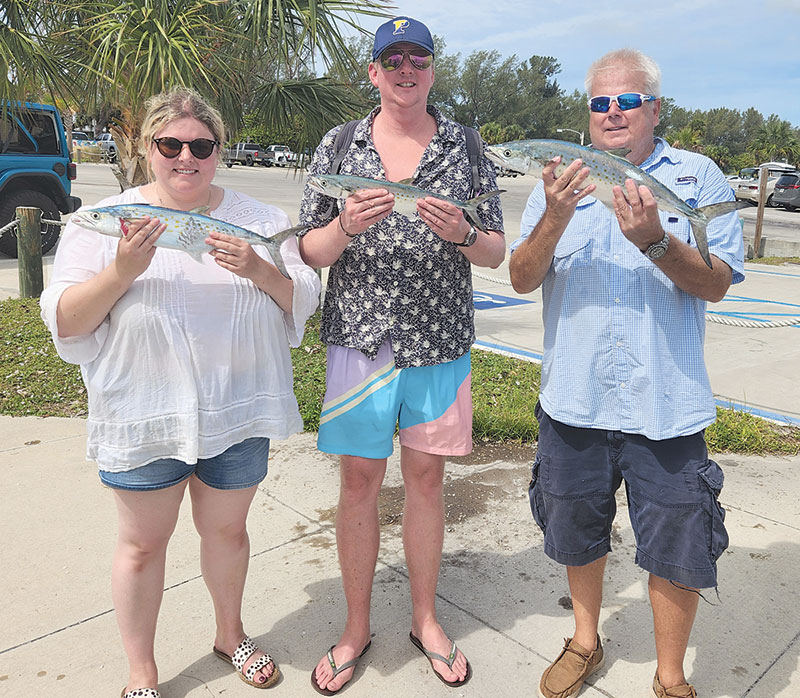
Spanish mackerel are making their presence known throughout the nearshore waters in the Gulf. Girle says chumming with live shiners is getting the macks fired up and receptive to taking a bait.
When targeting the macks, Girle is seeing an occasional tarpon take the bait.
Moving inshore to the flats of Sarasota Bay, Girle is finding snook, trout and redfish willing to take his bait. For the snook and reds, casting baits along the mangrove shorelines is working best. As for the trout, Girle says slightly deeper flats in the middle of the bay are “where it’s at.”
Capt. David White of Anna Maria Charters says he’s seeing a lot of macks in the Gulf and Tampa Bay, and he’s putting clients on plenty of the high-speed toothy predators. Freelining shiners on a longshank hook is leading to plenty of fierce strikes and drag-screaming action for White and his clients.
Gag grouper also are being caught while in Tampa Bay. Fishing around rocks, reefs and wrecks is working best to find these bottom dwellers.
Moving to the flats, White is enjoying action on snook and redfish. The snook bite is most apparent, with several redfish a day in the mix.
Jim Malfese at the Rod & Reel Pier says redfish are frequently taking a hook baited with live shrimp. Schools of rat reds — fish in the 15-inch range — are randomly showing up and eating every bait dropped in front of them. Larger redfish are being caught, although not in the fashion of the smaller ones.
Malfese says he’s also seeing snook caught here and there, as well as black drum and sheepshead. Sheepshead? Winter must be around the corner.
And, if you’re fishing the R&R, watch out for alligators. A large female alligator was recently observed near Bean Point after Hurricane Ian.
It was captured by a licensed wildlife trapper, but found to be injured and euthanized.
Send high-resolution photos and fishing reports to fish@islander.org.
Apply now for goliath grouper ‘harvest’
The Florida Fish and Wildlife Conservation Commission is accepting applications for the first harvest of goliath grouper in state waters since 1990.
The limited-entry harvest will allow access to a fishery that has been catch-and-release since 1990 by issuing permits via random-draw lottery.
The cost to apply is $10 plus fees and permit lottery applications are available online at gooutdoorsflorida.com.
The total recreational harvest is limited to 200 goliaths per year.
The harvest permit and tag costs $150 for Florida residents and $500 for nonresidents.
The 2023 season will be March 1-May 31.
Harvest will continue to be prohibited in federal waters.
— Lisa Neff