






Will it stay or will it go?
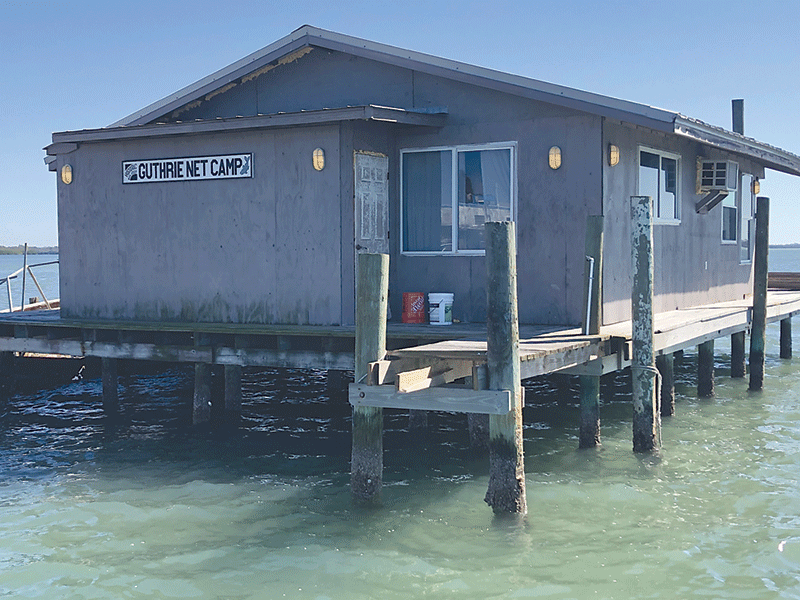
The fate of Raymond Guthrie Jr.’s stilt-house — built in the “kitchen” area of the Cortez bayfront — rests in the hands of Judge Edward Nicholas at a March 1 hearing on a motion for a stay of enforcement of his final order that the structure be demolished.
Guthrie filed the motion for a stay less than two weeks before a court-ordered Jan. 24 demolition deadline.
If the motion is granted, Guthrie and his supporters, including A.P. Bell Fish Co.-owner Karen Bell, will use the demolition extension to pursue legislative means of keeping the structure at its current location, yards off the A.P. Bell Fish Co. docks.
Regardless of the outcome, the Florida Department of Environmental Protection will be filing a motion for contempt, Shannon Herbon, DEP public information manager, wrote in a Feb. 15 email to The Islander.
If the state finds Guthrie in contempt, he could face jail time and monetary penalties.
Guthrie drew the DEP’s ire in 2017 when he built the 1,200-square-foot house — complete with lighting, air conditioning and appliances — on pilings over state-owned submerged land in Sarasota Bay. The DEP successfully sued Guthrie in 2019 and a demolition date was set for June 2020, but court-sanctioned extensions allowed the structure to remain.
Guthrie maintains the structure is an active “net camp” rebuilt by his family three times over three generations.
Net camps — barren stilt-shacks that sheltered cotton nets and fishing gear — were built over the bay in the early 19th century and dotted the waters off Cortez into the 1960s. They became obsolete in the 1970s with the implementation of monofilament nets, which didn’t require dry storage.
“It’s kind of confusing as to why anyone should build a net camp, since there are no nets to put in it, not since the 1995 net ban,” said Mary Fulford Green, a 95-year-old Cortez resident whose grandfather was one of the village’s original settlers. “And the big fish houses have attics for anybody that wants to store their cast nets, which are the only legal nets.”
A Florida constitutional amendment enacted in 1995 banned the use of gill nets, forcing fishers to rely on cast nets and some limited-use larger nets for offshore fishing.
Guthrie said Feb. 18 that no nets of any kind are stored inside the structure but have been in the past, mainly during fall mullet runs. The 2020 run is the last time Guthrie said he used the stilt-house for fishing activities.
Members of his family and the fishing community have used the stilt-house’s interior and exposed dock to mend and build nets, he said.
John Banyas, owner of Swordfish Grill and N.E. Taylor Boatworks, among other Cortez establishments, said Feb. 14 he has used the dock to do net mending with his son. He also said a Manatee County contractor ties derelict vessels destined for his boatworks to the structure as a staging ground when the works are full.
“It’s OK, in my book. I think it needs to stay,” Banyas said. “It serves a purpose. It’s useful and it’s part of the community.”
In addition to work, the structure also is used for play.
“You know there’ll be 10 or 15 people that get together and go out there for a few hours, barbecue and drink a few beers,” Guthrie said. “But as far as party, party, party — that ain’t happening.”
While net camps were not historically used for leisure activities, Guthrie said times have changed.
“It used to be that when they had cotton nets and everything out there, it was just solely used for that purpose. But nowadays, people like to be out on the water.”
Guthrie estimates the stilt-house construction cost him about $5,000. He said tearing it down would probably cost about the same.
If things go south for Guthrie at the hearing, Green, who lives along the Cortez shoreline near the old Fulford Fish House, has an idea that still might save the structure.
“I said to cousin Karen (Bell): What you should do is move it to shore,” Green said. “Cut it off, put it on a barge, move it up here — they’d have to put it 12 feet up — and it would be a nice house for somebody to live in.”