







Their goal is legal-ease of understanding.
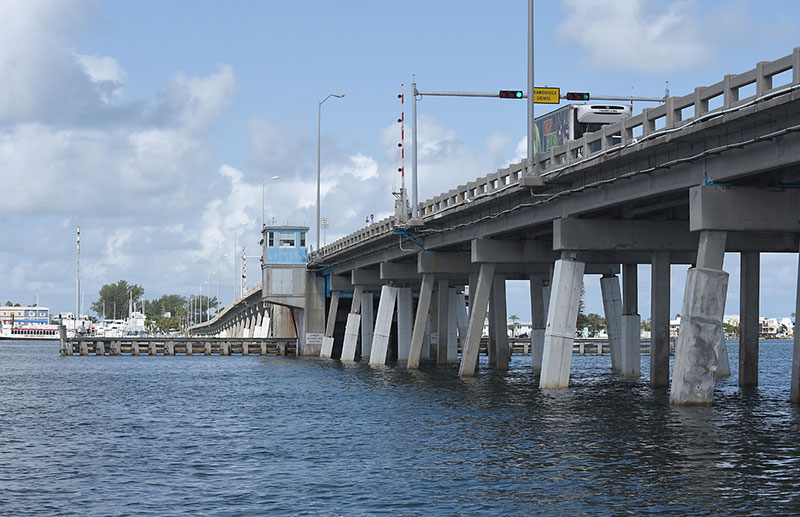
Ralf Brookes and Matt Farmer — attorneys for four complainants challenging the Florida Department of Transportation’s decision to replace the Cortez Bridge, a 17-foot-clearance drawbridge, with a 65-foot-clearance fixed-span bridge in 2026-27 — are clarifying their complaint. It is due to be filed in federal court Sept. 15.
The bridge over the Intracoastal Waterway connects Cortez on the mainland and Bradenton Beach on Anna Maria Island.
The anti-megabridge coalition jumped the gun Aug. 15 when they filed an amended complaint before filing a motion to do so.
The amended complaint, crafted by former County Commissioner Joe McClash — one of the complainants who helped forge the case for the anti-megabridge group to avoid legal costs — included the Florida Institute for Saltwater Heritage, a Cortez nonprofit, as a new party to the suit.
After the filing with FISH was stricken by the judge Aug. 19, the coalition removed the nonprofit, filed the judge’s required motion and requested a four-day extension to allow Brookes and Farmer to refine the pleading.
On Sept. 8, Judge Anthony E. Porcelli of the U.S. District Court in the Middle District of Florida granted the motion to amend the complaint and extended the deadline to file the pleading to Sept. 15.
“We’re very excited the court granted our motion and we’re working diligently to make a crystal-clear amended complaint that explains the facts of the law to the judge,” Brookes said Sept. 10.
An argument that will be worked into the improved complaint is the assertion that when the DOT was selecting its recommended replacement bridge, the agency improperly utilized a categorical exclusion to avoid conducting a lengthier analysis of the impacts of the high bridge on the natural and human environment.
“That’s the main focus of the case. The FDOT said they didn’t need to comply with the National Environment Policy Act,” Brookes said.
According to Brookes, NEPA requires a preliminary environmental study before the agency takes “significant action,” which would include constructing a much larger bridge than the existing drawbridge. If the first study indicates there may be a significant impact, a second, more detailed study is required.
“They avoided the whole process of looking to see if there is a significant impact and I think they would find that there is one if they actually look,” he said.
“They used this categorical exclusion that said, ‘based on our experience, this project will not have a significant impact.’ That’s all they said,” Brookes said. “Yeah, they may build bridges all around the state, but they don’t build bridges to historic commercial fishing villages that bisect the village in two.”
The fishing village of Cortez, one of few remaining in the state, has been on the National Register of Historic Places since 1995.
The high bridge would require the construction of retaining walls 20-feet-tall at their peak that would extend about 700 feet from the waterway through Cortez.