




It’s prime time for sheepshead.
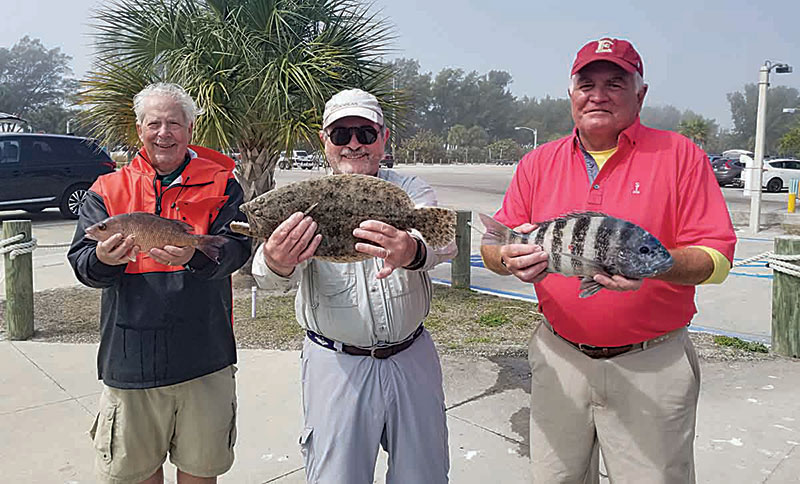
The sheepshead bite is near full swing for anglers on the waters around Anna Maria Island. Fishing structure in Tampa Bay and in the Gulf of Mexico is producing good action on sheepies of all sizes. Try to pick calmer days — with light breezes from the east — if you plan on venturing into the Gulf, allowing for an examination of spots on the reefs until you find a concentration of fish.
On breezier days, there also are options available. Fishing residential docks and seawalls can produce sheepshead action, too. Plus, you may find some redfish and black drum.
Another option is to work the natural contours on the beach, where the bite may require more of a search, particularly for areas not frequently renourished.
An abundance of sandfleas brings the sheepshead to the beaches. But most beaches that are renourished often appear void of the little crustaceans. Do your homework and you should find success. And, if you’re lucky, you may find pompano or black drum foraging, as sand fleas are in their diet, too.
For anglers hoping to find something other than sheepshead, the warmer days between cold fronts are triggering spotted seatrout to move out of their wintertime haunts to feed on deeper grass flats. When the waters are colder, spotted seatrout tend to seek deep water in canals or in the open waters of the Gulf or Tampa Bay to find a more steady, tolerable environment. In these waters, food for the trout may not be abundant, if it exists at all. So when water temperatures become favorable once again, the trout move back to the flats to feed. This creates an opportunity for the angler to find large amounts of trout — very hungry trout. Many hungry fish means plenty of action. This will apply to the snook bite in the upcoming weeks, as long as we don’t experience a cold March.
What did that groundhog say about winter?
On my Just Reel charters, I’m finding the sheepshead accommodating to my clients. Large spawning fish, 5-6 pounds, are being caught frequently as well as numerous smaller fish in the 2-3 pound range. I’m finding the best action on calmer days, when I can spend time working the artificial reefs in the Gulf of Mexico and Tampa Bay. On windier days, I’m fishing inshore around docks and canals, finding fish and a wind break, although the bite is not comparable to the reef bite.
Capt. Warren Girle also is finding a good sheepshead bite while fishing reefs and wrecks in the Gulf of Mexico. He reports that live shrimp on a knocker rig is resulting in many hookups on the convict-striped fish. Most catches are 2-3 pounds, although larger fish are mixed in for the lucky angler.
While targeting the sheepies in the Gulf, Girle is seeing Key West grunts, juvenile grouper and a few mangrove snapper. Moving inshore on the flats of Sarasota Bay, Girle is finding respectable numbers of spotted seatrout. Drifting and jigging with soft plastics or using live shrimp under a popping cork is yielding good numbers of these species. Mixed in with the bite is an occasional jack crevalle or ladyfish.
Capt. David White’s clients are putting their share of sheepshead in the baitwell while working nearshore structure. Using live shrimp on a bottom rig is leading White to many 2-5 pound sheepshead. Calm, days are yielding a better bite. Accessibility to the structure in open water is key to finding good numbers of fish, says White. On windier days, White is putting a trip together by fishing sheltered areas — docks and canals — where sheepshead are munching on barnacles and some redfish and black drum also are hooking up.
Jim Malfese at the Rod & Reel Pier says sheepshead are starting to arrive, although the masses of striped fish that commonly congregate under the pier have yet to make a showing. Malfese anticipates the sheepie bite to turn on in full swing in the next couple of weeks. Right now, pier anglers using live shrimp are catching a few sheepies, as well as an occasional black drum. Once the sheepies take up residence to nibble the barnacles off the pilings under the pier, the real bite will occur. Keep a watchful eye out for this bite. It’s a good one.
Send high-resolution photos and fishing reports to fish@islander.org.