







A Fort Myers company in late March completed a deep injection well to hold wastewater from the Piney Point phosphogypsum stacks in east Manatee County.
The well completion came two years after the county and state decided to release millions of gallons of polluted water into the Tampa Bay ecosystem to avert a larger disaster — the collapse of a toxic stack system at the defunct plant.
Manatee County Utilities crews were ready to move the wastewater the week ending April 2 into the injection well, drilled 3,300 feet below the surface by Youngquist Brothers Inc. under a Florida Department of Environmental Protection permit.
“The cooperation and collaboration with the DEP have been key in getting this project fast-tracked,” Manatee County Utilities director Evan Pilachowski said in a news release. “We are so pleased that we are to this point in the process already.”
The county said the well “will be used to safely dispose of Piney Point’s process water into a confined saltwater aquifer over a half mile below the surface. That process water — which will be drained from the reservoirs atop nearby phosphogypsum stacks — will be pretreated before injection.”
Work on the pretreatment facility began earlier in 2023.
For decades, Piney Point has been an environmental hazard in terms of air, ground and water pollution. The site contains a massive phosphogypsum stack system with containment ponds, liners and cooling systems to handle the waste generated by the defunct fertilizer operation.
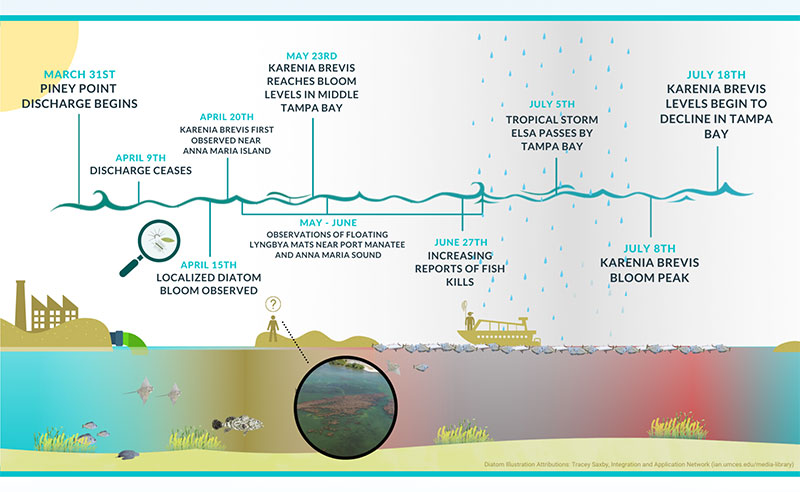
Two years ago — March 25, 2021 — on-site management at Piney Point observed and began monitoring what was described as “seepage” that intensified to a point where monitors asked the DEP to allow a controlled release of wastewater into Tampa Bay.
DEP, with concern about the stability of the gypsum stack and to avoid injury or severe property and environmental damage, authorized the release to begin March 30, 2021.
The county’s environmental division manager, Rob Brown, issued a statement at the time: “The water is not toxic. The real harm is the potential for excessive nutrients to reach Tampa Bay. Nutrients can cause algae blooms and exacerbate red tide and when we see red tide outbreaks, they may cause fish kills.”
And that’s what happened, according to many conservationists and scientists working in the region.
Since spring 2021, there has been an effort to prepare to remove the wastewater from Piney Point and close the site.
Meanwhile, a coalition of environmental groups pursued legal complaints over Piney Point — a federal lawsuit against Gov. Ron DeSantis, the secretary of the Florida Department of Environmental Protection, HRK Holdings LLC and the Manatee County Port Authority for the 2021 release of polluted water and also a federal challenge over the deep well.