






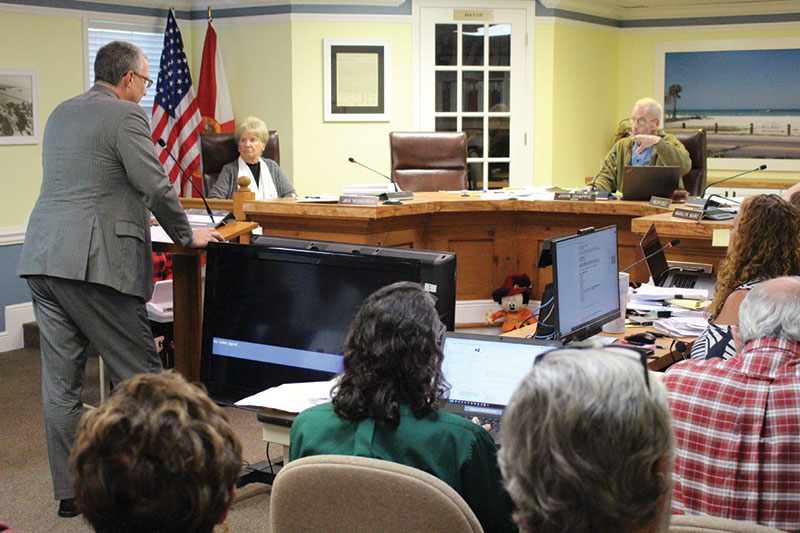
Bradenton Beach commissioners voted Nov. 16 to advance a Bridge Street resort development that promises to transform the commercial district.
The Bradenton Beach Planning and Zoning Board, on a motion by vice chair John Burns, unanimously recommended Nov. 13 that the city commission approve the major development application along with an ordinance amending the zoning atlas for the 1.61-acre site, provided certain conditions are met.
The planning and zoning board recommended changes to accommodate the resort, with up to 106 rooms, a restaurant and retail space on Bridge Street and Third Street South at Gulf Drive.
The city commission will hold a second hearing and is expected to take a final vote on the matter at 6 p.m. Thursday, Dec. 7, at city hall, 107 Gulf Drive N.
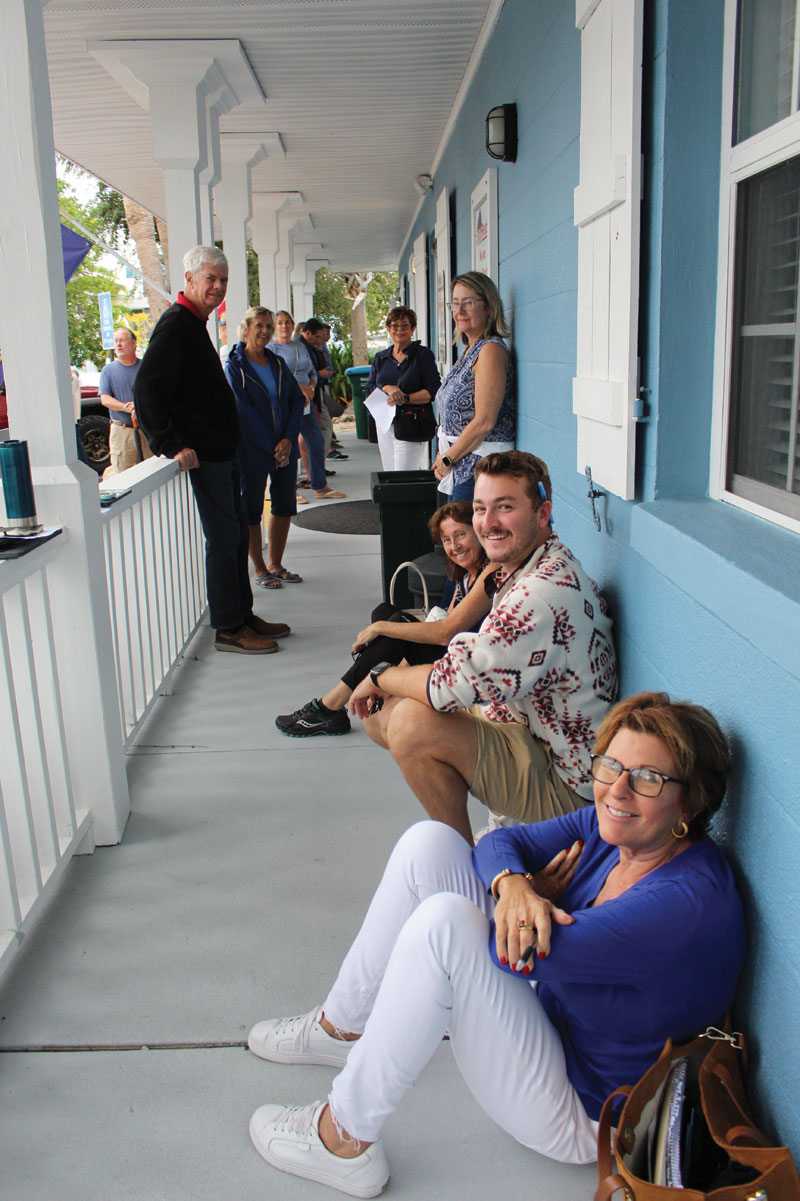
The commission approval followed the hearing at which 20 people spoke.
Some properties involved are owned or leased by developer Shawn Kaleta and Najmy-Thompson PL.
Other involved properties — 108 Third St. S.;110 Third St. S., Unit W;112 Third St. S. and 117 Bridge St. — are registered to Commissioner Jake Spooner.
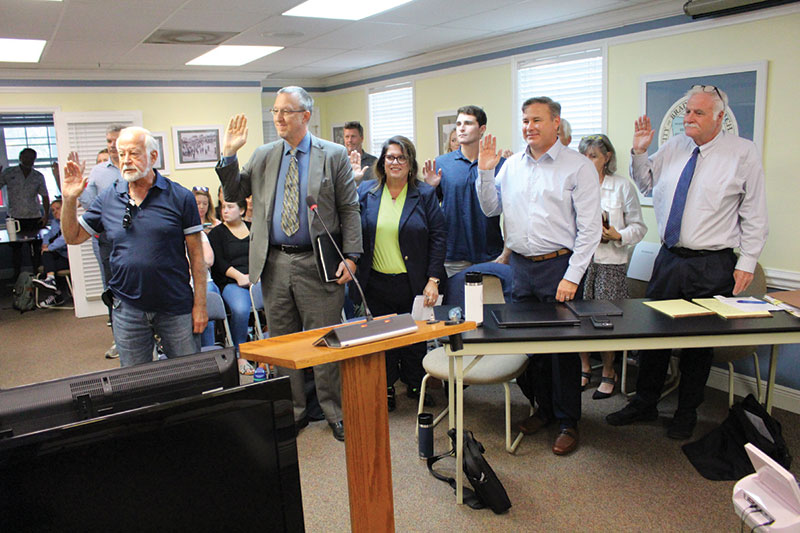
Spooner, who was absent from the Nov. 16 resort meeting and the Nov. 17 swearing-in of commissioners due to illness, had previously filed paperwork to recuse from voting on the resort.
The proposed development has stirred controversy since plans became public about a year ago.
The resort group is asking the city to consider the project as a planned development, meaning typical zoning and codes would not apply, easing the way for final approval by the city commission.
The development team — attorney Steven Thompson of Najmy-Thompson PL, traffic consultant Nathan Poole, architect Shaun Luttrell of Luttrell Architecture and planner Susan Swift — said the hotel would bring economic growth, tourism and jobs.
Critics of the project, including those who launched a petition drive against it, maintain it will destroy the small-town character of the city and negatively impact the already congested commercial corridor.
City staff recommended approval of the application, which city planner Louis Serna presented to commissioners and, before them, the P&Z recommended approval.
Serna said the planned development is to provide “a flexible zoning overlay with a submission of a custom plan of development for the site” and the proposal is in line with the comprehensive plan.
“The Bridge Street mixed-use overlay district is intended to be the most intense land use category in the city,” Serna said. “The subject parcels and the surrounding community are also located in the community redevelopment agency district, which is an area that is statutorily established to eliminate and prevent conditions of blight.”
Building official Steve Gilbert observed that some of the structures in the development plans have been in disrepair for years.
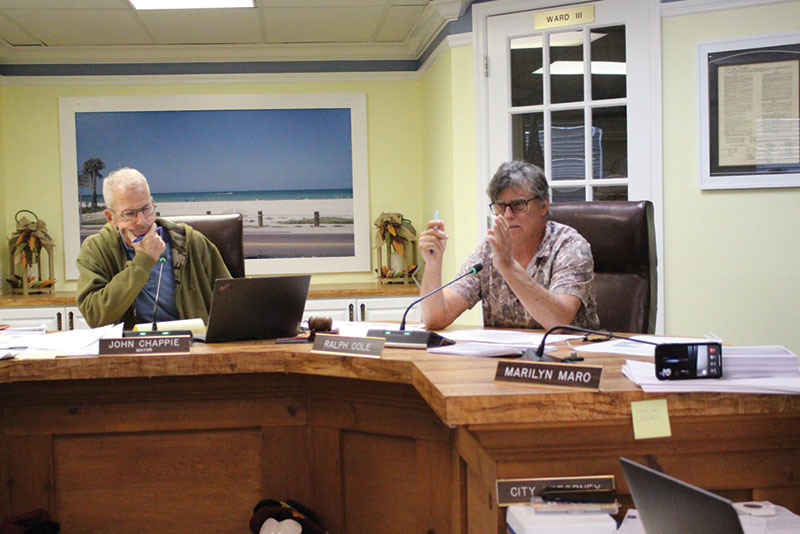
Commissioner Ralph Cole asked if allowing the planned development might set a precedent for other large-scale developments.
“Each development gets weighed on its own merits because their need may change,” Gilbert said. “So setting one PUD in place does not automatically give the same waivers to everyone else.”
Other questions and answers dealt with density and parking.
For the applicant, Swift said a floor-area-ratio should determine the allowable number of rooms.
FAR is used to evaluate the intensity of a project using a building’s square footage in comparison to lot size.
But Misty Servia, a former county commissioner who spoke on behalf of some challengers to the project, said 18 hotel units are allowed per acre in the city per the comp plan and the proposal is “clearly inconsistent.” She said the plans call for 66 units per acre.
Cole said, “It’s in question because I have heard two different testimonies and I don’t know what to believe.”
City attorney Ricinda Perry advised, “It’s up to you, the decision-maker, to decide which interpretation is in the best interest of the city.”
The applicant also wants relief on parking, with 133 spaces required for a 106-room development, but providing only 99 spaces.
Luttrell and Cole engaged in a back-and-forth on parking.
“You’re in an area that’s already congested,” Cole said. “I think it’s important that there is plenty of parking for what’s there.”
“We have one chance to get this right,” Cole added. “I’ve made my say, I think you know what I am looking for… a reduction in some of the number of units and the impact.”
“When it comes to parking, which is the big hurdle here. We’ve got two options,” Luttrell said. “We either find more parking or a reduction of the units. We can certainly reduce the units by making them larger, so we have a handful of luxury suites. Right now, these are all basically very simple guest rooms.”
Mayor John Chappie, who commented the proposed resort is “really great,” added, “This is a part of that continued path of when we created the CRA. This could be a significant part of that plan.”
After more than six hours of discussion, Commissioner Jan Vosburgh motioned to approve the first reading of the ordinance.
Chappie, as he asked for each commissioner’s vote, said Commissioner Marilyn Maro’s call had dropped from the meeting.
Maro, absent since Jan. 19, attended the Nov. 16 meeting by phone, but by the time Vosburgh made her motion, she had either hung up or disconnected.
The vote was 3-0, with Vosburgh, Chappie and Cole voting yes. Maro did not vote.
Section 10 of the city charter states that “an affirmative ‘supra-majority’ (at least four out of five members) vote of the city commission shall be required to approve any comprehensive plan amendment (including map or text amendments), rezoning, special exception, variance or vacation of any city rights of way. This authority may not be delegated to any other individual or entity.”
Neither the commissioners, mayor or city attorney commented as to Maro’s failure to vote.
For the record
The Bradenton Beach City Commission’s public hearing Nov. 16 on a resort project that will transform Bridge Street brought to the city hall podium people of varied interests addressing various issues.
Some showed enthusiasm for the project and an anticipated boost to business in the commercial district and others fear for the impact on Bradenton Beach’s small-town vibe.
Some commenters said they wanted the project to move forward so dilapidated buildings would be replaced. Others raised concerns about traffic, parking, infrastructure and the environment.
Several people employed by Prime Vacations Anna Maria, a company owned by developer Shawn Kaleta, backed the project, including director of owner services Lisa Coba, property acquisitions associate Sam Negrin, vice president of growth and development Eric Pullen and COO John Munn.
“You look at Bradenton Beach and you have Bridge Street at the absolute heart of it. Yet, for some reason, we allow a good quarter to 50% of it to remain with these derelict buildings that are vacant with homeless people occupying them and that to me doesn’t make much sense. For that reason, I truly think that it’s a great idea to begin the redevelopment process.”
— Sam Negrin
Other comments from the hearing:
“I think, at the end of the day, the balance that’s got to be found is allowing the island to evolve and keeping the charm and the things that make this island so special.”
— John Munn, Holmes Beach
“I also don’t like dilapidated buildings. However, there is no rule that says either 106-unit hotel or a dilapidated building. There is something in between. Development is great as long as it is right-sized for our community.”
— Elisabeth Owen, Bradenton Beach
“I am not against the hotel. What I am against is the size of the hotel. I agree we need something there. I just plead for you to take the time to make it right because we only have one chance.”
— Christine Johnson
“Parking does seem to be short. I feel parking is an issue. If they can resolve that, God bless them.”
— Evelyn Stob, Bradenton Beach
— Compiled by Robert Anderson
At the P&Z
The Bradenton Beach Planning and Zoning Board, on a motion by vice chair John Burns, unanimously recommended Nov. 13 that the city commission approve the Bridge Street Resort’s major development application provided the following conditions are met:
- City commission approves the major development plan/site plan accompanying the application;
- Development of the property shall be consistent with the major development plan;
- The use of hotel top deck is limited to hotel staff and guests, with no food or beverage service;
- Live entertainment, food and beverage only would be allowed or permitted through a special event permit and approved by the city commission;
- Guest drop-off and check-ins shall be accommodated within first level of the parking garage;
- Applicant shall demonstrate to the satisfaction of the city building official that the loading area can accommodate deliveries from a semi-trailer to receive a building permit;
- Applicant cannot use parking spaces wholly or partially on public rights of way to meet the required parking;
- To the extent the applicant cannot accommodate or seeks to reduce the number of parking spaces, they shall use the special use permit process;
- The applicant shall provide landscaping, a physical barrier and existing landscape easement along Gulf Drive.
— Robert Anderson