




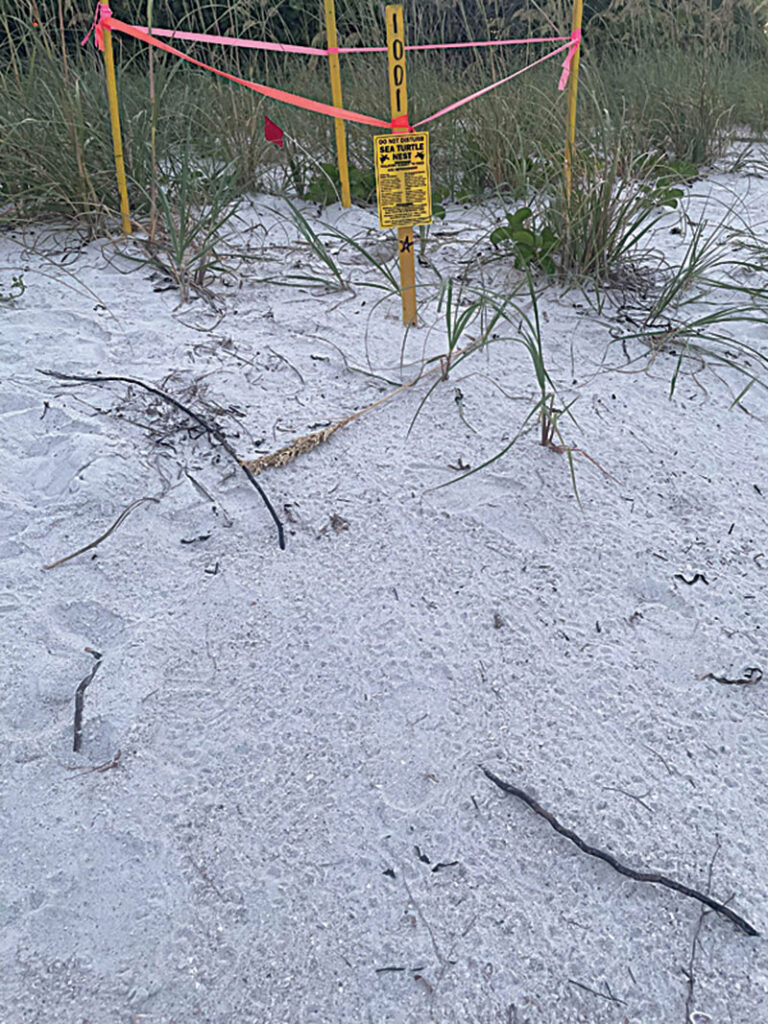
Anna Maria Island beaches contain more than 400 sea turtle nests while two early nests hatched out on July 3.
Yes, it’s hatch time for this year’s sea turtle nesting season.
Loggerheads, the sea turtle species most common for AMI, create a pit in the sand to deposit about 100 eggs — each one about the size of a golf ball. Each nest, wider at the bottom and narrower at the top, will reach a depth of around 21 inches.
The female turtle will camouflage the nest and return to the Gulf, leaving the clutch to incubate for about 60 days.
Hatchlings emerge from the nest, usually at night, in what’s called a boil.
They’ll use a temporary, sharp egg tooth called a caruncle to break the shell. This process can take several days.
Once most of the hatchlings in the clutch have broken free from their shells, a surge of oxygen demand in the chamber triggers a collective, synchronized effort to reach the surface.
After erupting onto the sand, they’ll orient toward the brightest, most open horizon and crawl to the surf.
Understanding these natural behaviors can help humans protect the vulnerable hatchlings, as only one in 1,000 hatchlings will survive to adulthood.
The risks begin immediately after their emergence from the eggs.
How can beachgoers and waterfront residents help?
There are several ways, according to the Florida Fish and Wildlife Conservation Commission and Anna Maria Island Turtle Watch and Shorebird Monitoring:
- Before heading home each day, dispose of or recycle all trash. Food scraps attract predators, such as raccoons and crows, which can prey on sea turtle hatchlings, as well as shorebird eggs and chicks.
- Fill in human-made holes in the sand, which could trap turtles.
- Remove all toys, beach gear and furniture from the sand. Obstacles on the beach can entrap sea turtles.
- Fishing line can be deadly to sea turtles, waterbirds and other wildlife, so be sure to dispose of it properly.
- Turn off lights visible on the beach or close curtains and blinds after dark to ensure nesting turtles and hatchlings do not become disoriented. Lighting can misdirect and disturb sea turtles, leading them away from the Gulf and toward potential danger.
- Keep pets at home or on a short leash and far away from wildlife. Pets are prohibited on island beaches.
It’s elementary: Class lessons from AMITW, AME
Anna Maria Island Turtle Watch and Shorebird Monitoring, during the 2024-25 academic year, invited teachers and students at Anna Maria Elementary School in Holmes Beach to compose questions about sea turtles, shorebirds and AMITW’s work on the beaches. This summer, the Islander is sharing AME’s questions and AMITW’s answers.
Teacher Stephanie Davis’ fifth-grade class: What do you call a group of sea turtles?
AMITW: A group of sea turtles is called a bale.
Also, a nest of sea turtle eggs is called a clutch.
Talking turtles
The city of Holmes Beach is hosting Anna Maria Island Turtle Watch and Shorebird Monitoring for weekly talks about sea turtle and shorebird nesting.
Sea Turtle Tracks and Shorebird Facts talks continue most Mondays at 10 a.m. through August at city hall, 5801 Marina Drive.
For more information, call turtle watch at 941-301-8434 or go to www.islandturtlewatch.com.