




Don’t miss your window of opportunity for good fishing
With last week’s cold front sweeping across Anna Maria Island, fishing patterns were all over the boards. Not for better, and not for worse, these changes help trigger some fish to head deeper into the bays, the Manatee River and the Intracoastal Waterway.
So you’ve done your homework. You’ve followed the fish as they moved from one feeding spot to the next before settling down in their wintertime haunts. Now the question is getting them to bite. You may experience “sitting on the fish” without getting a bite, especially on colder days. If so, look at the time when you’re trying to catch these fish. Early in the morning often proves prosperous on cooler days.
However, it can pay off to wait until the sun is straight up to target fish during the warmest part of the day. If you plan this time of day to coincide with the perfect tide and no wind, you’re golden. Then it’s just up to you.
If you’re targeting reds and snook, live and artificial baits are getting action. Live shiners weighted with a small split shot to slow them down will produce a bite. For artificials, soft plastics, especially the scented ones on a jig head, will get you connected. Don’t forget when working jigs in cooler water temps, its best to slow down your retrieve. Let that jig just sit in front of a snook’s nose — he want be able to stand it for long — and whomp — he eats it.
Lastly, although there are still a lot of pinfish in the grass flats and around docks, there are sheepshead and black drum making a showing. It wouldn’t hurt to put a flo-trill with a couple dozen shrimp inside in your bait well with the shiners, in the event these fish present an opportunity.
Capt. Rick Gross of Fishy Business Charters is targeting redfish and snook during high tides. By free-lining live shiners over sandy potholes throughout the flat, Gross is finding keeper-size reds. As for the snook, most are under-slot, but the sheer number of hookups makes for the side. There’s plenty of rod-bending action.
As the tide drops, Gross is moving to deeper grass flats in search of spotted seatrout. By casting live shiners, Gross is catching good numbers of slot-sized trout. While catching trout, Spanish mackerel, ladyfish, flounder and mangrove snapper are being reeled aboard. This adds diversity to the catch as well as a mix of fillets to take home for dinner.
Finally, while fishing the Gulf of Mexico, Gross is finding Spanish mackerel, bonito and a few kingfish. These species are lurking around nearshore structure where baitfish are plentiful. Also in these areas, Gross is finding keeper-size mangrove snapper, flounder and juvenile grouper.
Capt. Aaron Lowman at Island Discount Tackle is hooking up clients with spotted seatrout in Anna Maria Sound. To catch these fish, Lowman is drifting over the grass flat and jigging Berkley Gulp shrimp through the sandy potholes. By using a quarter-size jig head combined with a soft plastic, Lowman is landing trout in the slot of 15-20 inches. Larger fish are mixed in, although tough to come by. While jigging the flats, you can also expect to encounter jack crevalle, ladyfish, Spanish mackerel and, if you’re lucky, an early-arrival pompano.
On higher tides in the heat of the day, Lowman is venturing to shallower flats, especially those around oyster bars and mangrove edges. In these areas, Lowman sets up for free-lining live shiners, resulting in snook and redfish.
Finally, along the beaches of Anna Maria Island, Lowman is targeting migratory fish, such as bonito and Spanish mackerel. Both species are responding to live shiners combined with a long shank hook. It’s possible to encounter a stray kingfish in the mix, too.
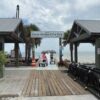
Jim Malfese at the Rod & Reel Pier says the black drum have arrived and are biting on live shrimp. Unwary anglers fishing with live shrimp are quick to get their rods bent on a feisty drum. Limits of fish are being caught daily, with most fish 16-20 inches. Fish exceeding 24 inches are also available.
If you arrive early in the morning, watch for Malfese to start cleaning out the bait tank. He gathers up any dead shrimp in the tank and tosses them into Tampa Bay, which almost always chums up some action. It results in a feeding frenzy amongst the drum. A live shrimp cast into the fray is a sure fire way to get hooked up.
While targeting black drum, expect to hook up sheepshead and flounder, too, mixed in with the drum under the pier. Keeper sheepies are being reeled up, although keeper-size flounder can be a challenge.
Capt. Warren Girle is fishing nearshore structure despite a light chop on the Gulf of Mexico. Braving these seas is paying off for Girle, as he is being rewarded with limits of mangrove snapper. Live shiners dropped to the depths on a bottom rig is resulting in fish averaging 14-16 inches, and bigger fish are mixed in. While targeting snapper, juvenile grouper, as well as some keeper flounder, are being hooked.
Moving inshore, Girle is finding an abundance of spotted seatrout. Live shiners fished under a popping cork are resulting in numerous strikes from fish averaging 14 inches, while slot-size fish are also in the mix.
Finally Girle is finding rallies on redfish. Smaller reds are migrating throughout Sarasota Bay, which is providing great light-tackle action for Girle’s clients. Although these reds are in the 16-inch range, catching more than a dozen in one spot can wear out your arm. Slot-size fish are being caught and filleted upon return to the dock.
Send high-resolution photos and fishing reports to fish@islander.org.