





Rain, rain, go away.
And, please, let our sandy beach stay.
Rainstorms barraged Anna Maria Island in July, sending down some 6.8 inches of rain during the month, hiding the sunny sky behind a cover of gray clouds.
Large puddles formed on city streets as the stormwater was slowly absorbed or flowed from streets and lawns into the surrounding waters. It’s common to see stormwater standing in roads and intersections during high tides, as storm drains back up with saltwater.
Water levels rose. Waves crashed against the Gulf of Mexico shoreline.
Seemingly with each wave, as water reached farther ashore on island beaches, sand was pulled back, taken from the shore.
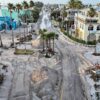
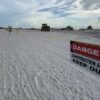
The disappearing sand is most noticeable at the Anna Maria City Pier, 100 S. Bay Blvd. Where white sand used to stretch from the boardwalk into Tampa Bay. All that remains now could barely be called a beach.
During high tides near the pier, there is nowhere to walk on the beach.
At low tides, people can walk along the bayfront, but exposed rocks and concrete rubble line the shore, creating new dangers.
Anna Maria public works director George McKay said the beach is in critical condition and something needs to be done. “When this happens we normally renourish the beach with sand from the inlet at Lake LaVista,” he said.
McKay said when contractors dredge the inlet, the most common practice has been to pump the sand and silt from the bay to the beach near the pier or to a reserve pile at the south end of Anna Maria Bayfront Park, 316 N. Bay Blvd.
Anna Maria Mayor Dan Murphy said an ongoing project by the West Coast Inland Navigation District is preventing the city from dredging more sand to renourish the beach.
WCIND is studying the inlet to find a permanent solution to the need for repetitive dredging.
Frequent dredging has been necessary to maintain navigation for boaters using the inlet.
“If we go in there and dredge the inlet, we’ll mess up the results” of their study, Murphy said. “We were told we’d have to wait at least two months — until the project is finished — before we can dredge.”
Justin McBride, WCIND executive director, said the district asked the city to hold off dredging until its project is completed, but the district project has yet to get underway.
“We’re waiting for the all clear from the city engineer. All of our permits are in place but we haven’t gotten the ‘OK’ to start,” McBride said, adding that he’s trying to contact Lynn Burnett, the city’s engineer, to get the project and the contracts moving.
According to McBride, studying Lake LaVista, the inlet and the jetties, could take up to 16 weeks.
Murphy said the city is working on ideas for how it can renourish the beach without influencing WCIND’s study.