





The answer, my friend, is blowin’ in the wind.
Lynn Tran and husband, Richard Hazen, owners of a beachfront tree house in Holmes Beach, might see their five-year battle with the city in the lyrics of Nobel in Literature winner Bob Dylan.
Tran applied Sept. 30 for an after-the-fact accessory structure permit.
“We’d like a resolution, that’s for sure,” Holmes Beach building official Jim McGuinness said Oct. 14, adding the permit is in review.
At press time Nov. 18, the city had not responded to the application.
Tran’s application for a city permit is a first for the owners, who’ve taken a circuitous route over the years through city code enforcement, the state’s environmental regulator, the courts and now back to the city.
At each juncture, the city has prevailed.
Tran’s philosophy after the long process without a win: “If it’s meant to be here, somehow things will work out.”
Background
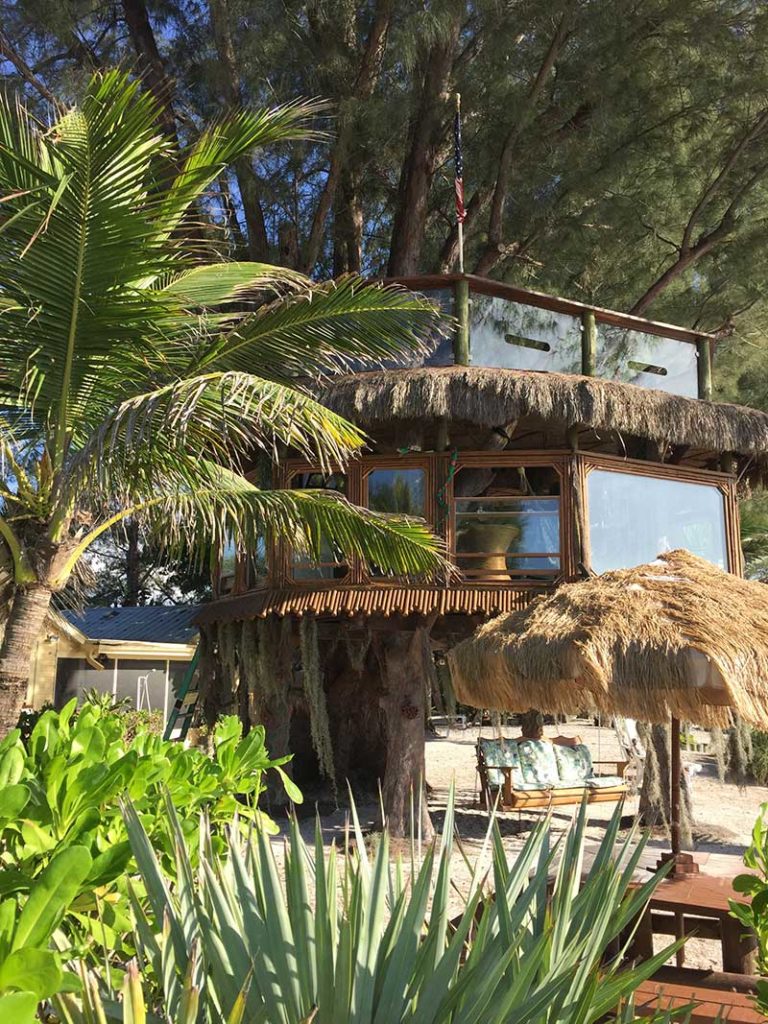
In 2011, Tran and Hazen built the elevated two-level structure in an Australian pine, with removable windows — no plumbing, but with solar electric paneling — at 103 29th St., where they live and operate a four-unit resort, Angelinos Sea Lodge.
Tran and Hazen read, relax and exercise in the tree house.
Before starting its construction, they inquired about a permit. According to Tran and Hazen, the then-building inspector advised no permit was needed. They did not submit plans or request a review of their plans.
In November 2011, the city received an anonymous complaint about a tree house under construction.
Code enforcement issued a violation and referred the matter to the Florida Department of Environmental Protection, which, in January 2014, denied an after-the-fact permit. The city refused to submit a no-objection letter to the DEP.
Both city and state permits are required for coastal construction.
Until Tran’s permit application, the city has been focused on the tree house code violations.
In July 2013, the code enforcement board ordered the owners to remove the structure or correct the violations — including a 20-foot encroachment in a 50-foot city setback — and pay $4,241 in costs plus fines.
Tran and Hazen, with Sarasota attorney David Levin of Icard Merrill, appealed the order to the 12th Circuit Court, and in 2014, Judge Janette Dunnigan upheld the code board order, finding it unreasonable for the owners to rely on a city inspector’s nonspecific verbal OK.
Levin next took the code board case to the 2nd District Court of Appeal, which declined to review the case in 2015.
In May 2016, the city magistrate reviewed the case and imposed a fine against Tran and Hazen of $50 daily from July 22, 2015 — the day the 2nd DCA denied the appeal. To date, the fine has climbed to $24,500.
The owners initially noticed an appeal of the magistrate decision, but 12th Circuit Judge Gilbert A. Smith dismissed the case Oct. 19 for failure to file an initial brief — an appeal Tran says they have abandoned.
The attorney handling all tree house cases for the city is Jim Dye of Dye, Deitrich, Petruff & St. Paul of Bradenton, the same firm as city attorney Patty Petruff.
In August 2013, Dye filed suit to stop an effort to grandfather the tree house by a citywide vote.
After Tran and Hazen collected voter signatures and presented the city clerk with the petitions, Dye contended the ballot question amounted to a “development order” prohibited by a 2013 state statute.
Twelfth Circuit Judge Don T. Hall agreed with Dye in its Aug. 15 decision.
That decision is currently on appeal in the 2nd DCA and Levin has until Nov. 30 to file an initial brief.
City permit bid
In the September permit request to the city, Tran submitted documents on materials used, including windows on the first deck, construction checklists, a signed owner/builder disclosure, a coastal engineering study, structural engineering plans, construction photos and a December 2011 survey.
Plans from R&S Professional Engineering of Ellenton dated Aug. 28 note the tree house conformance to the Florida Building Code, including pilings, railings and corrosive resistant components.
Filed with the permit are plans stamped by Sego & Sego Structural Engineering and Interior Design of Anna Maria, including as-built sketches drawn by Hazen.
A list of materials includes:
- Two 12-inch diameter pressure-treated wood posts embedded 6 feet below grade.
- Deck framing 2-by-6-foot of pressure-treated southern yellow pine.
- Two deck support beams.
- Galvanized or stainless steel hardware.
- Railings with 3/8-inch tempered glass and removal clips.
- Flame-resistant thatch panels.
Tran also submitted a 2012 letter from Erickson Consulting Engineers of Sarasota to the DEP, concluding the tree house was “a minor activity” under state coastal construction rules.
In her Sept. 30 letter to McGuinness, Tran described the project as “an open structure that allows rain water to drip through the tree branches through the deck to the sandy soil below.”
In the permit application, Tran estimates the project cost $28,000.
Tran said “that’s just for the structure,” not including engineers, surveys and other related costs. According to the Dunnigan decision, the owners estimated the cost at $30,000-$50,000.
Attorney’s fees for Tran-Hazen have been estimated at $10,000-$20,000 per proceeding.
The city reports the Dye firm was paid $76,935.94 as of Nov. 7. The city paid $3,276 to magistrate Kelly Fernandez.