





With nothing but a few minor cold fronts, this winter is feeling more like spring. And you don’t hear me complaining.
With springtime weather dominating, fishing the island waters is winding up better than average for January. Live shiners are still available for bait on the local flats. Catch-and-release snook fishing is quite productive in the back country and I’m seeing schooling redfish on the grass flats. These scenarios generally don’t occur in January, so having these opportunities now is a blessing. How can you not love Florida?
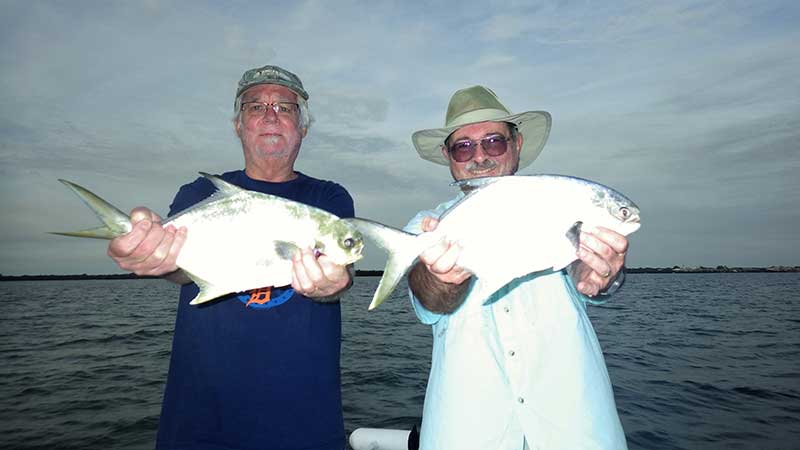
For my Southernaire fishing charters, I’m targeting the elusive pompano. With a little luck and also knowing where to fish, I’m hooking up with these famous light-tackle fish. Pompano can be hard to “nail down,” as they are constantly on the move. Like the old saying goes — “here today, gone tomorrow.” That’s pompano fishing. So knowing where to look is important and being lucky is imperative.
Once the pompano are found, I’m casting small pink or chartreuse jigs tipped with small pieces of fresh-cut shrimp. The bouncing of the jig, the puffs of sand on the bottom and the scent coming off the shrimp is resulting in ferocious bites followed by erratic runs and skips across the water that only end when the fish is in the landing net. On good days, limits of pompano are finding their way into the cooler and a fry pan.
Pompano are a prize for light-tackle anglers. They are considered by most to be the best of the best on the plate and, when hooked on light tackle, their fight can be matched by no other fish of the same size. Also, pompano can be taken from shore or by boat, which makes them available to everyone. Fishing along the beaches with live shrimp or sand fleas is a popular way to target these fish. Walking the beach while jigging is effective, too. You also can find pompano throughout the grass flats as they forage on small shrimp and other crustaceans. Typically, while fishing the flats, a jig is most effective, although they can be taken on the simplest of rigs — a shrimp and a popping cork.
Lastly, pompano sometimes like to gather in inlets and passes. Fishing Longboat Pass between Anna Maria Island and Longboat Key and New Pass at the south end of Longboat Key can be most effective. In these instances, “cannonball” jigs work best because the large round balls are heavy enough to reach the bottom in a current. Again, tipping these jigs with shrimp is a good idea.
Capt. Aaron Lowman is working in southern Sarasota Bay for pompano. By drifting and jigging over deeper flats, Lowman is putting clients on pompano as well as other migratory species — jack crevalle, ladyfish and bluefish. Tipping small jigs with fresh-cut shrimp is Lowman’s secret to success. These small pieces of shrimp add just enough scent to the jig to make it irresistible to an elusive pompano. Drifting while fishing also is effective. It helps the angler cover a wider area of water, which, in theory, will aid in finding the bite.
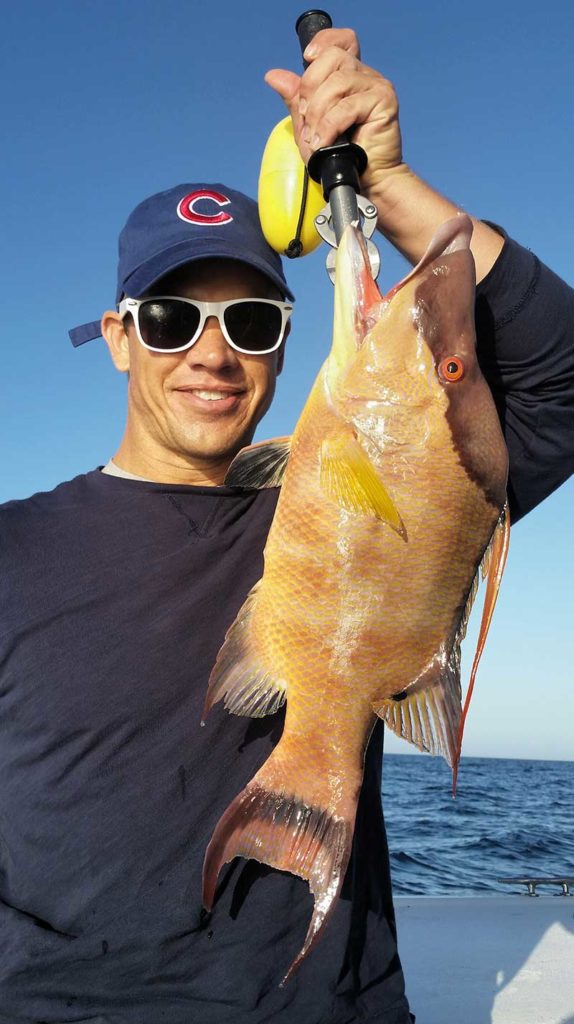
Moving offshore, Lowman is using live shrimp as bait, putting anglers on hogfish, porgies, red grouper and triggerfish. For rigging, Lowman likes to use a 1/2- to 1-ounce knocker rig paired with a circle hook.
Capt. Jason Stock is running clients offshore for amberjack. Rather than use live bait to catch these fish, Stock is taking advantage of their sheer aggressive nature and casting top-water poppers to trigger the bite. Working these poppers across the surface quickly creates a lot of splashing and the erratic behavior can prompt the amberjack to aggressively strike the lure. Then the battle is on. Amberjack up to 30 pounds are being taken in this manner.
Live bait also is proving successful offshore for Stock. Blackfin tuna, kingfish and gag grouper are being caught on live threadfin herring, pinfish and large shiners. Hogfish are being caught, too, on offerings of live shrimp on a bottom jig.
Steve Leonard at the Rod & Reel Pier says sheepshead are beginning to make a showing at the pier. Although they are not abundant like they will be in February, if the water turns colder, anglers are pleased to find these tasty fish lurking around the pilings. Live shrimp, fiddler crabs and sand fleas are the baits of choice.
Other species being caught at the R&R include flounder, black drum and an occasional mangrove snapper — all coming to the hook for a live shrimp.
Capt. David White of Anna Maria Charters is lining up inshore around docks and canals. By casting live shrimp combined with a size-1 hook and a couple of split shots for weight under and around docks, he’s putting anglers on sheepshead, mangrove snapper and black drum. According to White, dock fishing is proving productive for filling the cooler.
Moving offshore, White is finding numerous amberjack. Also snapper — lane, yellowtail and mangoes — are being caught in abundance. For bait, White is using live shiners, although on days when the fish are finicky, he’s finding frozen squid is attracting a bite. He’s using a 2-ounce fish-finder rig, combined with a Mutu Circle hook.
Lastly, jigging the passes for pompano is yielding results for White and his clients. White likes using a Doc’s Goofy jig tipped with a small piece of fresh-cut shrimp to attract a bite — and it works.
Send high-resolution photos and fishing reports to fish@islander.org.