





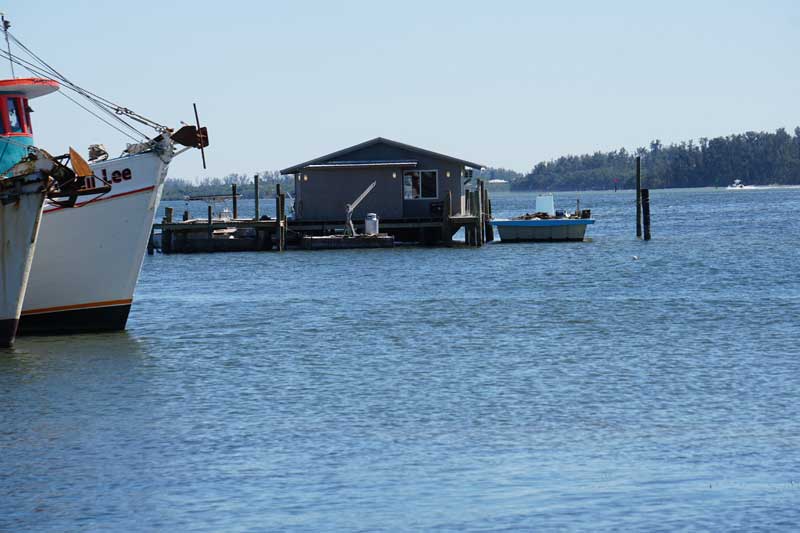
The Florida Department of Environmental Protection ordered Raymond “Junior” Guthrie Jr. to remove his house on stilts in Sarasota Bay — and, thus far, has assessed $6,500 in fines.
Mary E. Yeargan, the agency’s southwest district director, signed a notice of violation, orders for corrective action and administrative penalty assessment Oct. 19, giving Guthrie 21 days after receiving the order to remove the house or file an appeal.
The DEP sent the notice/orders/assessment to Guthrie’s Cortez post office box Oct. 24 via certified mail.
Shannon Herbon, DEP public information manager, said the order was sent after Guthrie failed to agree to the DEP’s proposed consent order.
Neither Guthrie nor his representative, Joanne Semmer, president of Ostego Bay Environmental Inc. of Fort Myers, had received the document as of press time for The Islander.
Guthrie, with the help of Capt. Tom Mora, built the structure in early 2017 in Outstanding Florida Waters — an area designated for special protection due to its natural attributes. The structure sits about 300-400 feet from the A.P. Bell Fish Co. fish house.
Guthrie, known locally as Junior, told The Islander in May he built the structure in the water for seagrass experiments “just trying to help the sea life around here.”
The DEP notice of violation concludes that permits were required before building the enclosed structure on state-owned submerged lands.
The DEP inspected the structure May 25 and, in May and June, ordered Guthrie to halt construction due to possible state law violations.
The DEP corresponded with Guthrie and met June 30 with Semmer about a possible Butler Act disclaimer to grandfather the structure.
Semmer and Guthrie both said Oct. 26 they’ve been working with the DEP and planned to continue to do so.
Semmer said she’d hoped to get more time to establish the disclaimer.
DEP offered Guthrie the consent order in August, which allowed Guthrie to apply for a disclaimer, but with no promise the DEP would grant it.
Guthrie sent back a signed consent order Sept. 25 with three crossed out DEP conditions.
Guthrie struck out provisions stating:
• He violated state laws by building without a valid permit or authorization to use state lands.
• A Butler Act disclaimer, if granted, would not relieve him from DEP requirements, including reducing the structure to 500 square feet or less.
• His waiver right to an administrative hearing.
The agency, in turn, asked Guthrie to sign the document as presented and resubmit, advising him a violation would be issued if it was not — and as of Islander press time, no consent order was signed.
Semmer said she objected to the legalese in the provisions — and the order was not what she expected after meeting with the DEP in June.
They didn’t have an attorney look at it, Semmer said, adding she hadn’t spoken to Guthrie for a couple of months, but knew the DEP consent order was “a take-it-or-leave it” proposition.
Guthrie said he’d taken the recommendation from Karen Bell, owner of A.P. Bell Fish Co., and was allowing Semmer to handle the case.
In the Oct. 19 notice/orders/assessment, the DEP assessed Guthrie a $3,000 penalty for failing to obtain a permit before dredging or filling surface waters, $2,500 for damaging state lands, plus $1,000 in DEP costs, to be paid within 30 days of the order.
The notice also advised Guthrie he could still enter the consent order or request mediation or a formal or informal hearing.
Semmer said Oct. 26 she and Guthrie want to negotiate better terms.
Semmer hopes the DEP gives Guthrie more time to research the history for a Butler Act disclaimer.
“If you show footprints before May of 1951, and you can prove who built it … connect it to the shoreline … and basically establish a chain of title,” she said the DEP may grandfather the new structure under the act.
The most recent DEP document states: “Based on Google Earth aerial imagery and historic aerial photograph reviews, the enclosed docking structure appears to have been constructed in 2017. Aerials show that prior to 2017, a smaller, dilapidated structure existed.”
Bell said Guthrie told her the site was once a net camp owned by his family.
Net camps and docks, used to dry cotton fishing nets, jutted into the bay in the early 1900s.
The structures became obsolete with the advent of monofilament and over the years hurricanes destroyed all but one — next to Guthrie’s new structure — which recently was restored by the Florida Institute for Saltwater Heritage.
Guthrie seems like an honest guy just trying to do “sea grass experiments”. hahahahahaga.