







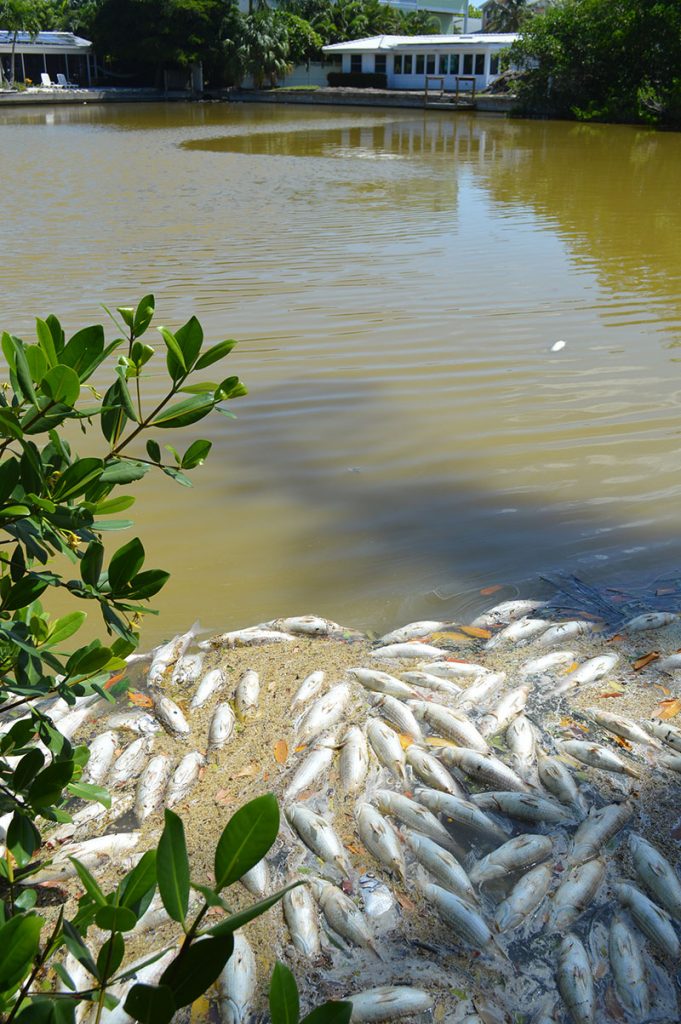
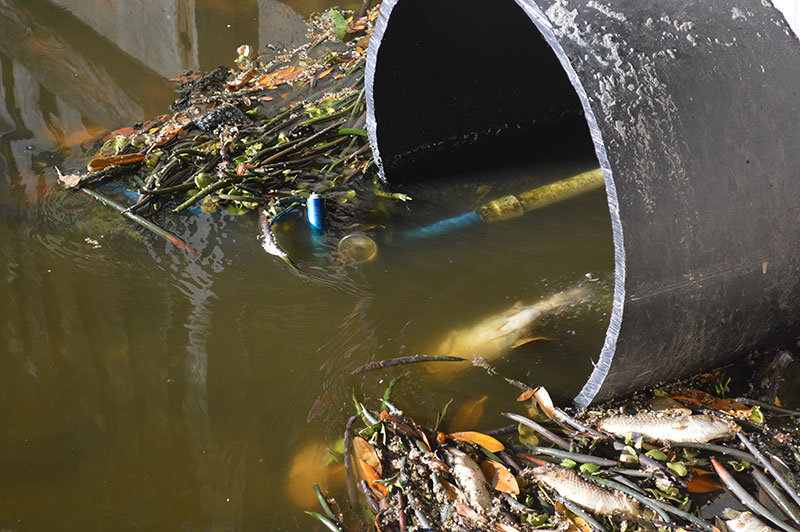
People who live on Spring Lake in Holmes Beach are concerned about their health and property values.
The lake is suffering.
At a Sept. 24 city commission meeting, Eran Wasserman, project manager for LTA engineers, the engineering firm contracted by the city, reviewed the status of the lake following resident complaints of a stench and numerous dead fish after the Sept. 17 activation of an aeration system.
The city commission approved the installation of the system to clean the brackish lake between 68th and 70th streets, which accumulated 3 feet of muck after a sewage spill in 2015. About 22,000 gallons of waste poured from a ruptured Manatee County sewer line into the lake.
Following testing in March that indicated poor water quality, the city decided to install a system that would generate millions of small air bubbles to circulate and blend the murky, salt- and freshwater mixture and vent harmful gases, allowing more oxygen absorption.
Wasserman said Sept. 24 that organic matter in the lake — dead fish and vegetation — breaks down without oxygen, resulting in muck. He said infusing the water with oxygen can break down and release gases and improve the lake water quality.
Consultant perspective
Wasserman introduced Chris Byrne, a consultant with Vertex Water Features, the company that installed the aeration system, to explain why the condition of the lake worsened after the system was activated, and what to expect as the lake aerates.
Byrne said his company took water samples from the lake that showed levels of phosphorus, nitrogen and ammonia at the bottom were 10 times higher than those at the surface.
“That’s a clear indicator that this pond is stratified and needs to be circulated,” he said. Water stratification happens when water of varied salinity, density and temperature form layers that act as barriers.
“Every now and then we come across a pond that is so bad, that even though we establish a protocol to minimize attrition of the fish, there is still some attrition,” he added.
Byrne said as the lake water circulates, the water quality readings at the surface will worsen.
“It’s just one of the growing pains you have to go through to properly circulate the lake,” he said.
Commissioner Rick Hurst asked how long it would take for the lake to recover.
Byrne said, “Every pond is different.” It could take months, he said, but the worst effects probably already occurred.
Commissioner Carol Soustek asked if running the system more frequently would speed up the process.
Byrne said that would kill more fish, but the gases would vent more quickly, leading to better water quality.
Residents speak
“Water at my house right now is greenish-brown and it looks like a sewer,” said Carol Grayson, who, along with her husband Boyd, has owned a home on the lake for six years. “The reason I’m hoarse right now is because I have asthma. The quality of the air is awful and I’m afraid I’m not even going to be able to stay here.”
Boyd Grayson also addressed the commission. He said two WaStop tidal valves installed in storm drains in 2017 between the lake and an adjacent canal to prevent tidal flow further disrupted the balance of the lake.
The drain pipes, which run under Palm Drive, allowed the lake to fill and flush saltwater from the canal.
“I just can’t imagine a better solution we could offer this lake than to let the tide back in and let 2 million gallons of water, twice a day, come through that lake and go back out,” he said. “Eventually, in the shortest period of time, that lake would be clean.”
“We all purchased our properties with a healthy, active lake as part of our value,” said Phil McDonald, also a lakefront homeowner. “Now we have a dead drainage pond as a viewshed.”
He added that the city did not send notices to people who live on the lake indicating there would be detrimental effects when the aeration system was turned on.
Tim Gibson purchased property on the lake 19 years ago. He said he chose the location above other spots on the island so he could fish for the mangrove snapper, redfish and juvenile tarpon that were present before the sewage spill.
“The fish are gone,” he said. “Manatee County killed that lake and turned it into a septic hole.”
Commission takes action
“We all want to make it right,” Mayor Judy Titsworth said. “But we can’t be wasteful of tax dollars based on fearmongering, or based on anything other than the facts. We have to rely on the professionals telling us what to do.”
She said the valves are needed to prevent flooding, and there are many lakes in the state that do not get tidal flow. They require aeration, like Spring Lake.
Titsworth said the recovery process would take time, but if the city determines the system is insufficient, the commission will consider other options, such as reopening the tidal valves.
Commission Chair Jim Kihm asked Wasserman and Byrne for recommendations.
Wasserman said he could respond to tidal flow questions, as that is city engineer Lynn Burnett’s area of expertise, and she was not in attendance.
Byrne, speaking to the aeration system, suggested running the system for seven or eight hours a night for two weeks to produce faster results.
After two weeks, he said it might be best to run the system around the clock.
The commission unanimously reached consensus to direct Wasserman to run the system throughout the night for two weeks, with water samples taken each week, before running it full-time.
Titsworth also asked Wasserman to provide the city with daily updates on the status of the lake, including visual water quality and fish kill numbers, until the lake begins to recover.
“I don’t want to solve it here, but I want a focused effort on this,” Kihm said. “And by the end of the week, I want a broader recommendation about what we are going to do in light of some of the comments we received this evening.”
Myself and my neighbors on both sides have been sick for weeks.It wasn’t until I saw this article that I found out the county is responsible for all this.I will be visiting everyone that lives around this sewer and will be contacting a lawyer to force some action.My wife has asthma and copd and can not go outside without getting sick.The day they started this so called treatment of the lake it turned the whole neighborhood into a sewer smelling environment.Something needs to be done immediately.
The fact that they SHUT off the access to tidal flows shows true incompetence. One would think that our lifetime resident am
Nd mayor would know better. Her response was one of a deer looking into headlights. Oblivious is being nice. These people did not sign up for arbitrary water closure in their canal(Lake). It is same as canal except a part is underground .Think we should shut off the canals where commission members live until these people get the valves removed .to prevent misuse. We live on a barrier island the ebb and flow of water is vital and necessary .
I applaud everyone’s efforts to reverse the destruction of Spring Lake in Holmes Beach. The county is fully responsible for polluting it and then doing nothing to correct it for along time. Mayor Titsworth and the HB Commissioners and residents are tackling the work the county should have done long ago. Any liability, cost, serious health issues or resultant lower real estate values lies clearly with the county who should allocate whatever funds and resources are required to finance the City of Holmes Beach efforts to reclaim the lake. The county takes a lot of tax money out of here an put very little back in. This is one occasion where they should do it or be sued. I am impressed by the appropriate immediacy of attention to this matter that Holmes Beach has demanded.
When was the artificial circulation system activated? The method isn’t meant to destratify an already stratified lake- that can result in the response you’ve witnessed. Bubbling pumps water from the bottom to the surface, it raises bottom temperature, it often causes the kind of problems pictured in the article. There are other, newer, more ecologically sound methods to manage oxygen loss and internal loading of nutrients and anaerobic respiration products. There are solar-powered downward pumping systems- it is usually better to push oxygen-rich water to the bottom than to pump nutrient-rich anoxic water to the sun-lit surface. There are aeration systems that add oxygen to overcome the oxygen deficit rate while maintaining stratification and colder bottom temperatures. There are aeration systems that use oxygen produced by photosynthesis. An expert review by someone who isn’t marketing their product would be prudent.