








Multiple warning signals went out before the crisis at a retired phosphate plant resulted in the flow of polluted water into Tampa Bay.
HRK Holdings LLC, which manages the Piney Point site, had cited “significant deterioration” of the upper portion of the liner system holding millions of gallons of wastewater in July 2020.
An engineer then advised the company to look for alternatives due to the poor condition of the plastic liner.
Environmentalists had been raising similar concerns about the site for decades.
But an alternative didn’t come soon enough.
After identifying leaks at Piney Point March 25, HRK received permission from the Florida Department of Environmental Protection to release polluted wastewater into Tampa Bay.
The controlled discharges began March 30 and continued until April 9.
Uncontrolled releases of wastewater also took place as states of emergencies were enacted, residents evacuated and roadways closed due to concerns of a collapse of the massive system built to contain the waste — nutrient-rich water and radioactive gypsum rock – at Piney Point.
Addressing the immediate crisis involved county, state and federal emergency management agencies, the U.S. Army Corps of Engineers and Coast Guard, federal and state environmental protection staff, federal and state fish and wildlife services and many nonprofits and educational institutions.
Personnel, pipes and pumps were deployed to siphon water from the Piney Point reservoir while pilots directed drones for an aerial view and dive teams investigated underwater conditions.
By April 8, emergency officials indicated the likelihood of a large-scale breach or collapse of the phosphogypsum stack at Piney Point had diminished.
And by April 9, the DEP reported that all discharges of “untreated water” had ceased to try technologies to reduce the nutrients and removal with other treatments before discharging more wastewater.
By then, about 215 million gallons of polluted water had been discharged to the bay and the DEP was sampling water from about 25 locations, including northeast of Anna Maria Island, for salinity, dissolved oxygen, clarity, nutrient levels, turbidity, radionuclides and more.
The DEP was reporting water quality met standards but the area nearest the discharge point at Port Manatee showed elevated phosphorous levels.
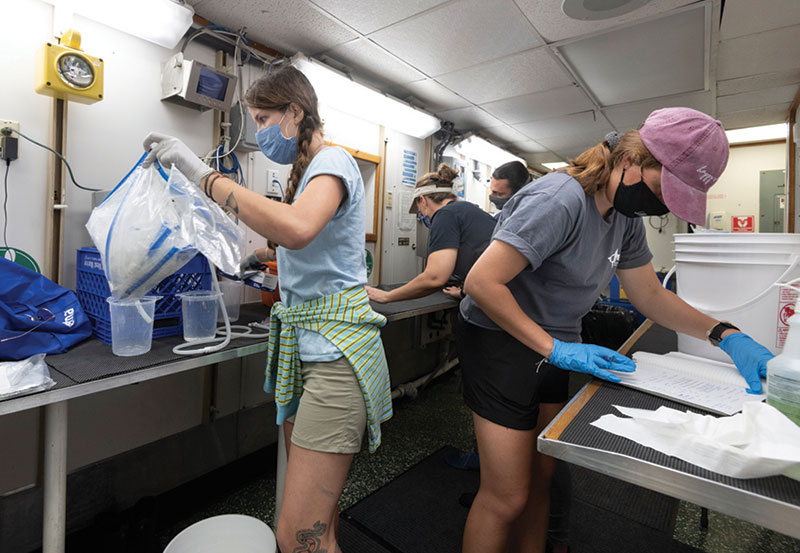
Aboard the research vessel Weatherbird II April 7, a team from the University of South Florida College of Marine Science also collected water samples, surface sediments and fish from Tampa Bay to analyze for salinity, bacteria, nutrients, trace metals, oxygen and pH, or acidity.
“Rapid deployments … provide us with an unprecedented opportunity to get out there and provide science necessary to inform an effective response, as well as any necessary mitigation efforts, so that we can safeguard our vulnerable coastal resources,” said USF’s Tom Frazer.
Now, there are many questions for government officials, politicians, plant management, environmentalists and scientists to answer about the environmental impact and how to eliminate the threat of Piney Point and other phosphate plants.
The boards of two prominent environmental groups met April 5 and issued a joint statement, calling for action on “phosphogypsum stacks endangering the coastal habitats in Florida.”
The statement from Suncoast Waterkeeper and Tampa Bay Waterkeeper said the failures at Piney Point were preventable.
They said the discharge of wastewater allowed had delivered excess nitrogen and phosphorous, nutrients known to fuel harmful algal blooms.
Meanwhile, the wastewater in the phosphogypsum stack contains about 10 times the amount of nitrogen in raw sewage.
“Our community and environmental organizations need assurances by the state of Florida, our governor and the secretary of the environmental protection agency, the Senate and the House that this failure will be handled promptly with utmost caution and assurances that future failures will be averted by enlightened leadership,” the statement read.
The boards demanded a state commission for phosphogypsum stack operations and closures, state-funded closure of the Piney Point stacks and the removal of water, enhanced water monitoring for five years, testing of fish in the Tampa and Sarasota bay estuaries for two years, a moratorium on processing phosphate for six months and an accounting for the parties responsible.
DEP Secretary Noah Valenstein, visiting the site April 3, said the state priorities were to stop the discharges as soon as possible and then focus on regulatory review and enforcement.
But cleanup at Piney Point might be government-funded and controversial.
State Sen. Jim Boyd, R-Bradenton, in Senate Bill 2500, cosponsored a budget amendment to fund the cleanup and closure of the stacks at Piney Point.
The money — estimated at more than $200 million — could come from the Biden administration’s American Rescue Plan, which is intended to provide relief from the coronavirus pandemic.
The cleanup, as proposed, would involve constructing a deep-injection well to handle the waste.
“There are many problems associated with deep-injection well,” said the ManaSota-88 environmental group in an April 5 statement. “All wells are subject to failure and there are too many unknowns to safely inject treated or partially treated effluent. The operation of deep well relies very heavily on predictions and good faith.”
And good faith, environmentalists say, is not in good supply at Piney Point.
About Piney Point: Then and now
THE PLANT: Borden Chemical opened the plant in 1966 to mine and process phosphate used in fertilizer. Ownership transferred to Amax Phosphate in 1980, FCS Energy in 1986, Royster Phosphates in 1988 and Mulberry Corp. in 1993. Mulberry ceased operations in 1999 and abandoned the property in 2001.
THE OVERSIGHT: The U.S. Environmental Protection Agency assumed oversight, followed by the Florida Department of Environmental Protection and then HRK Holdings LLC, which purchased the site in 2006, agreeing to maintain and monitor the phosphogypsum stacks and wastewater system.
PAST TROUBLES: 1970 — Waste dumped into Bishop Harbor kills fish.
1989 — A storage tank leak released 23,000 gallons of sulfate, prompting an evacuation.
1991 — Two incidents resulted in the release of sulfur dioxide and sulfur trioxide into the air, killing three workers at the site and creating an acid cloud that sickened 30 people.
2004 — A storm ruptured a dike, releasing 70 million gallons of polluted water.
2011 — A spill dumped 170 million gallons of polluted water into Bishop Harbor and Tampa Bay.
TODAY’s TROUBLES: October 2020 — The ManaSota-88 environmental group warned of the “risks of catastrophic failure” of the stack system and called for an EPA investigation.
February 2021 — A coalition of environmental groups urged the EPA to address Piney Point and other stacks.
March 25, 2021 — A leak was found in the wall of a pond containing about 400 million gallons of wastewater and seawater.
March 30, 2021 — The DEP authorized the controlled release of polluted water to protect the stack system.
April 1, 2021 — Manatee County declared a local state of emergency with concern for a large-scale breach of the containment system. Evacuations and road closures followed.
April 3, 2021 — Florida Gov. Ron DeSantis declared a state of emergency for Manatee, Hillsborough and Pinellas counties as polluted water was pumped, flowing into Tampa Bay.
April 4, 2021 — The response team grew to include the U.S. Army Corps of Engineers, Florida Department of Emergency Management, Federal Emergency Management Agency.
April 6, 2021 — The evacuation orders were lifted and roads reopened. Manatee County authorized the use of a deep-injection well for the transfer of polluted water.
April 7, 2021 — Discharges of water continued. Sampling showed water-quality standards maintained in Tampa Bay but areas surrounding the discharge point showed elevated levels of phosphorus.
— Lisa Neff