







The season’s first loggerhead hatchlings will emerge from nests on Anna Maria Island beaches in about a month and make their way across the sand to the Gulf of Mexico.
Such activity takes place on many beaches in Florida, home to about 90% of the sea turtle nests in the United States, including leatherback and green turtles, in addition to loggerheads.
Hatchlings will emerge from nests in the sand, crawl, swim, get swept through the surf zone and eventually reach the oceanic zone.
In the past three decades, monitoring programs such as the one conducted by Anna Maria Island Turtle Watch and Shorebird Monitoring, have helped build knowledge and data about sea turtle nesting and hatchling activity on land.
But mysteries remain in the water, including where young turtles go during their “lost years” — the time between hatching from their nests and when they return coastal habitats.
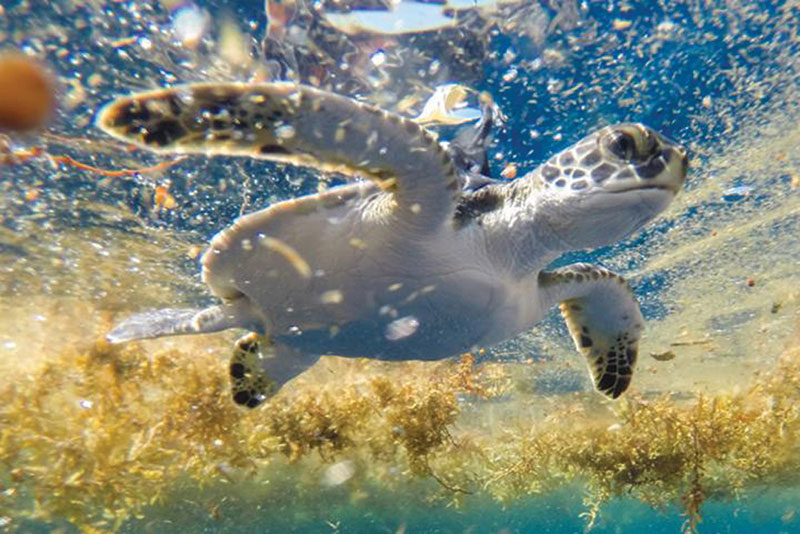
University of Central Florida scientists examined the question and found that the legendary Sargasso Sea, which includes part of the Bermuda Triangle, may be a critical nursery habitat for young sea turtles — particularly green turtles and loggerheads.
Their research was published in May in the journal Proceedings of the Royal Society B.
Scientists have long assumed that hatchlings would drift in currents and then ride the currents until their juvenile years.
“That green turtles and loggerheads would continue in the currents, but that some might leave the currents and go into the Sargasso Sea was not considered or predicted by long-held hypotheses and the assumptions in the field,” said UCF researcher Kate Mansfield in a news release..
“We found that the green turtles actively oriented to go into the Sargasso Sea and in even greater numbers than the loggerheads tracked in our earlier work. Granted, our sample sizes aren’t huge, but enough turtles made this journey that it really throws into question our long-held beliefs about the early lives of sea turtles.”
The Sargasso Sea off the U.S. east coast has often been featured as a place where ships could become derelict when trying to travel through thick mats of brown, Sargassum algae.
In reality, the Sargassum clumps together in patches and poses little threat to vessels.
The researchers followed turtles by attaching solar-powered tracking devices to their shells.
In the latest study, 21 greens less than a year old had transmitters affixed and were released into the Gulf Stream about 10 miles offshore from the beach where they were born.
The release dates were from 2012 to 2013, and the researchers tracked the turtles for up to 152 days.
Of the 21 turtles, 14 departed the Gulf Stream and the North Atlantic gyre of circulating currents and entered the Sargasso Sea region.
In a previous study, seven out of 17 loggerhead turtles that left the Gulf Stream entered the Sargasso Sea.
Jeanette Wyneken, a professor of biological sciences and director of Florida Atlantic University’s Marine Science Laboratory at Gumbo Limbo Environmental Complex, worked with Mansfield on the study.
“These studies in which we learn where little sea turtles go to start growing up are fundamental to sound sea turtle conservation,” she said in a news release. “If we don’t know where they are and what parts of the ocean are important to them, we are doing conservation blindfolded.”
Mansfield said the next steps for the “lost years” research will involve looking more closely at differences in orientation and swimming behavior between turtle species and understanding the role Sargassum plays in turtle development.