




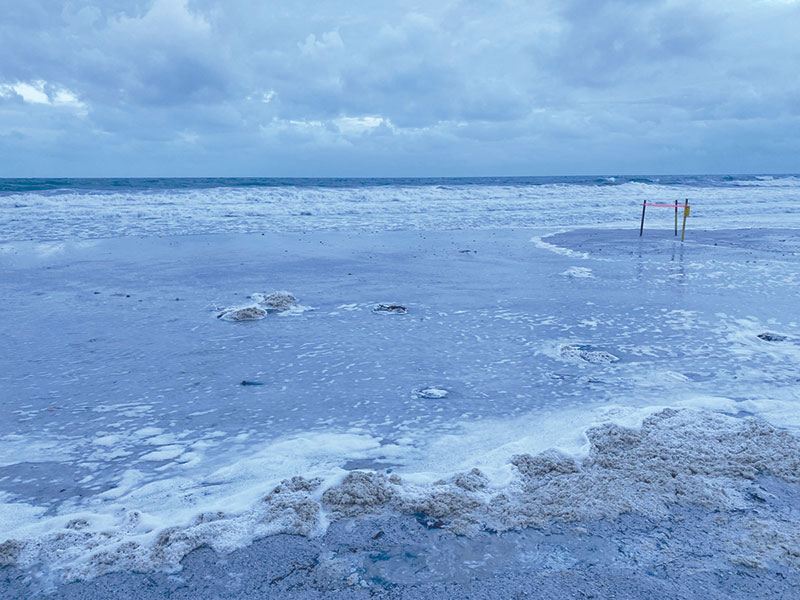
Elsa took a toll on Anna Maria Island’s sea turtle nests as the storm passed July 6-7 in the Gulf of Mexico.
Turtle nests on AMI faced destructive waves, according to the Anna Maria Island Turtle Watch and Shorebird Monitoring team.
AMITW is a nonprofit that collects data on sea turtle and shorebird nesting habits.
After the storm — which moved up the Gulf of Mexico as a category 1 hurricane but was downgraded to a tropical storm as it passed the island overnight July 7— AMITW volunteer Pete Gross reported 53 nests were washed away by waves and 131 nests were washed over by waves.
Gross said nests that were washed over likely would hatch.
A fraction of the nests that were washed away also will hatch.
Additionally, some sea turtle eggs were found rolling in the surf, said executive director of AMITW Suzi Fox.
The eggs found in the surf will not hatch, as they are water permeable.
“Once they roll to the water, the likelihood of them hatching is zero,” Fox said.
She added that anyone who finds sea turtle eggs in the water should bury them in a hand-sized hole in the dunes, as they improve vegetation growth.
A sea turtle nest contains about 100 eggs, Gross said. So 53 lost nests could mean as many as 5,000 eggs that won’t hatch.
But, Gross said, “It’s pretty typical for a storm like this.”
Nesting season runs May 1-Oct. 31. Comparatively, storm season in Florida runs June 1-Nov. 30.
AMITW volunteers pounded nest markers deeper into the sand and removed adoption plaques to prepare for the storm.
Bradenton Beach code enforcement officer Ronald Peterson said he went out July 6 to make sure beach gear was removed from the shore.
Asked if he had concerns before the storm, Peterson said, “This is my first time being out on the beach during a tropical storm or hurricane, so I’m not sure what to expect. I’ve never seen the island flood.”
Fox said AMITW did not move or remove nests. They let nature take its course. She said the beach nourishment project completed in 2020 was effective, noting the tide was high but receded quickly.
“It’s doing what it should do after renourishment,” she said.
Neither Manatee County parks and natural resources director Charlie Hunsicker nor county information outreach manager Nicholas Azzara were available July 8 and they did not respond to emails with Islander questions about beach erosion in the storm.
Fox asked people who see hatchling tracks in an unmarked area to contact AMITW at 941-778-5638.