




Fishing success around Anna Maria Island is greatly dependent on tidal flow, as our surrounding waters heat up with the sun, reaching temperatures of 88 degrees.
This is especially apparent on days when the weaker tides exist, as you’ll notice the fish are not quite as motivated, not moving much as they could be.
It’s best to choose the days to fish by watching a tide chart for times and days, with strong tidal flow and an influence on the bite, determining whether you have a good day or bad day at fishing.
You can go as far as trying to time the best tides in correspondence with low light hours in the early morning. This tends to be conducive when targeting snook among the shallow grass flats. When fishing shallow flats of 2-3 feet, you’ll notice the water temp can be similar to the air temp. And, the cooler hours just before and after sunrise can be peak feeding times for the shallow-water fish.
As the day progresses, the shallow waters heat up to the point where snook are forced to retreat into the shoreline shade among the mangrove roots, which makes them harder to target. And by this point, you may find they’re not motivated to eat, as they are on siesta, taking refuge from the heat in the shade.
Now that we’ve established that fishing the shallows is best in low light during a good tide, the question is what to do as things get hotter.
The answer is to try fishing deeper water, where temperatures remain slightly cooler. Spotted seatrout on the deeper grass flats of 6-8 feet of water is a good bet. Or try targeting mangrove snapper around some of your favorite reefs or wrecks. There’s a good chance you’ll find the deeper fish slightly more motivated in the heat of the day, as they comfortably roam around their hideouts. And again, keep in mind, the movement of the tide. It may not be as apparent as it is in the shallows but it will play a factor on the bite.
On my Just Reel charters, we’re finding good action during the early morning hours just after sunrise and around the full moon. Spotted seatrout and snook are feeding on shallow grass flats with some ferocity and free-lined live shiners are being inhaled by both species.
Mangrove snapper are in on the action — taking our bait between snook and trout bites.
As the shallow-water bite decreases with the rise in temps, we’re moving to deeper grass flats, where a good tidal flow exists. In these areas, my clients are hooking up on more spotted seatrout, as well as Spanish mackerel, ladyfish and jack crevalle.
Lastly, for entertainment purposes, we’re targeting 5-6 foot blacktip sharks for a fight along the beaches.
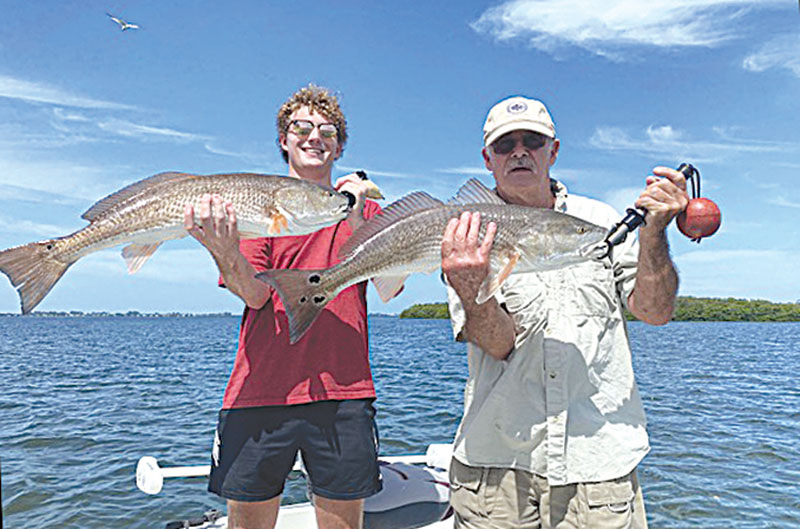
Capt. Warren Girle is finding schooling redfish while working the flats in Sarasota Bay. In depths of 2-3 feet of water, he’s putting anglers on redfish that lurk in sandy potholes where good flow and lush grass are present. Oyster bars and mangroves also make up the landscape for these redfish to frolic and take a bait.
Since the water is quite shallow, the approach to these fish must be silent and stealthy. Keeping as much distance as possible from the school is key to getting a bite, according to Girle.
Using heavier baits, such as live pinfish or fresh-cut pieces of ladyfish, works well.
Targeting spotted seatrout in Sarasota Bay is worth a cast. On deeper grass flats, Girle has his clients free-lining live shiners, which are quickly being devoured by hungry trout. Mixed in are ladyfish, jack crevalle and mangrove snapper.
Capt. David White is putting his sport fishers on the catch-and-release snook action in Tampa Bay. Free-lining live shiners over shallow flats during swift moving tides is leading White’s anglers to numerous catches of linesiders. While targeting snook on the flats, White’s charters also are hooking into redfish — with most reds coming in within the slot of 18-27 inches.
Structure fishing in Tampa Bay is producing action, too, according to White. Anchoring over reefs and wrecks is yielding mangrove snapper up to 16 inches.
Finally, for anglers looking to hook into something big in the backcountry, White is leading them to their goal by putting them on blacktip sharks. Fresh-cut chunks of ladyfish and mackerel are working well as bait.
Jim Malfese at the Rod & Reel Pier is seeing mangrove snapper being caught by anglers using live shrimp as bait. Drifting shrimp under the pier deck — with the addition of a small split shot to add enough weight to get the bait toward the bottom — results in the most fish.
Limits of snapper are attainable by patient anglers. And, while drifting shrimp under the pier, anglers also can hook into an occasional redfish or snook. A few black drum are being caught in this fashion, too.
When the bait schools are present around the pier, make sure to purchase a speck rig from Malfese and try casting away from the pier to hook up with some mackerel, jacks and ladyfish.
Send high-resolution photos and fishing reports to fish@islander.org.