






Anglers around Anna Maria Island are facing uncertainty as the threat of red tide looms.
Areas such as Siesta Key and southern Sarasota Bay are suffering the consequences of toxic water caused by red tide, where our nearshore waters remained relatively clear as of Dec. 2. Hopefully, with upcoming cold fronts and a combination of strong north and easterly winds, Anna Maria Island will be lucky and dodge this unfortunate “natural occurrence” of nature.
With red tide so close, fishers are planning ahead and scouting waters to the north and east to find areas of clean water and action from a variety of species.
Typically, the Manatee River, Terra Ceia Bay and the waters north of the Sunshine Skyway Bridge on the eastern shoreline of Tampa Bay are good places to escape red tide. In these areas, spotted seatrout are abundant, as there are lush grass flats in depths of 3-8 feet, offering a great habitat.
If you’re not familiar with these waters, try drifting and jigging with soft plastics on a jig head. This technique is most effective as it gives anglers an opportunity to cover quite a bit of territory and good chances for locating concentrations of trout. Plus, there are other species present here that will take the jig, including ladyfish, jack crevalle and pompano.
If fishing with artificials isn’t your thing, you can try live bait. Live shrimp under a popping cork works for targeting trout. It may take longer to locate the fish but when you do, the shrimp and the hook are usually quickly devoured by a hungry trout.
Lastly, practicing catch-and-release is advantageous, as there is potential for our fish populations to decline as a result of red tide. Under normal circumstances, keeping daily limits of fish is acceptable, although in times when there is the potential for fish kills, it’s best to practice catch-and-release and preserve the fish we have.
On my Just Reel charters, I’m enjoying a variety of fishing in the Gulf of Mexico and in the inland waters of Tampa Bay. In the Gulf, Spanish mackerel are prevalent around structure, such as reefs and wrecks. Free-lining live shiners on a long shank hook is resulting in as many macks as my clients can stand. And, with all of the commotion with the macks, cobia are finding their way to the boat to investigate what is going on. In many instances, we are sight-casting to these fish as they appear boat side. Once hooked, the battle ensues, with some fish taking up to 15 minutes to get into the boat.
Moving inshore, I’m finding that jigging with DOA CAL jigs on the flats is most effective for spotted seatrout. I’m also seeing jack crevalle, ladyfish and pompano mixed in with the trout bite. The pompano are sporadic but we are averaging a few every trip.
Capt. Jason Stock is in pursuit of gag grouper. Offshore fishing for the popular grouper is proving to be some of the best we’ve seen in recent years, according to Stock. On many days, Stock is leading clients to limits of the tasty fish. Live pinfish as bait will attract the groupers from their hiding places among the reefs, wrecks and hard-bottoms areas.
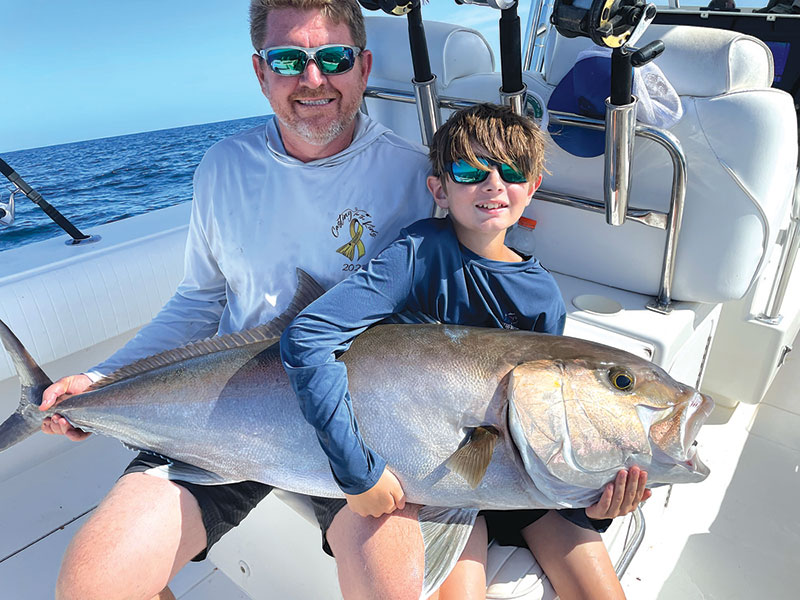
Migratory species — amberjack and kingfish — are making their presence known in the Gulf. Numerous methods are being used to catch the fish, including live bait offerings, slow trolling and the use of surface plugs.
Capt. David White says he’s catching a lot of large gag grouper while working in- and nearshore around Anna Maria Island. Targeting reefs and wrecks is resulting in plenty of action on these tackle-busters.
While inshore, White is targeting others species — snook, redfish and Spanish mackerel.
Moving offshore, White is finding the snapper bite quite good. Mangrove and yellowtail snapper are frequently being reeled up. Migratory fish, such as amberjack and kingfish, are being caught while offshore.
Capt. Warren Girle is impressed with the nearshore bite and the variety of species. In depths of 35-45 feet of water, Girle is finding action for his clients on mangrove snapper and gag grouper on live shiners combined with a knocker rig. Many snapper are 12-14 inches. As for the grouper, some keeper-size fish are being caught, as well as numerous shorts. Fishing live shiners as bait on a flatline is producing action — especially on kingfish and macks.
Moving inshore to the flats, Girle is catching snook and redfish, as well as plenty of trout.
Jim Malfese at the Rod & Reel Pier says pier fishers using live shrimp as bait are hooking up with a variety of species. Black drum are the most prevalent bite, with some catches reaching 24 inches in length. Redfish are being caught, with most falling16-20 inches. Anglers using shrimp are hooking into an occasional mangrove snapper or sheepshead. On days when shiners are present, anglers are finding success on artificials — silver spoons, Gotcha plugs or speck rigs. All of those lures are resulting in catches of Spanish mackerel, jack crevalle, ladyfish and skipjacks.
Send high-resolution photos and fishing reports to fish@islander.org.