





Summer’s here and the time is right for some seasonal warnings.
June 21 marked the official start to summer, a season that brings warmer water, crowded beaches, afternoon storms and changes in behavior for animals on the shore and in the water.
So with the arrival of the new season — especially for those on break or holiday — come a series of cautions:
- Stingrays are being reported in the shallow waters around AMI.
The rays are not aggressive but they are defensive, equipped with a venomous barb near the base of their tail.
In the summer, people entering shallow water should do the “stingray shuffle,” lightly sliding or shuffling your feet, pushing the sand forward.
Why shuffle?
To give the stingray time to swim away.
If stung by a ray, use piping hot water to flush the wound and soak it as soon as possible.
- Look for warning flags on beaches.
With a glance at the beach towers where lifeguards monitor the shore, people can check for hazards in the water.
Two red flags: Water closed.
Red flag: High hazard, high surf, strong currents.
Yellow flag: Medium hazard.
Green flag: Low hazard, calm conditions.
Purple flag: Dangerous marinelife.
- When thunderstorms are in the forecast, lightning can be a threat. Did you know that each year there are about 25 million cloud-to-ground lightning flashes?
Give yourself enough time to pack and leave the shore ahead of a storm.
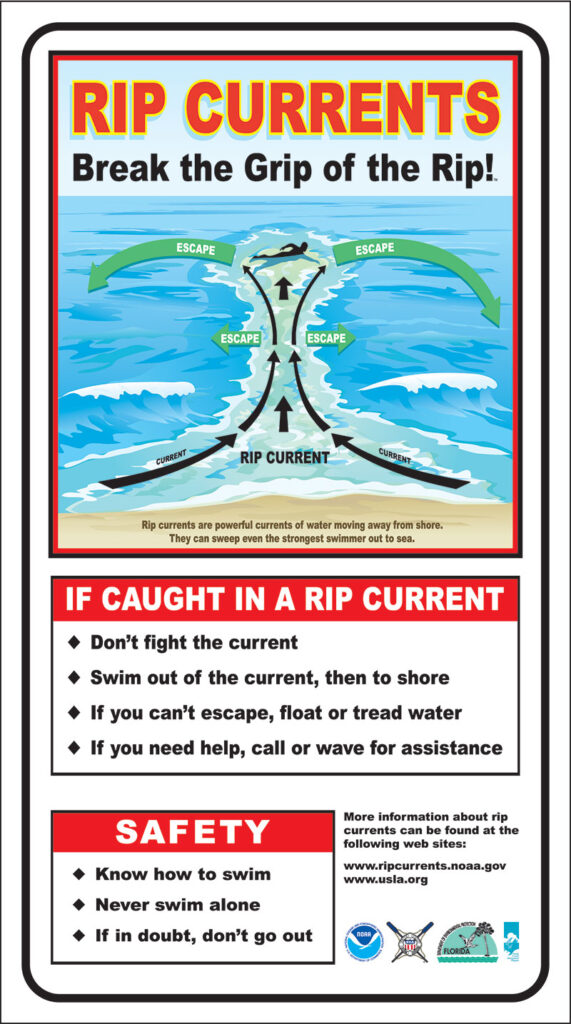
- Rip currents are responsible for a majority of drowning deaths in Florida.
The best safety measure is to swim where lifeguards are on duty.
If you are not a strong swimmer, go only knee-deep into water.
If caught in a rip current, try to relax and do not swim against the current. Instead, try to tread water and float while calling for help. If help is not available, swim parallel to the shore until released from the current and then swim toward shore, letting the waves do the work.
- In the summer, sargassum can be present in local waters and wash onto the shore.
The Florida Department of Health has issued an advisory for people to be cautious with the seaweed, which can contain vibrio vulnificus.
To reduce the risk of vibrio infections, people should avoid exposure of open wounds or warm brackish saltwater; eat shellfish promptly after cooking; wear protective clothing when handling raw shellfish and seek health care if feeling ill after exposure to the water.
- The health department also issued an alert June 19 after a second case of malaria from a mosquito was confirmed.
Mosquitos definitely can be found on the island and, to some degree, on the beaches.
The health department advises people to apply insect repellent, cover up and avoid areas with a lot of mosquitoes at dawn and dusk.
- The summer season is nesting season for shorebirds and sea turtles.
Beachgoers should respect nesting habitats, maintain a distance from wildlife and keep the shoreline clear of litter.