







After 13 years and hundreds of thousands of dollars spent on litigation, the treehouse saga has reached a conclusion.
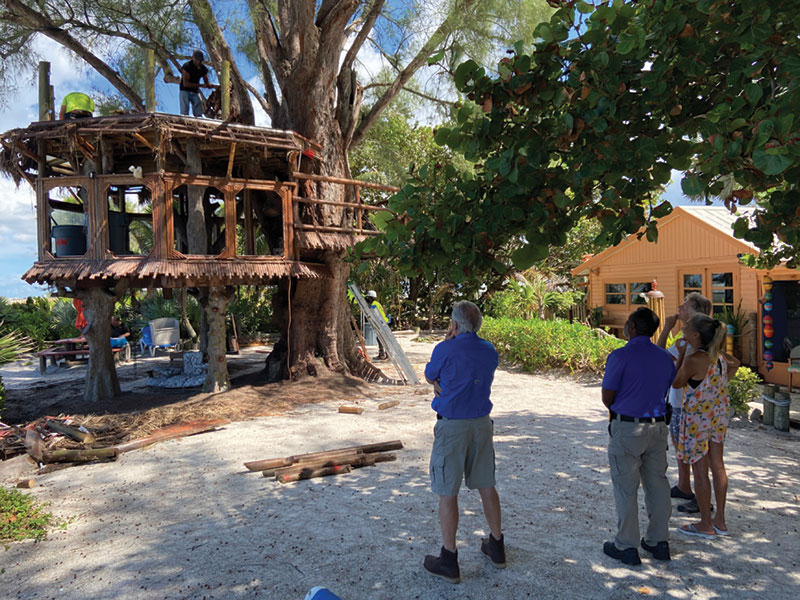
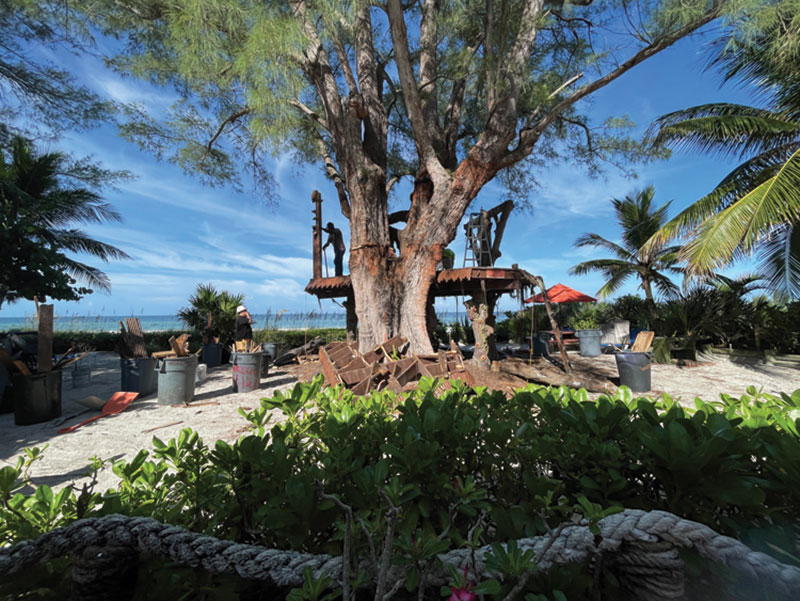
Tampa-based Allied Wrecking demolished the two-story elevated treehouse behind the Angelinos Sea Lodge, 2818 Ave. E., Holmes Beach, over the week of Aug. 26.
The lodge is owned by Richard Hazen and Lynn Tran-Hazen, who reside there on the beachfront, where they built the structure in 2011 without permits from the city or the Florida Department of Environmental Protection.
On top of being built without permits, the treehouse is located within 30 feet of the erosion control line — a state boundary between private land and public property on nourished beaches — and including a 50-foot setback for construction.
Both the city and DEP found the structure in violation of municipal and state law.
Litigation began in 2013, when the property owners filed their first lawsuit against the city to contest the constitutionality of municipal codes enacting setback restrictions that prohibit the treehouse.
They have been on the losing side of each legal case since and were ordered in February to demolish the structure.
The demolition was not completed within 90 days ordered by the judge, but the property owners were not saddled with additional repercussions due to good faith efforts to comply.
Almost six months after the demolition order, Allied Wrecking began work tearing down the treehouse the morning of Aug. 26.
Work started with dismantling the top floor and roof, with some parts preserved — such as the treehouse’s tempered glass removable windows and some carved railings — while most ended up in dumpsters.
Richard Hazen also preserved some carved animals and other items that decorated the treehouse.
He told The Islander, “It was time.”
Over the next couple of days, the contractor continued chipping away at the structure and, by Aug. 28, there was nothing left but the base of the first floor and the support pilings.
Code compliance supervisor JT Thomas and development services director Chad Minor told The Islander Aug. 29 that the contractor had nearly completed the demolition.
Thomas said that the four pilings driven to support the treehouse had been removed and the only remaining work was to clear the area of debris and remove some materials that had become embedded in the Australian pine tree the structure was built upon.
The tree was not removed as part of the demolition.
Building official Neal Schwartz was set to complete a final site inspection on Sept. 3, after The Islander’s press deadline.
Tran-Hazen told The Islander Aug. 27 that she was happy the tree could remain and was exploring ways to memorialize the demolished structure.
“Things come in waves. Everything changes and we will deal with this, too,” she said.
However, demolition is not the only measure needed to bring the property into compliance with city code.
As of Aug. 30, the property owners owed the city $341,500.88 in outstanding fines for years of noncompliance.
That is the accrued total of a $50 daily fine for an unpermitted treehouse that began July 22, 2015, and a $125 daily fine that began March 18, 2021, for renting units at Angelinos Sea Lodge without a city-issued vacation rental certificate.
Minor said the property owners could submit a request to seek relief from the city’s special magistrate but the municipality had yet to receive such a request.
“The city was not going to engage in any discussions regarding that until the treehouse was brought into full compliance,” Minor said
Treehouse timeline
- April 2011: Property owners Richard Hazen and Lynn Tran-Hazen begin construction on the treehouse without permits from the city of Holmes Beach and the Florida Department of Environmental Protection;
- November 2011: The city receives an anonymous complaint about the treehouse and reports the matter to the DEP, leading to the issuance of a state violation;
- April 2013: The city issues notice of municipal violations for the structure;
- June 2013: The property owners file their first lawsuit against the city to challenge the constitutionality of codes enacting setback restrictions prohibiting the treehouse;
- July 2013: the city’s code enforcement board files a final administrative order fining the owners for the violations and ordering them to comply with city code or remove the structure;
- January 2014: the DEP denies an after-the-fact permit for the treehouse and the city refuses to submit a no-objection letter to the state;
- September 2014: 12th Circuit Judge Janette Dunnigan upholds the city code enforcement board’s order;
- May 2016: the city magistrate reviews the case and imposes a $50 daily fine beginning July 22, 2015, against the property owners for the unpermitted treehouse;
- April 2021: the city magistrate imposes a $125 daily fine from March 18, 2021, for operating without a city-issued vacation rental certificate;
- May 2021: the U.S. Supreme Court declines without comment the property owners’ request to review their case for a second time;
- January 2023: Judge Edward Nicholas of the 12th Circuit Court issues a final ruling in favor of the city on all counts;
- February 2024: Nicholas orders the treehouse to be removed within 90 days, or the city could remove it at the owners’ expense;
- August 2024: Tampa-based Allied Wrecking demolishes the treehouse.
— Ryan Paice
Issue at a glance…
Who owns it: Richard Hazen and Lynn Tran-Hazen.
What is it: A two-story treehouse comprising a wood deck framing and railings, tempered glass removable windows, palm frond roofing, solar power and galvanized or stainless steel hardware, supported by the Australia pine tree and four added pilings.
When was it built: Over about six months, April-November 2011.
Where was it located: Attached to an Australian pine tree behind the Angelinos Sea Lodge, 2818 Ave. E., Holmes Beach.
Why was it removed: 12th Circuit Judge Edward Nicholas ruled Feb. 28 that the structure must be demolished.
Problems with it: Construction without a permit and its location within a 50-foot setback for the erosion control line that excludes construction.
Total cost to owners: $341,500.88 in fines have accrued against the property owners, adding to an almost $200,000 litigation bill.
I love that phrase of “on top of being built without permits”, of course it doesn’t tell the real story or convey any reality to the saga of this presumably illegal tree house. The missing part is the admission of the permitting authority that permitting was sought and told that it was not in the code and was not necessary. Gee, the property owner didn’t just build it without permit they were told permitting was unnecessary. After someone took issue with the look of the treehouse, the complaints apparently roused a search to find a reason it could be found illegal, the arbitrary setback line was the excuse, and it too was found to differ from that which the State listed as an arbitrary line; the State was perfectly willing to issue a permit but not the city. Wonder how many wasted hundreds of thousands of dollars were involved, does anyone know?