








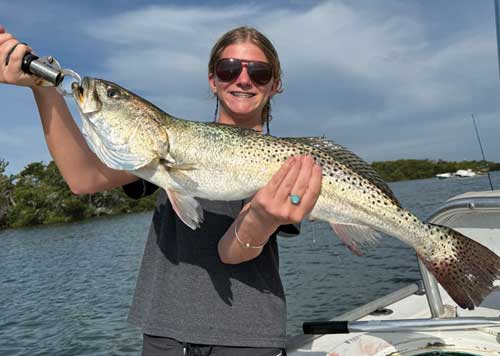
As we approach May, Anna Maria Island anglers are flocking to the shallow inshore waters to target spotted seatrout.
With the lack of rain, most waters remain clear, providing good visibility and enabling anglers to locate where good grass flats exist and set their sights on large trout.
Taking advantage of water clarity makes finding the fish attainable because the angler can move from one grass patch to the next until stumbling upon a school of trout.
Spotted seatrout are one of the most popular fish to target throughout our inshore waters, as they are readily available. They also are fun to catch using a variety of techniques and provide good table fare.
Although the name suggests trout, gators are actually in the drum family. This becomes apparent to the angler because, like all fish in the drum family, mature males make a drumming sound to attract females in the spawning season. Upon landing a male trout and while removing the hook before being released, the sound is audible to the angler.
Upon further inspection, trout have a bright yellow mouth, accentuated by two prominent canine teeth reinforced by small, jagged teeth that line the jaws. Depending on location, trout have a green to bluish back and silver sides speckled with black spots resembling some freshwater species. Hence, they have the name of a trout.
Generally, trout take 1-2 years to grow to 12 inches and 2-3 years to reach 16 inches, with a lifespan of 4-5 years. They reproduce frequently throughout spring and summer, ensuring healthy populations — except for factors like red tides, freezes or pollution, which can reduce their numbers or cause them to move elsewhere.
Trout are reliant on their camouflage as they are ambush predators. They blend in with eel grass and turtle grass that makes up their habitat.
Targeting spotted seatrout can be intriguing. They are frequently caught in the grass flats, but they will take residence in other terrain, such as sandy beaches, rock piles and wrecks, which means they can be found in depths as shallow as 2 feet or as deep as 20 feet.
Trout are susceptible to a variety of live baits and artificials, which can make them easy to catch, although their wants can change depending on the day, so it’s advantageous to be well versed on what to present.
Large baits such as shiners, pinfish, finger mullet and shrimp are worthy of targeting trout. Artificials also can trigger a response, with the most popular being soft plastics on a jighead. Suspending baits and topwater plugs are effective, especially for larger trout. The MirrOlure 84 MR top-water plug is definitely a part of many trout anglers’ arsenal because it attracts trophy-size fish.
When catching trout, remember they are delicate and must be released with care. When using live baits, it’s best to use circle hooks, which aid in lowering the frequency of “gut hooking.” A hook ripped out of the throat of a trout will result in a casualty. So if you experience a gut hook, it’s best to cut the line as close to the hook as possible and release the fish with hopes the hook will rust away.
As far as table fare is concerned, trout have a sweet white fillet that can be cooked in a variety of methods.
In larger examples of trout, a parasitic tapeworm, commonly called a spaghetti worm, can be present in the flesh. Although unsightly, these worms are harmless to humans and can be cut out of the meat.
What’s amazing about the worms is that they exist in the intestines of sharks. The worms lay eggs in the intestines, which are expelled by a shark and, after hatching, use the trout as an intermediate host. The lifecycle is completed when the host trout is eaten by a shark.
Lastly, let’s touch upon the topic of ethics. In our region, spotted sea trout must be 15-19 inches to be harvested, with a limit of three fish per person per day. In this bag limit, the angler is allowed one fish of the three to exceed 19 inches. When fishing from a boat, only one fish over 19 inches is allowed on the boat.
Local guides believe any trout over 20 inches is a spawning fish. Therefore, we never keep the big ones. Harvest of the slot-sized fish ensures sustainability.
On my Just Reel charters, targeting spotted seatrout is paying off, resulting in plenty of action on the shallow grass flats of Sarasota Bay. Freelined live shiners on a circle hook are leading to numerous hookups, with some instances providing multiple anglers with a fish.
Size ranges vary. On deeper flats in 6-10 feet of water, a variety of other species are mixed in. Spanish mackerel, ladyfish, blue runners and jack crevalle are being caught, adding a nice variety to the bite.
Targeting snook is quite productive, especially during the higher stages of the tides. Mangrove edges and oyster bars are holding good numbers.
Fishing along Gulf beaches is producing some action for anglers who like to sight cast to snook.
Lastly, blacktip sharks are infesting shallow grass flats of Anna Maria Sound, providing some drag-screaming action on medium spinning gear.
Capt. David White says he’s finding plenty of action while working his charters inshore. He says spotted seatrout are abundant, with limits of fish attainable on most days. Snook and redfish also cooperate for White, especially on high tides around spoil islands and mangrove shorelines.
Fishing over deep grass flats or structure is leading to some Spanish mackerel, jacks and ladyfish, according to White.
Moving into the Gulf is yielding action for White on kingfish, which are ranging 10-20 pounds and are taking live shiners or threadfins as bait.
Lastly, White is chasing tarpon, which has yielded several fish on recent outings. And that contest is just getting underway in Tampa Bay.
Send high-resolution photos and fishing reports to fish@islander.org.