




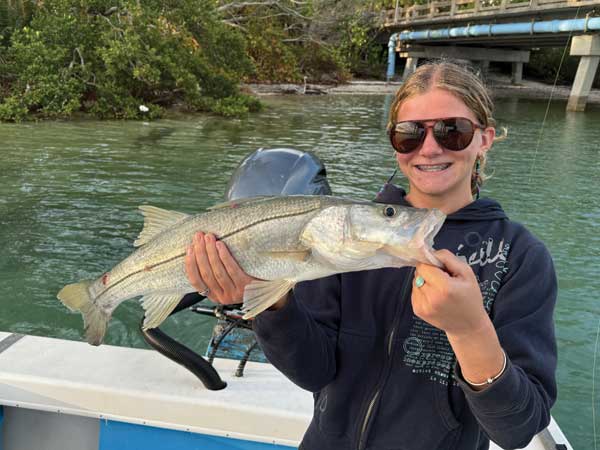
As we settle into September, Anna Maria Island anglers are excited to get on the water in search of our most revered backwater species — snook.
Opening day for snook season was Sept. 1, and the season remains open through Nov. 30, giving anglers ample time to try to catch a slot-size fish.
Snook not only have a minimum-size requirement, but they also have a maximum size. A keeper snook must measure at least 28 inches in total length and not exceed 33 inches to be considered for harvest.
Having only a 5-inch window for slot size and being one of the most fun fish to target on the flats makes snook a sought-after species throughout our region.
Once hooked, snook are notorious for being powerful. They have the ability to scream off a lot of drag and fight to the end, including a sequence of long runs and acrobatic jumps in shallow water.
Snook appear to be an intelligent species — they’re cunning enough to swim into structure or mangrove roots or loop pilings under piers — in order to cut the line and escape.
And the final aspect that makes snook so popular is their delectability on the plate. With thick, white fillets that hold up to numerous cooking applications — grilling, blackening and frying — snook rule as one of the best fish to eat. In fact, many anglers consider them to be the best in the backcountry.
Snook are targetable in a variety of environments, depending on the time of year. During spring and fall, most snook can be found staging on the flats, crashing bait schools and foraging on crabs and shrimp. These are the opportune times to look for snook as they are on the feed, making them slightly more vulnerable than during other times of year.
During the summer, many snook migrate to the Gulf beaches to spawn, making them targetable for shore anglers with live bait and artificials.
The beach snook are also popular due to the fact that they are in shallow water, making them visible to casting anglers.
Finally, during the winter, snook generally will move into backwater creeks and canals to conserve energy as they are not tolerant of cold temperatures. Although these fish are still targetable during these months, many anglers leave them alone to avoid putting too much stress on the species.
Lastly, don’t forget to be legal when targeting snook. A Florida fishing license is required, as well as a snook endorsement or “snook stamp” with the license in order for the angler to harvest a snook. Or you can fish with a licensed guide, like me.
Remember the slot is 28-33 inches and one fish per day per angler can be harvested in season, of course.
Pre-snook opening, Capt. David White said he was impressed with the volume of redfish he caught on the flats of Tampa Bay southward to Sarasota Bay.
On some occasions, schools of reds were being located, resulting in numerous catches in a short amount of time. In other instances, casting baits along mangrove shorelines and waiting for a strike was the protocol. It didn’t always result in an instant bite, but with patience could yield just as much action.
White said fishing around bait schools in Sarasota Bay lent to a variety of species, including spotted seatrout, Spanish mackerel, ladyfish and jack crevalle.
He also was putting anglers on mangrove snapper in the passes and in the Gulf of Mexico, especially around structure during slower stages of the tides.
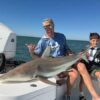
Lastly, targeting blacktip sharks was giving anglers a good fight and keeping them occupied. The predators were running 4-6 feet.
Send high-resolution photos and fishing reports to fish@islander.org.