





Days of rain did more than flood island streets — it washed out some turtle nests.
Anna Maria Island Turtle Watch and Shorebird Monitoring estimates that the markers for at least 48 nests were lost in recent rains, according to executive director Suzi Fox.
Fox said the stakes marking the nests were lost or washed away by the higher than normal waves. AMITW uses a tracking system for the nests, but it’s only accurate within about 20 feet, making it difficult to determine exactly where the nests are without the markers.
Some nests, those closest to the water and high surf, were uncovered by rising tides and waves, causing the eggs to be pulled out into the Gulf of Mexico. According to Fox, some beachgoers saw eggs in the surf and tried to gently gather as many as possible. Unfortunately, turtle eggs are water permeable, so it’s unlikely that any eggs that spent time in the water will hatch.
AMITW volunteer Glenn Wiseman said turtle nests can withstand several washovers without damage to the eggs. It’s when water stands on the nest, exposing the eggs in the nest to water or collapsing it, that the eggs can be destroyed or the hatchlings drown.
According to Wiseman, one of the nests involved in the June 27 turtle nest and shorebird criminal incident was washed away, while a second entered its 70th day on Aug. 6 without hatching. The average hatch time is 62 days.
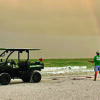
Five turtle nests were potentially damaged June 27 when someone driving an all-terrain vehicle illegally on the beach ran over the nests. The vehicle also was driven through a protected bird nesting area, killing three protected shorebird chicks.
AMITW will uncover and excavate the remaining damaged nest in the hope of learning what caused it to not hatch.
Fox asked that beachgoers be aware of unmarked turtle nests on the beach and use caution. With so many nests unmarked, AMITW is unable to protect nests. Beachgoers are asked to be careful where they put chairs, umbrella posts or canopy stakes that push into the sand.
AMITW volunteers also are diligently looking for signs of hatched nests and hatchlings on their early morning walks. The most common sign is small tracks leading from the nest to the water. Another sign is a small, caved in place — the nest — in the sand where the hatchlings have emerged.
Beachgoers who find turtle eggs or hatchlings rolling in the surf can help. Eggs and hatchlings should be collected carefully from the water and placed in a bucket with a small amount of damp sand. Cover the bucket with a cloth, leaving room for air to get in without exposing the hatchling or egg to the sun, and immediately contact AMITW.
Hatchlings typically emerge from their nests at night, when the sand and water are cooler. During the day, it can take only about 10 minutes for an exposed egg to “cook” in the sun. Hatchlings that emerge during the day risk death from sun exposure and are at an increased risk from predators.
Sea turtles — mostly loggerheads — are continuing to lay nests. Fox reported two new nests Aug. 4 and expects more as the season continues.
Turtle season officially ends Oct. 31.
Anyone who finds an unmarked turtle nest should contact AMITW at 941-778-5638 or suzilfox@gmail.com.