








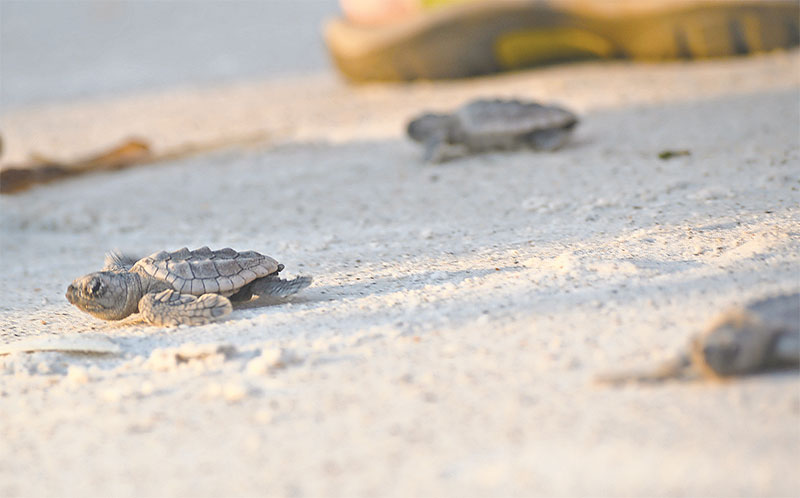
Enforcement agents and turtle watch volunteers were alerted July 9 to an alleged disturbance at a sea turtle nest hatching out on the shore in Bradenton Beach.
The incident was under investigation as of July 11, but regardless of the outcome, there’s good reason to spell out for beachgoers — including kids — the rules for nesting season. Out on AMI’s shores, we have laws protecting sea turtles. And we have best practices promoted by Anna Maria Island Turtle Watch and Shorebird Monitoring.
AMITW encourages people to:
- Not use lights on the beach at night;
- Shield or turn off any lights from their beachfront property;
- Leave the shore clear of furniture, toys and litter;
- Keep their distance from nesting sea turtles and hatchling sea turtles.
Encouragement, a polite ask, an educational talk should be enough to protect sea turtles and other animals on AMI but local ordinances, state law and federal acts and regulations also exist for their protection.
Ordinances in Anna Maria, Bradenton Beach and Holmes Beach require dark, clean beaches.
Florida statutes restrict the take, possession, disturbance, mutilation, destruction, selling, transfer, molestation and harassment of marine turtles, nests or eggs.
Protection is also afforded to marine turtle habitat.
At the federal level, the main protections for sea turtles are found in the Marine Turtle Conservation Act and the Endangered Species Act of 1973, which makes it illegal to harm, harass, or kill any sea turtles, their nests or eggs.
What consequences might a person face for harassing a sea turtle?
Violators can face civil penalties, criminal fines that exceed $100,000 and imprisonment and sometimes investigations do result in arrest or punishment.
Enforcement examples include:
- In 2015, a Florida woman was arrested for harassment after a photo of her riding a sea turtle went viral.
- That same year, a Florida man was sentenced to a month in jail for lifting a sea turtle out of the water.
- In 2017, two tourists in Hawaii were fined $750 for catching and holding a green sea turtle.
It’s elementary
Class lessons from AMITW, AME
Anna Maria Island Turtle Watch and Shorebird Monitoring, during the 2024-25 academic year, invited teachers and students at Anna Maria Elementary School in Holmes Beach to pose questions about sea turtles, shorebirds and AMITW. The Islander is sharing AME’s questions and AMITW’s answers.
Teacher Rachel Mauk’s first-grade class: Do the turtles stay with their families?
AMITW: Unlike people, sea turtles do not stay with their families.
The mother sea turtles lay their eggs in the sand and leave their babies — hatchlings — to hatch, find their way out of the nest, and travel to the water.
Even though all the hatchlings come out around the same time, they do not stick together once they reach the water.
Talking turtles
The city of Holmes Beach is hosting Anna Maria Island Turtle Watch and Shorebird Monitoring for weekly talks about sea turtle and shorebird nesting.
Sea Turtle Tracks and Shorebird Facts talks continue most Mondays at 10 a.m. through August at city hall, 5801 Marina Drive.
For more information, call turtle watch at 941-301-8434 or go to www.islandturtlewatch.com.
My wife and I walked the beach before dawn the day after this article was printed and we were very surprised at the number of bright white lights on houses from 77th Street north to Bean Point. And very few red lights. One spotlight mounted high on a pole at a house being constructed was particularly egregious.