






The Tour de Turtles featuring AMI swimmer Winnie the loggerhead is underway.
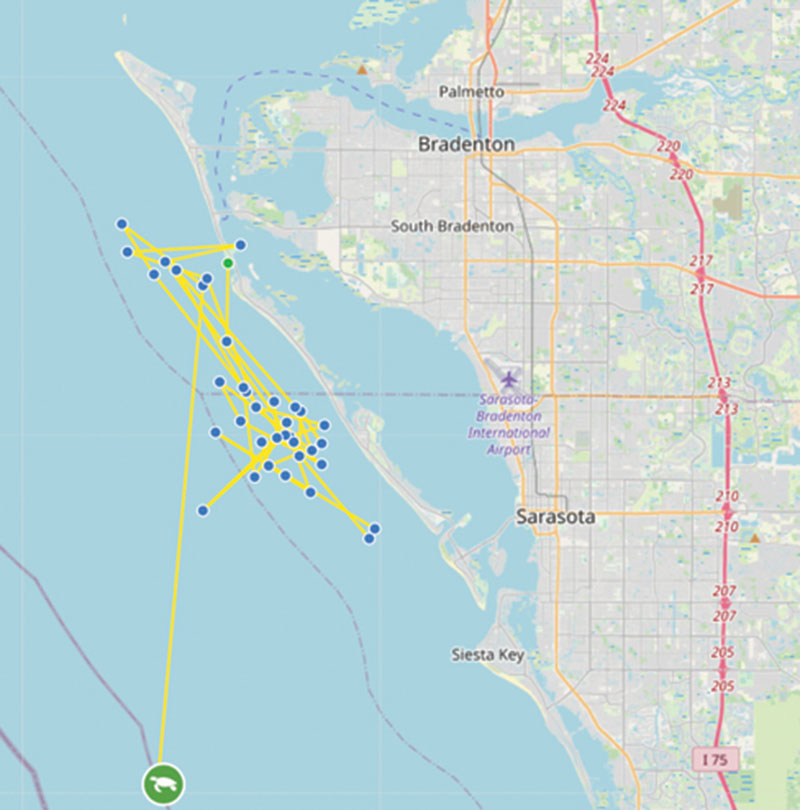
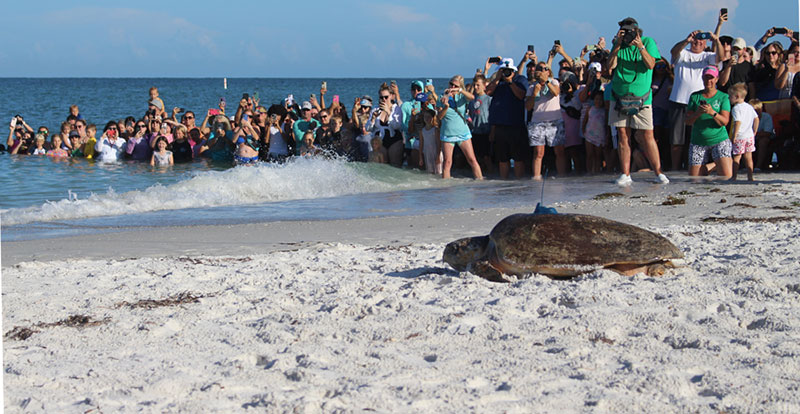
The Sea Turtle Conservancy’s annual migration marathon officially began Aug. 1, though The Islander has been tracking Winnie for more than a month. The loggerhead was tagged with a tracking device June 23 after nesting at Coquina Beach in Bradenton Beach.
Between June 23 and Aug. 1, the tracker showed Winnie had traveled more than 100 miles in the Gulf of Mexico.
The Sea Turtle Conservancy, based in Gainesville, conducts two seasonal marathons — one for leatherbacks, which started earlier this summer, and another for chelonians, hard-shelled turtles, which started Aug. 1.
The races, which date back to 2008, serve multiple purposes, providing scientific information about migration for research while also providing opportunities to educate people.
The small, low-wattage devices attached to the turtles are controlled by a microprocessor programmed before being attached.
Polar-orbiting satellites operated by NOAA — the same satellites used for monitoring weather patterns — track the turtles. Instruments attached to the satellites listen for transmitters to determine where the turtles, which must be at the surface, are located.
The data from the transmitters allows researchers to determine the latitude and longitude coordinates of the turtles, the number of dives taken during a 24-hour period, the duration of the most recent dives and water temperatures.
Others in the hard-shell race include green sea turtles Seartina, Miso Speedy, Esmeralda, Ariel and Haven; hawksbills Billy and Rush and loggerheads Moana, Nugget, Clarissa Cobblecrumb and Wassaw Will.
Each turtle has a sponsor — Winnie’s is Hurricane Hanks Grill and Bar in Holmes Beach. Winnipeg, Canada, is Hanks owner’s hometown.
Disney has sponsored a couple of racers. The Disney Conservation Fund sponsored Moana and the Disney Cruise Line sponsored Ariel.
And each turtle also has a cause or concern to spotlight — Winnie’s is light pollution. Other causes include plastic and marine debris, illegal egg harvest, water quality, coastal erosion, boat strikes, coastal armoring, climate change, illegal shell trade and trawl fisheries.
The chelonian tour will end Oct. 31.
For more information, including race maps and charts, go to tourdeturtles.org.
It’s elementary: Class lessons from AMITW, AME
Anna Maria Island Turtle Watch and Shorebird Monitoring, during the 2024-25 academic year, invited teachers and students at Anna Maria Elementary School in Holmes Beach to compose questions about sea turtles, shorebirds and AMITW’s work on the beaches. This summer, the Islander is sharing AME’s questions and AMITW’s answers.
Teacher Katrina Thomas’ second-grade class: Do sea turtles live on coral reefs?
AMITW: Yes, some sea turtles live on coral reefs.
Hawksbill sea turtles especially like coral reefs because they can find their favorite food there — sponges!
Other sea turtle species, like green sea turtles and loggerheads can also be found on coral reefs.
Talking turtles
The city of Holmes Beach is hosting Anna Maria Island Turtle Watch and Shorebird Monitoring for weekly talks about sea turtle and shorebird nesting.
Sea Turtle Tracks and Shorebird Facts talks continue most Mondays at 10 a.m. through August at city hall, 5801 Marina Drive.
For more information, call turtle watch at 941-301-8434 or go to www.islandturtlewatch.com.