





Editor’s Note: Don Moore began this story before his death. Marisa Porto finished it for him.
By Don Moore and Marisa Porto
Charlotte Sun
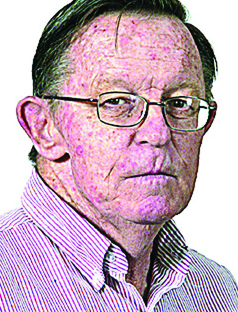
For more than 50 years, Thomas D. “Don” Moore wrote stories along Florida’s west coast. His work foiled a state service tax, triggered a federal investigation of the Navy, and honored the service of the region’s military servicemen and women.
A pit bull of a newspaper reporter, one of his favorite quotes was, “It is a newspaper’s duty to print the news and raise hell.”
Moore had planned to live until he was 115 but missed the mark by a few years.
A heart transplant patient, Moore died shortly after midnight on Valentine’s Day. His wife, Mary, was by his side. Moore was 81.
His association with newspapers began in 1949 when he was hired at 9 years old to deliver papers for the Tampa Times. He had a small route on Anna Maria Island, off Bradenton, where he grew up.
Moore got his first reporting job working as a part-time police reporter for The Bradenton Herald in 1958, during his senior year in high school.
A short time later, he went to work for the Sarasota Herald-Tribune when it opened a news bureau in Bradenton in 1959.
He continued working for the Tribune while attending the School of Journalism and Communications at the University of Florida in Gainesville. Shortly after graduating with a B.S. in journalism, he was contacted by Red Newton, managing editor of the Tampa Tribune, and offered a job as the Tampa paper’s Bradenton bureau chief.
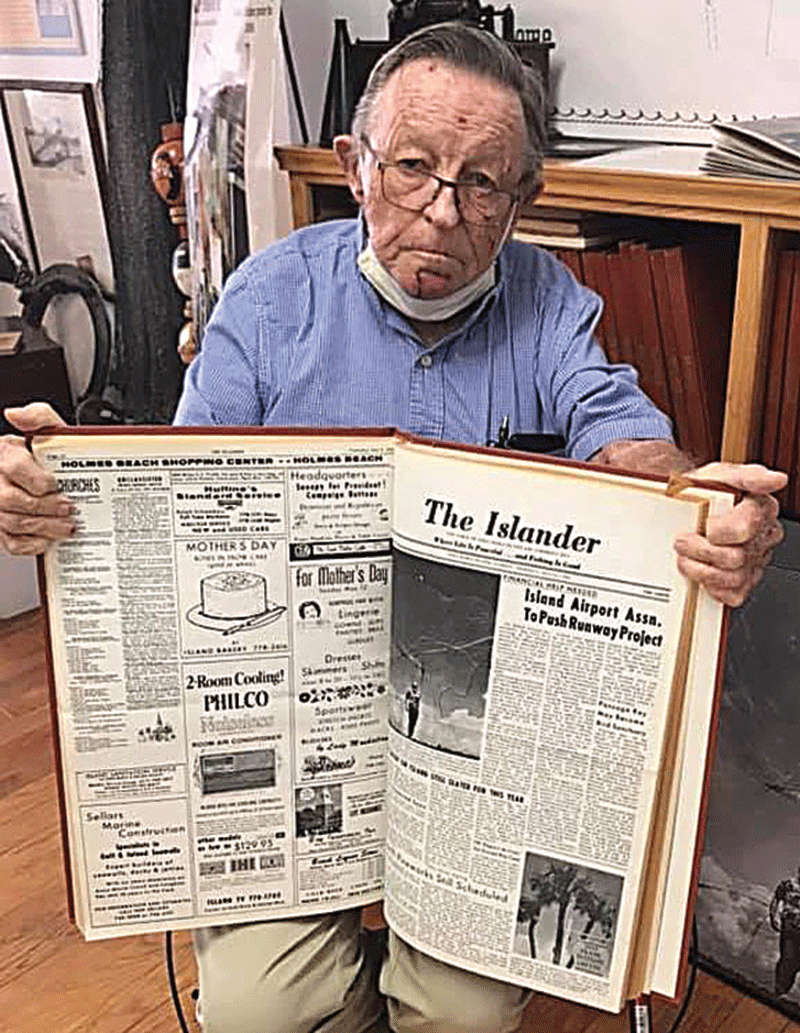
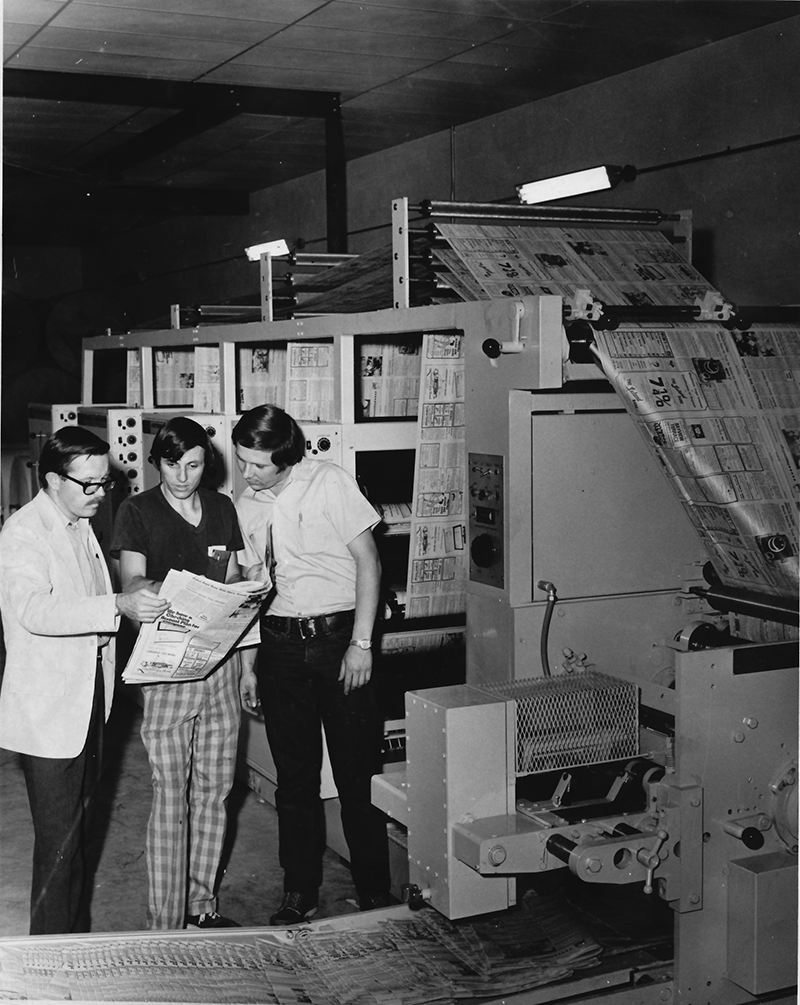
Three years later, in 1966, Steve Kimball, owner of The Anna Maria Islander, a 1,200 paid-circulation weekly newspaper, offered Moore the editorship.
For the next 14 years, he was the driving force behind what would eventually become one of Florida’s best weekly newspapers.
In 1973, Moore bought out Kimball and became editor and publisher of The Islander.
Anna Maria resident Jack Egan met Moore when he was hired as a cartoonist for the newspaper.
“We were probably the only two members of the Fourth Estate that couldn’t spell,” Egan said, laughing.
The two men remained friends for more than 40 years.
“He was a fighter. He wouldn’t let anyone get away with anything. I remember one time he was at one of those meetings, it was at city hall or something. They were building some duplexes, and they weren’t using fireproof insulation.”
Concerned about the safety of the building, Moore decided to make a point.
“He got up to the podium and took a piece of the insulation and put a match to it, and it went up in flames,” Egan said.
That was classic Don Moore.
The New York Times purchased the paper from Moore in 1980. By that time, Moore had expanded the coverage area to include Anna Maria Island and Longboat Key. The Islander’s circulation had climbed to 9,000 paid.
Moore decided to retire at 40. He moved from Longboat to Little Gasparilla Island, an island paradise only accessible by boat, about 10 miles south of Englewood.
Moore had not finished his family’s beach get-away on Little Gasparilla when he was contacted by Derek Dunn-Rankin, the new publisher of the Venice Gondolier, a weekly paper a few miles north of where Moore planned to retire. Dunn-Rankin’s pitch: “Help me out as a consultant for six months getting my newsroom up and running, and I’ll leave you alone.”
At first Moore said “no.” Eventually, he agreed to work three days a week for 90 days with the Gondolier’s news staff. That was more than 40 years ago. Dunn-Rankin convinced Moore to stay and made him executive editor.
Working with the existing news staff, Moore turned the paper into Florida’s best weekly newspaper after several years.
Over the years, Moore wrote many lead stories and editorials that appeared in Dunn-Rankin’s Suncoast Media Group newspapers circulating in Charlotte, DeSoto and Sarasota counties.
“Don was a unique person,” said Englewood/North Port Editor Chris Porter, who was hired by Moore in 1988. “He never told you anything different than what he was actually thinking. He didn’t flatter people, no matter how important they were or thought they were. In fact, it was usually the opposite. Some people really appreciated that, but not everyone. The important thing for him was keeping people in power accountable, which is what local journalism is about. Don was committed to that.”
Moore led an editorial campaign against former Gov. Bob Martinez’s proposed state service tax that went down to defeat with the help of Moore’s “People’s Tax Revolt.” This was a concerted effort by Moore, who enlisted the support of some 150 weekly papers around the state to publish editorials, columns and stories he wrote against the governor’s proposed 5% tax.
He shared the story of the Ray brothers, Ricky, Robert, and Randy, who had hemophilia and contracted AIDS in 1986 after receiving blood transfusions. The boys were kicked out of school after their diagnosis and their parents, Louise and Clifford, filed a federal lawsuit. After winning $1.1 million and the right to return to school, the family’s house burned down in a fire caused by an arsonist.
The family moved out of Arcadia. Only one of the boys, Randy, is alive today.
Moore also chronicled a series of abuses at Arcadia’s psychiatric hospital, G. Pierce Wood Memorial. A state investigation into those abuses concluded that hospital management and staff missteps may have led to 10 deaths at the state-operated facility. Established in 1947, the hospital closed in 2002.
Dunn-Rankin’s newspaper holdings grew during these years. Eventually, he acquired the Port Charlotte weekly paper. After that, he bought the Punta Gorda Daily Herald News, a Thompson paper, in 1990. He combined the two publications in a new daily called The Charlotte Sun.
When he was not working, Moore loved grilled oysters, Crown Royal on the rocks and grumbling about young reporters who spent too much time on the phone. Moore believed that a good reporter had to talk to people face to face to get the job done right.
Moore could find a story in a crack in the sidewalk and never returned to the newsroom without one — or more likely three or four.
Moore, whose father began adopting aging greyhounds from racetracks in the 1930s, took on the plight of those greyhounds as well, adopting several during his lifetime and writing about them for the newspaper. Today, greyhound racing is illegal in more than 40 states. The final race in Florida was in December 2020.
In July 1999, Moore became — in his words — “Lab Rat #414” and underwent a heart transplant at Tampa General Hospital. Moore wrote about the experience of waiting (and slowly dying as each day passed) for a new heart. His stories, before and after the surgery, convinced others to become organ donors.
Moore was considered one of the hospital’s greatest success stories. He lived more than two decades after the surgery thanks to Dr. Mark Weston, his cardiologist, and Lisa, his nurse coordinator, and the rest of the TGH staff.
Along with a St. Christopher medal he received after his heart transplant, Moore credited a host of other health care professionals who helped him manage his health challenges over the years.
“We talked about it more than a few times. It took more than a village to keep Don going,” his wife, Mary, said. “It was a battalion.”
Moore’s kidneys began to fail about 17 years after the transplant.
“The average survival rate for patients on permanent dialysis is about five years. He had a heart transplant 20+ years ago …The surgeon told me that when they went to remove his old heart it was practically mush, almost liquid. Don gained 20+ years he wouldn’t have had,” said his brother Colin.
In that 20-plus years, Moore achieved another journalistic accomplishment. He chronicled the stories of more than 1,000 veterans.
At the time of the transplant, Moore’s primary job for The Sun was writing investigative stories and articles about people who had problems and needed the public’s help. Just by chance, Moore – who served in the Army Reserve for a short time — was asked by a Sun editor to write a war story about a local individual who took part in World War II. The story was supposed to be published the following Sunday, but breaking news kept it out of the paper. This same editor requested another war story from Moore a few days later.
Both stories were run back-to-back on Sunday and Monday the following week. By 8 a.m. Monday, The Sun’s operators were overwhelmed with calls from hundreds of readers who wanted Moore to write their father’s, uncle’s, brother’s, friend’s war story for next Sunday’s paper.
Thus began a tradition in all of Dunn-Rankin’s newspapers. On Monday and Thursday each week, a war story written by Moore about local veterans almost always appeared in the Our Town section of the paper.
“What (Moore) really wanted to do was tell stories,” Porter said. “When he began focusing on our local veterans and conveying their experiences in his column, he not only gave our readers compelling stories, he preserved them for history. He really understood that responsibility.”
In addition to the newspaper stories, Moore turned the best of the accounts into two books: “War Tales” and “War Tales II.” Each book contains 25 of his best stories with supporting pictures.
By early 2010, Moore started putting his stories up on the web for the world to read. With the help of his wife, hundreds of these stories are now available on a site called donmooreswartales.com.
He began working for the Library of Congress that same year. His interviews of local veterans are now part of the library’s “Veterans’ History Project.” Since early 2010, Moore’s interviews have not only appeared in The Sun newspapers and on his War Tales site, but also copies of the interviews were recorded on DVD and sent to The Library of Congress. About 600 interviews are placed in the Library of Congress permanent Veterans’ Collections available online.
When the Charlotte Sun began to republish the stories earlier this year, one reader wrote: “I must tell you how much I enjoy Don Moore’s articles personalizing the experiences of our veterans. I’m glad you are re-publishing them.”
In more than one case, Moore’s stories brought government acknowledgment to veterans. It was routine for him to help veterans or their families obtain the medals their loved ones were entitled to receive. He worked with former Charlotte Sun-Herald photographer Tom O’Neill to get the WWII medals for his father, who served in the U.S Army in Italy and Africa.
“I remember seeing the medals as a child and figured they were lost forever,” O’Neill said. “With Don’s help, I was able to replace them and display them beside my father’s photo.”
In 2001, Moore wrote about seven African-American brothers from Punta Gorda who served in World War II and the Korean War. His story brought recognition to their long-forgotten service. The Punta Gorda Airport terminal was named the Bailey Terminal in their honor and a park in the city was named for Charles Bailey, the first Black aviator from Florida to become a Tuskegee Airman, flying 133 combat missions.
Moore was mentioned in the U.S. Congressional Record for his stories on Glenn Jenkins, a Navy veteran who volunteered as a 17-year-old sailor for a mustard gas experiment that caused a congressional investigation on military misconduct 50 years later. During a four-year investigation, Moore chronicled how Jenkins and thousands of recruits were placed into chambers and gassed until they could not stand.
Jenkins, who was warned he could go to prison for sharing his story, was burned over 60 percent of his body.
Jenkins decided to talk about his experience because he wanted medical benefits and disability pay for his service. After reading the story in the Venice Gondolier, former U.S. Rep. Porter Goss, R-Sanibel, led the investigation and discovered hundreds of medical records on the Navy’s “gas guinea pigs.” Goss was able to convince Congress to provide medical support for the veterans who were involved in the experiment.
Moore was forced into retirement in 2020, when health concerns caused by the COVID-19 global pandemic stopped him from his passion for personally interviewing and writing the stories of the veterans he so admired.
He spent the last few months of his life enjoying life with his wife. Kindred spirits, they shared a passion for good architecture (tall windows, French doors, and wide porches), vintage cars, books, and big band music.
The couple often took day trips to visit their favorite restaurants, including the Oak Street Deli in Arcadia. Duffy’s on Anna Maria Island, Lili’s in Tampa for deviled crab rolls, Eldred’s Marina in Placida to visit friends, the Columbia in Ybor City for the 1905 salad, or a late lunch at Micelli’s in Matlacha, where Sarah, a restaurant employee, was always ready with bowl of water for their greyhound Honey.
If they were not on a day trip, Mary would take him for a drive along the beaches in Sarasota or fishing at one of several parks in Englewood. They always did their best to travel the Blue Highways.
“He was my best friend,” Mary Moore said. “He will always have my heart.”
Moore was preceded in death by his father, Thomas Jones Moore in 1967, and his mother, Eleanor (nee Baker) in 1987.
He is survived by his wife, Mary; son Sean; daughter Shannon; granddaughters Coral, Willow and Iris; brother Colin and wife Arlene and their sons, nephews Brendan and wife Laurianne and Devin and wife Robin; and Honey, his beloved rescue greyhound.
Moore also leaves behind his longtime friend, Marisa Porto, who put the finishing touches on this obituary and wishes that the St. Christopher medal she gave him all those decades ago had worked for another lifetime or two.
“Let’s hope God has a damned newspaper,” she wrote in an email to his brother, Colin. “If not, there’s going to be some trouble.”
Moore and his family would like to thank his “battalion,” including primary care physician Dr. Chris Jefferson and his nurse Edie; Drs Stephanie Carradonna and Lisa Halaby, who helped him over the years battle bouts with skin cancer; urologist Dr. Mohit Sirohi; endocrinologist Dr. Joseph Rand; Drs Lorriane Cho-Chung-Hing, and David Widmeyer, his nephrologists, the staff at the Fresenius Kidney Center in Venice and North Port; the third-floor staff at Venice Regional; the home health team from Amedysis; and the EMTS in south Sarasota County who spent the last two years helping him and Mary through every health emergency.
Because of the pandemic, there will be no funeral. A memorial service is being planned and will be announced at a later date.
To celebrate his life and work, Moore’s family and friends ask that you consider one or all of these options.
- Adopt a rescue, preferably a greyhound.
- Take a moment to thank a caregiver, a health care, or a veteran. They deserve it.
- Subscribe to your local newspaper. Don Moore believed news stories could inform, engage and make a difference. You would honor his memory by supporting journalists like him.
- Think of your favorite Don Moore story and share it. Send him on his way with good thoughts, a prayer and, if you are so inclined, a few oysters and a Crown Royal.
- Consider becoming an organ donor. After reading his story, we hope you understand why.
Reprinted with permission from the Charlotte Sun and Marisa Porto, who assisted with the obituary for the Sun. She is a former reporter who went to work as a young journalist for Don Moore.
Porto is an assistant dean at the Scripps Howard School of Journalism and Communications at Hampton University in Hampton, Virginia. She teaches media management and media entrepreneurship.
The former, late editor of The Islander, Paul Roat was a college scholarship recipient and began his career at Moore’s Islander. Bonner Joy and editorial cartoonist Joe Bird also worked for Moore in the 1970s.